Binding Quote by Friedrich Nietzsche
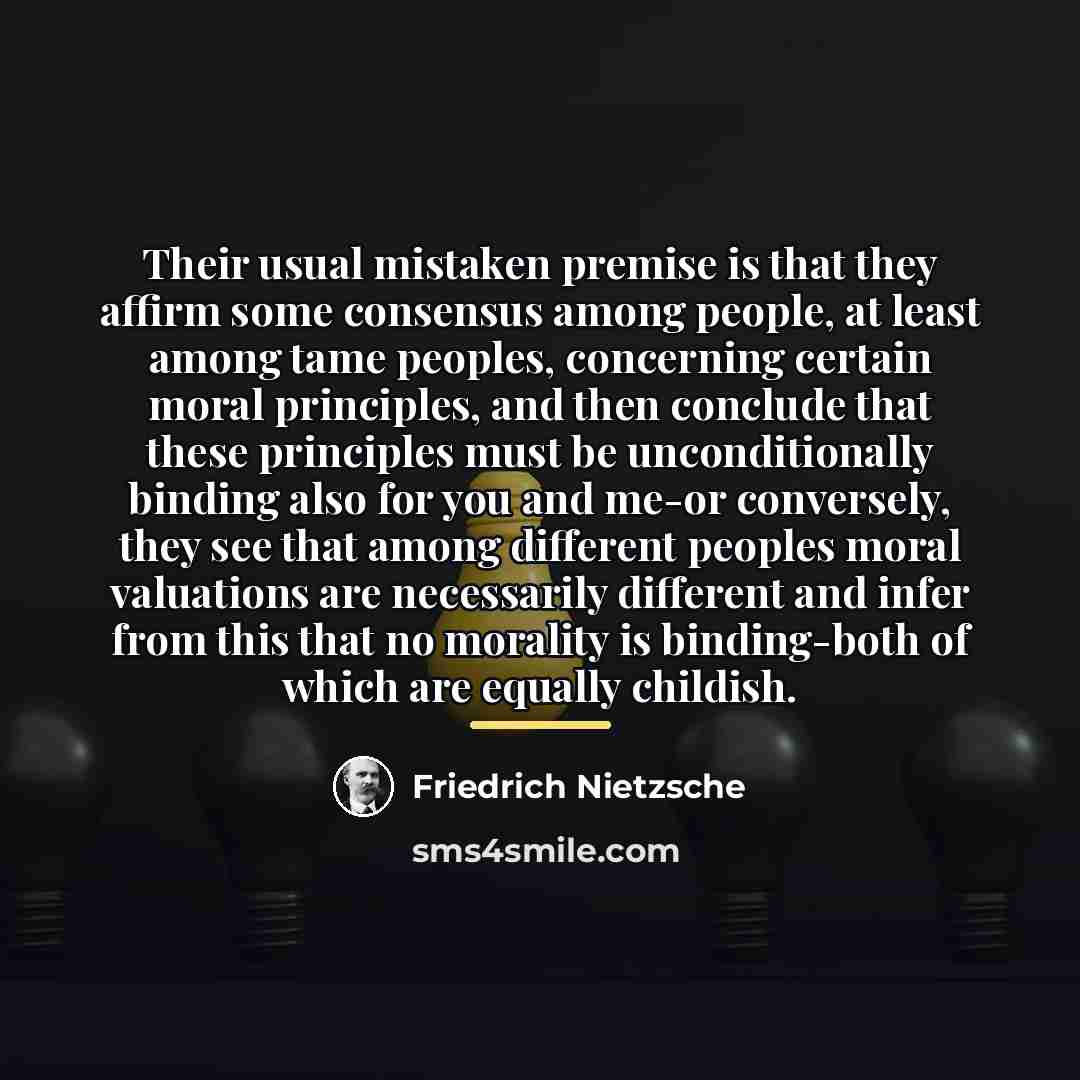
“Their usual mistaken premise is that they affirm some consensus among people, at least among tame peoples, concerning certain moral principles, and then conclude that these principles must be unconditionally binding also for you and me-or conversely, they see that among different peoples moral valuations are necessarily different and infer from this that no morality is binding-both of which are equally childish.”
About This Quote
Source Book: Beyond Good and Evil, 1886
Nietzsche critiques the idea that moral consensus is either universally binding or wholly relativistic, calling both extremes naive.
In simple terms: Both absolute morals and total relativism are simplistic
Key Takeaway
Question assumptions about universal morality
Themes
ethics
relativism
philosophy
Mood
critical
inquisitive
Type
philosophical
ethical
When to use this quote
- Cross‑cultural ethics debates
- legal frameworks
- personal moral decision‑making
- academic philosophy discussions
Key Concepts
Moral absolutism
cultural relativism
subjectivity
Questions to Reflect On
- What determines a moral principle's validity?
- Can societies find common ground without universal morals?
A Different Perspective
Absolute claims can ignore context; relativism can lead to moral paralysis


![“Above all, creators remain drawn to the age-old paradoxes that philosophy grapples with [and]...that art occasionally resolves...the problem of the one and the many; unity and variety; determinism and freedom; mechanism and vitalism; good and evil; time and eternity; the plenum and the void; moral…” quote by Frank Barron](https://sms4smile.com/quotes/img-quotes/c44/frank-barron-42375_absolutism_above-all-creators-remain-drawn-to-the-a_1821578.jpg)