Existentialism Quote by Friedrich Nietzsche
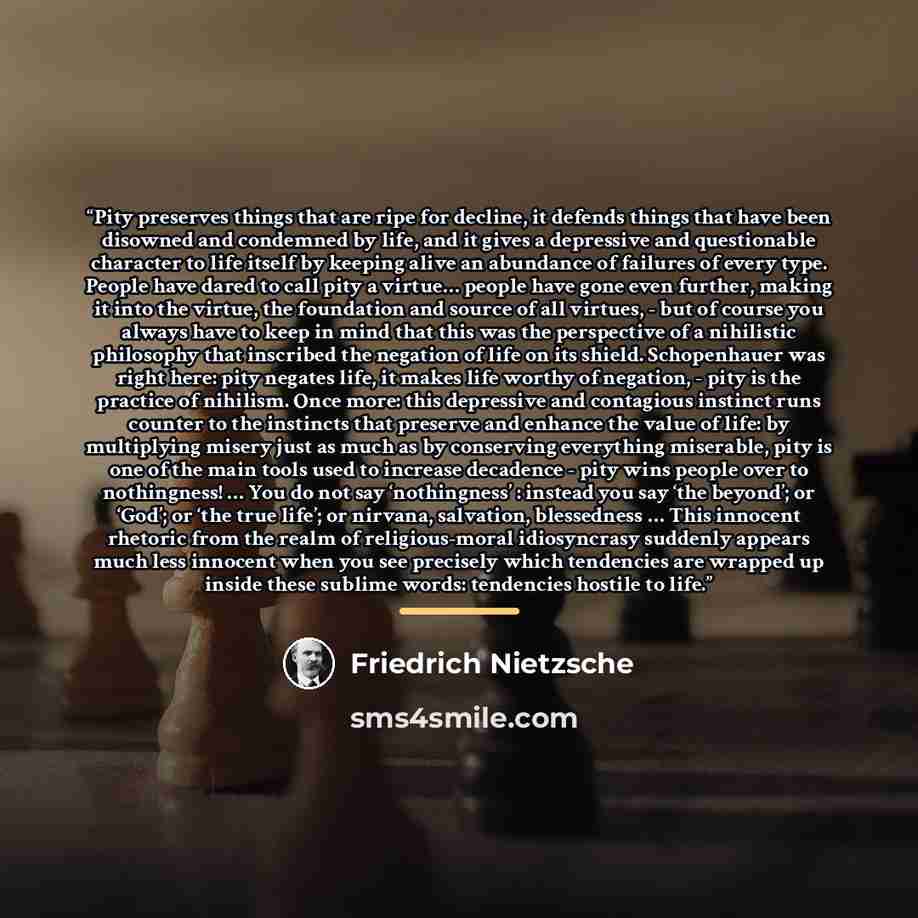
““Pity preserves things that are ripe for decline, it defends things that have been disowned and condemned by life, and it gives a depressive and questionable character to life itself by keeping alive an abundance of failures of every type. People have dared to call pity a virtue… people have gone even further, making it into the virtue, the foundation and source of all virtues, - but of course you always have to keep in mind that this was the perspective of a nihilistic philosophy that inscribed the negation of life on its shield. Schopenhauer was right here: pity negates life, it makes life worthy of negation, - pity is the practice of nihilism. Once more: this depressive and contagious instinct runs counter to the instincts that preserve and enhance the value of life: by multiplying misery just as much as by conserving everything miserable, pity is one of the main tools used to increase decadence - pity wins people over to nothingness! … You do not say ‘nothingness’ : instead you say ‘the beyond’; or ‘God’; or ‘the true life’; or nirvana, salvation, blessedness … This innocent rhetoric from the realm of religious-moral idiosyncrasy suddenly appears much less innocent when you see precisely which tendencies are wrapped up inside these sublime words: tendencies hostile to life.””
About This Quote
Pity is portrayed as a nihilistic force that preserves failure and undermines life's value, contrary to moral virtues.
In simple terms: Pity can diminish life's worth.
Key Takeaway
Beware of pity that glorifies failure.
Themes
nihilism
morality
existentialism
critique of virtue
Mood
critical
philosophical
Type
analytical
skeptical
When to use this quote
- philosophical discourse
- ethical debates
- personal reflection
Key Concepts
pity
life negation
decadence
Questions to Reflect On
- Is pity always harmful?
- Can compassion replace pity?
A Different Perspective
Pity may unintentionally support decay rather than growth.