Consolation Quote by Frederick Buechner
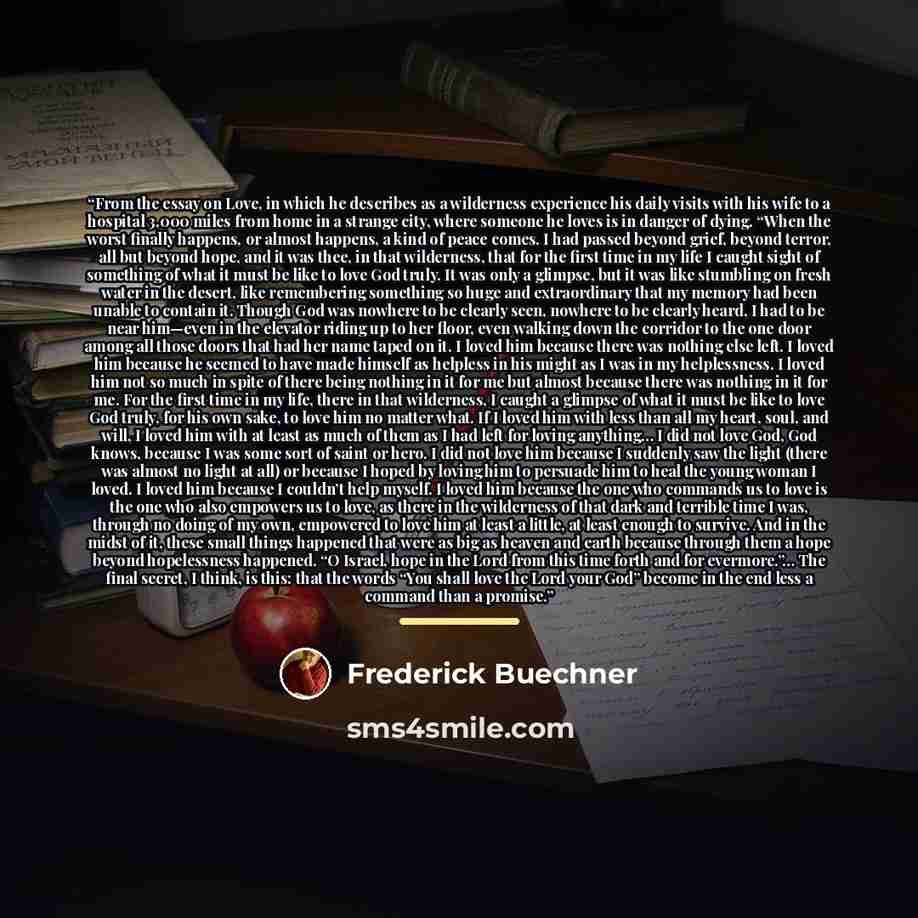
““From the essay on Love, in which he describes as a wilderness experience his daily visits with his wife to a hospital 3,000 miles from home in a strange city, where someone he loves is in danger of dying. “When the worst finally happens, or almost happens, a kind of peace comes. I had passed beyond grief, beyond terror, all but beyond hope, and it was thee, in that wilderness, that for the first time in my life I caught sight of something of what it must be like to love God truly. It was only a glimpse, but it was like stumbling on fresh water in the desert, like remembering something so huge and extraordinary that my memory had been unable to contain it. Though God was nowhere to be clearly seen, nowhere to be clearly heard, I had to be near him—even in the elevator riding up to her floor, even walking down the corridor to the one door among all those doors that had her name taped on it. I loved him because there was nothing else left. I loved him because he seemed to have made himself as helpless in his might as I was in my helplessness. I loved him not so much in spite of there being nothing in it for me but almost because there was nothing in it for me. For the first time in my life, there in that wilderness, I caught a glimpse of what it must be like to love God truly, for his own sake, to love him no matter what. If I loved him with less than all my heart, soul, and will, I loved him with at least as much of them as I had left for loving anything… I did not love God, God knows, because I was some sort of saint or hero. I did not love him because I suddenly saw the light (there was almost no light at all) or because I hoped by loving him to persuade him to heal the young woman I loved. I loved him because I couldn’t help myself. I loved him because the one who commands us to love is the one who also empowers us to love, as there in the wilderness of that dark and terrible time I was, through no doing of my own, empowered to love him at least a little, at least enough to survive. And in the midst of it, these small things happened that were as big as heaven and earth because through them a hope beyond hopelessness happened. “O Israel, hope in the Lord from this time forth and for evermore.”… The final secret, I think, is this: that the words “You shall love the Lord your God” become in the end less a command than a promise.””
About This Quote
Source Book: Godric, 1979 (excerpt)
In extreme suffering, the narrator experiences a profound, paradoxical peace that reveals a deeper love for God, beyond personal desire or benefit.
In simple terms: Suffering can bring a glimpse of divine love.
Key Takeaway
Seek meaning even in pain.
Themes
spirituality
grief
love
faith
Mood
reflective
hopeful
introspective
Type
religious
philosophical
When to use this quote
- hospital visits
- personal loss
- spiritual crisis
- pilgrimage
- prayer
Key Concepts
Theology
existentialism
mysticism
Questions to Reflect On
- What does love mean when stripped of self‑interest?
- How can suffering become a conduit for spiritual insight?
A Different Perspective
The passage is deeply personal and may not resonate with all readers.