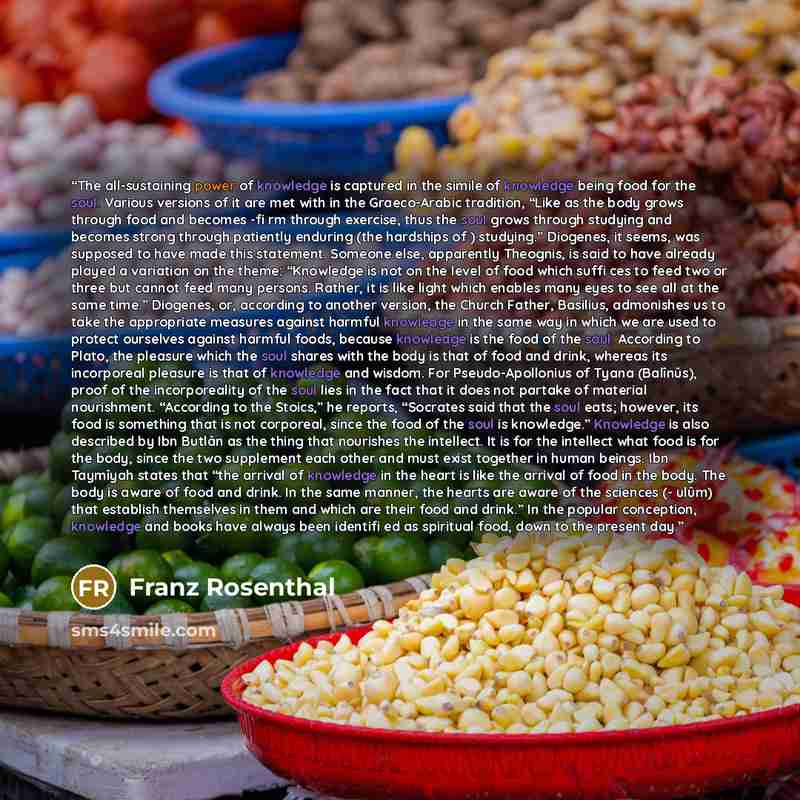
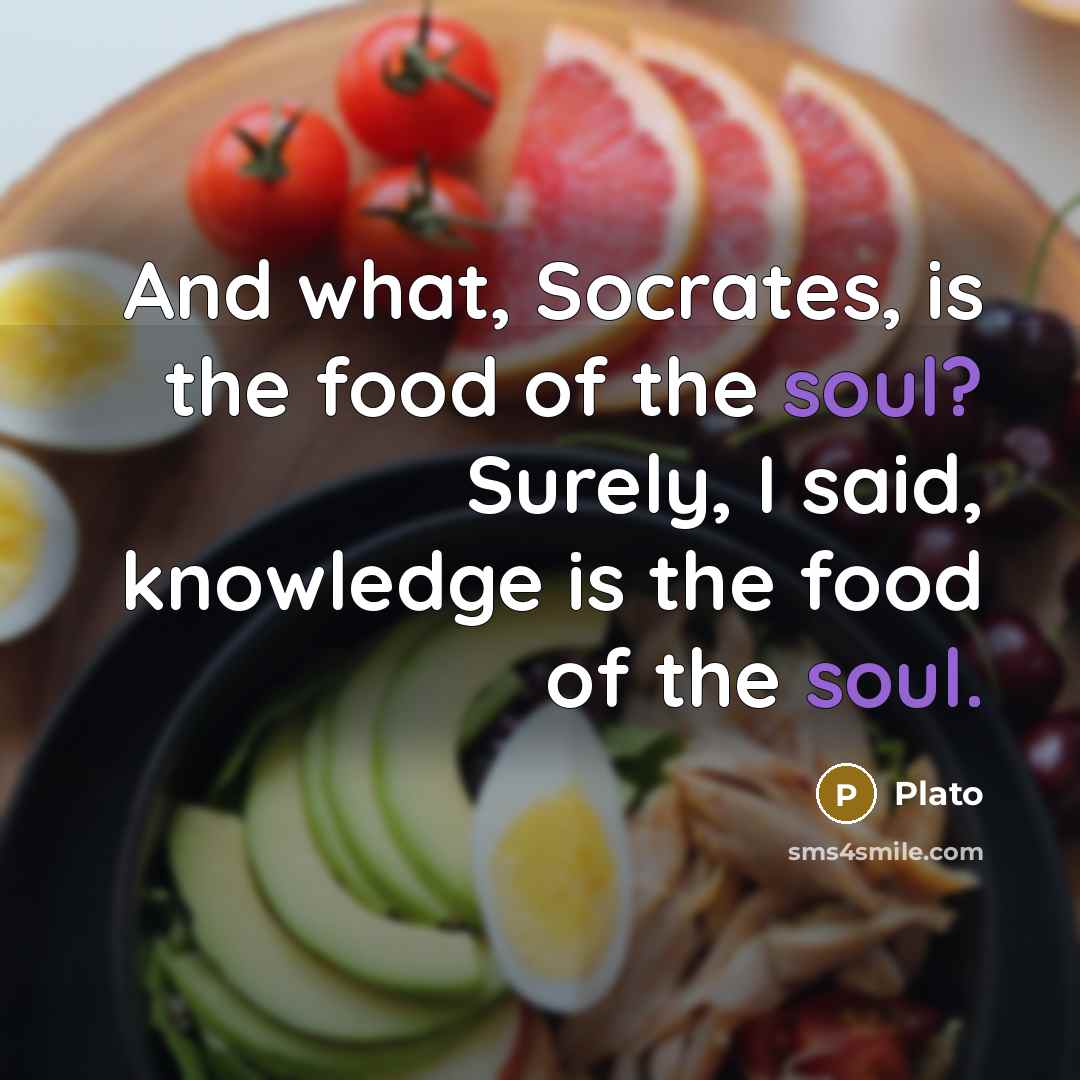
““The all-sustaining power of knowledge is captured in the simile of knowledge being food for the soul. Various versions of it are met with in the Graeco-Arabic tradition, “Like as the body grows through food and becomes -fi rm through exercise, thus the soul grows through studying and becomes strong through patiently enduring (the hardships of ) studying.” Diogenes, it seems, was supposed to have made this statement. Someone else, apparently Theognis, is said to have already played a variation on the theme: “Knowledge is not on the level of food which suffi ces to feed two or three but cannot feed many persons. Rather, it is like light which enables many eyes to see all at the same time.” Diogenes, or, according to another version, the Church Father, Basilius, admonishes us to take the appropriate measures against harmful knowledge in the same way in which we are used to protect ourselves against harmful foods, because knowledge is the food of the soul. According to Plato, the pleasure which the soul shares with the body is that of food and drink, whereas its incorporeal pleasure is that of knowledge and wisdom. For Pseudo-Apollonius of Tyana (Balînûs), proof of the incorporeality of the soul lies in the fact that it does not partake of material nourishment. “According to the Stoics,” he reports, “Socrates said that the soul eats; however, its food is something that is not corporeal, since the food of the soul is knowledge.” Knowledge is also described by Ibn Butlân as the thing that nourishes the intellect. It is for the intellect what food is for the body, since the two supplement each other and must exist together in human beings. Ibn Taymîyah states that “the arrival of knowledge in the heart is like the arrival of food in the body. The body is aware of food and drink. In the same manner, the hearts are aware of the sciences (- ulûm) that establish themselves in them and which are their food and drink.” In the popular conception, knowledge and books have always been identifi ed as spiritual food, down to the present day.””
![“The ‘Knowledge’ that does not let you mix [be one] with the non-Self [Anatma], that ‘Knowledge’ is itself the Soul [Atma, the Pure Self].” quote by Dada Bhagwan](https://sms4smile.com/quotes/img-quotes/84c/dada-bhagwan-31_gnan_the-knowledge-that-does-not-let-you-mix_2354052.jpg)



![“The heart becomes sick, as the body becomes sick, and its remedy is al-Tawbah (repentance) and protection [from transgression]. It becomes rusty as a mirror becomes rusty, and its clarity is obtained by remembrance. It becomes naked as the body becomes naked, and its beautification is al-Taqwa. It…” quote by Ibn Qayyim Al-Jawziyya](https://sms4smile.com/quotes/img-quotes/454/ibn-qayyim-al-jawziyya-10803_als_the-heart-becomes-sick-as-the-body-becom_66500.jpg)