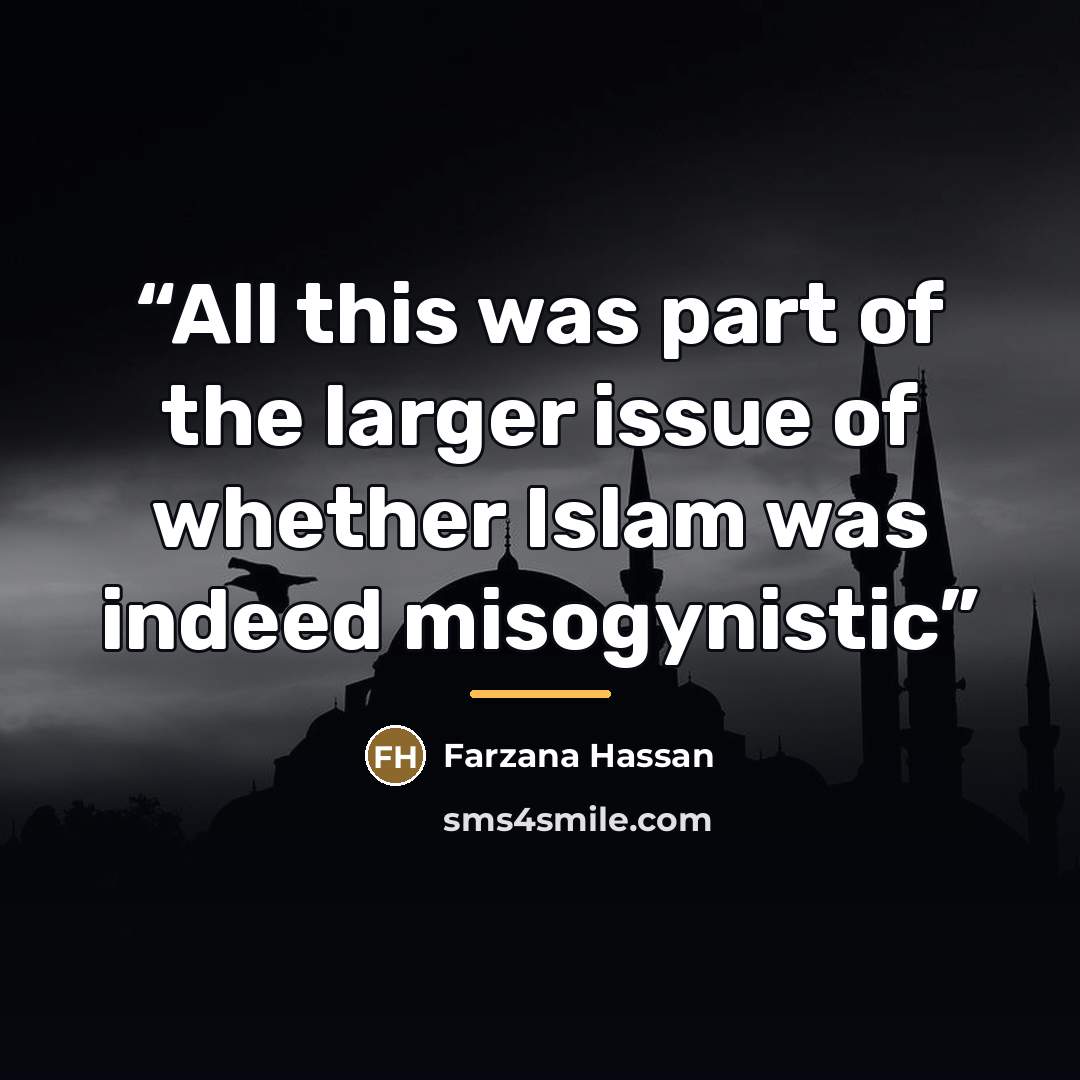
Islam Quote by Farzana Hassan
““works of Maryam Jamilah, a convert to Islam from Judaism. She had chosen to live as a co-wife to an assistant to Maulana Maududi, the prominent Pakistani commentator on the Quran. Jamilah argued that the Islamic version of gender equity greatly benefits society. Others, like Fatima Mernissi, had previously argued that Islam clearly discriminated against women. Look at polygamy, wife-beating and the segregation of women, she implored.””
About This Quote
Source Article: Gender and Islam, 2015
Islamic teachings on gender equity can be seen as beneficial, yet critics highlight practices like polygamy and segregation as discriminatory.
In simple terms: Islamic gender equity is debated; some see benefits, others see oppression.
Key Takeaway
Critically evaluate cultural practices versus religious ideals.
Themes
gender equity
religion
social justice
Mood
analytical
thought‑provoking
Type
sociopolitical
critical
When to use this quote
- family law reform
- women’s rights activism
- interfaith dialogue
- policy analysis
Key Concepts
Islamic law
feminism
cultural tradition
Questions to Reflect On
- How do cultural traditions shape gender roles?
- Can religious texts be reinterpreted for equality?
A Different Perspective
Counterarguments stress lived realities of inequality despite doctrinal claims.
![“Ben Carson also denounced [Donald] Trump's ban all Muslims proposal saying we do not and would not advocate being selective on one's religion.” quote by Rachel Maddow](https://sms4smile.com/quotes/img-quotes/0d7/rachel-maddow-1240_bans_ben-carson-also-denounced-donald-trump-s_674.jpg)
![“[Islam] Leaves no room of human legislation in an Islamic state, because herein all legislative functions vest in God and the only function left for Muslims lies in their observance of the God-made law.” quote by Abul A'la Maududi](https://sms4smile.com/quotes/img-quotes/704/abul-a-la-maududi-51903_function_islam-leaves-no-room-of-human-legislatio_886.jpg)
![“[T]he people who are close to Allah worry so much about wasting time that they call themselves to account for every breath they spend - how many of us wonder about how we spend our day, let alone each breath?” quote by Ethar El- Katatney](https://sms4smile.com/quotes/img-quotes/a43/ethar-el-katatney-236694_allah_t-he-people-who-are-close-to-allah-worry_3003.jpg)