Agony Quote by Erich Maria Remarque

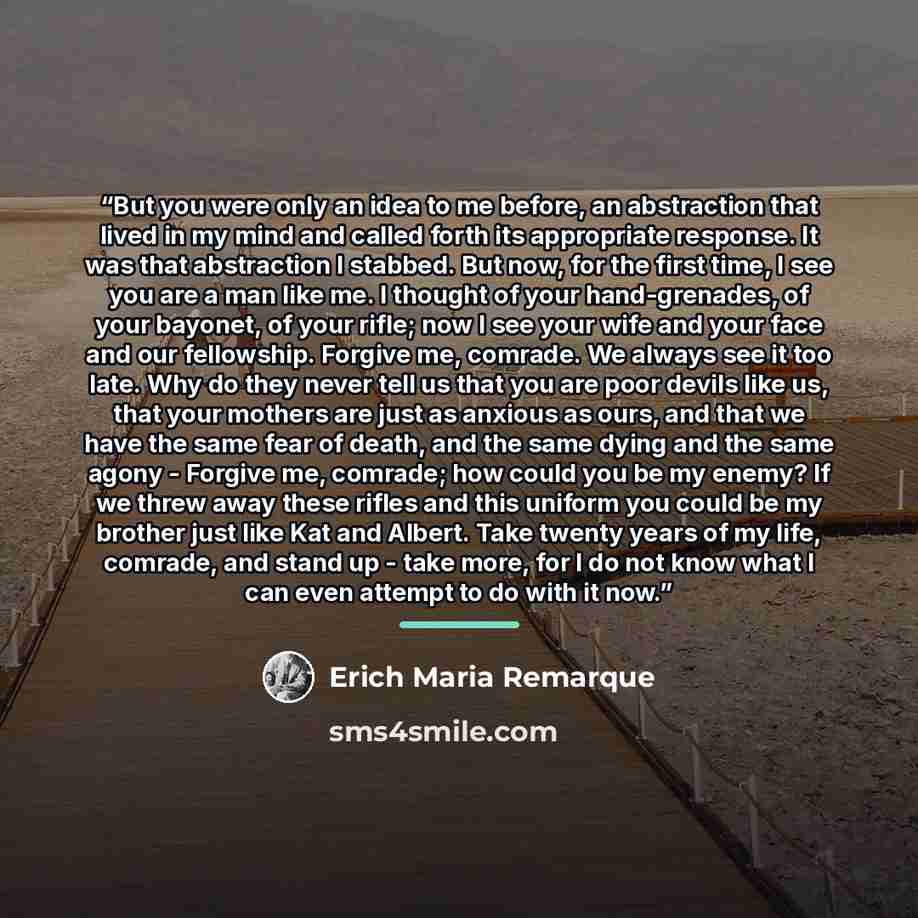
“But now, for the first time, I see you are a man like me. I thought of your hand-grenades, of your bayonet, of your rifle; now I see your wife and your face and our fellowship. Forgive me, comrade. We always see it too late. Why do they never tell us that you are poor devils like us, that your mothers are just as anxious as ours, and that we have the same fear of death, and the same dying and the same agony--Forgive me, comrade; how could you be my enemy?”
About This Quote
Source Novel: All Quiet on the Western Front, 1929
The narrator realizes that enemies share common humanity, suffering, and fear, urging forgiveness and empathy beyond wartime dehumanization.
In simple terms: Even foes are human and share the same fears.
Key Takeaway
Recognize shared humanity in conflict.
Themes
war
empathy
forgiveness
humanity
enemy
Mood
somber
hopeful
Type
reflective
inspirational
When to use this quote
- battlefields
- post‑war reconciliation
- peacebuilding
- mental health counseling
Key Concepts
dehumanization
solidarity
psychology
Questions to Reflect On
- What would happen if soldiers saw each other as comrades?
- How can societies heal after mass trauma?
A Different Perspective
War narratives can oversimplify complex motives and systemic causes.




















![“[W]e must learn to accommodate ourselves to the discovery that some of those cunningly-fashioned instruments called human souls have only a very limited range of music, and will not vibrate in the least under a touch that fills others with tremulous rapture or quivering agony.” quote by George Eliot](https://sms4smile.com/quotes/img-quotes/9be/george-eliot-84_agony_w-e-must-learn-to-accommodate-ourselves_12409.jpg)