Despair Quote by Erich Maria Remarque

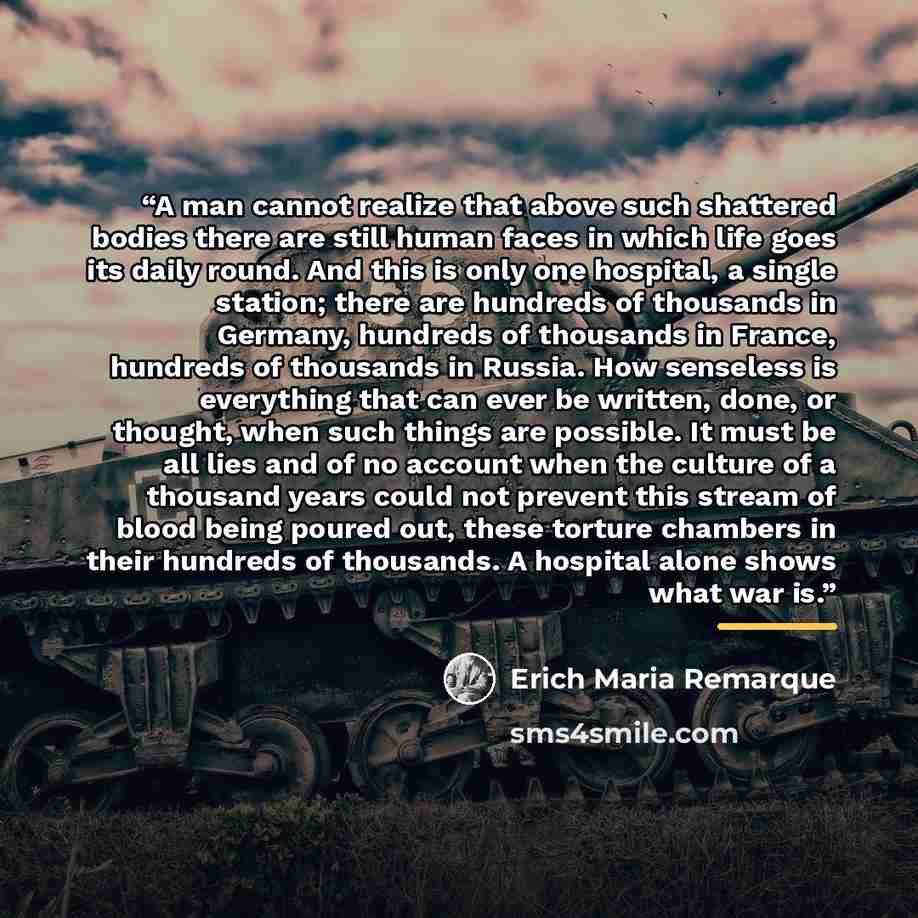
““A man cannot realize that above such shattered bodies there are still human faces in which life goes its daily round. And this is only one hospital, one single station; there are hundreds of thousands in Germany, hundreds of thousands in France, hundreds of thousands in Russia. How senseless is everything that can ever be written, done, or thought, when such things are possible. It must be all lies and of no account when the culture of a thousand years could not prevent this stream of blood being poured out, these torture-chambers in their hundreds of thousands. A hospital alone shows what war is. I am young, I am twenty years old; yet I know nothing of life but despair, death, fear, and fatuous superficiality cast over an abyss of sorrow. I see how peoples are set against one another, and in silence, unknowingly, foolishly, obediently, innocently slay one another. I see that the keenest brains of the world invent weapons and words to make it yet more refined and enduring. And all men of my age, here and over there, throughout the whole world see these things; all my generation is experiencing these things with me. What would our fathers do if we suddenly stood up and came before them and proffered our account? What do they expect of us if a time ever comes when the war is over? Through the years our business has been killing;—it was our first calling in life. Our knowledge of life is limited to death. What will happen afterwards? And what shall come out of us?””
About This Quote
Source Novel: All Quiet on the Western Front, 1929
The quote reflects on the absurdity of war, the massive human suffering it causes, and the moral emptiness of societies that allow such devastation.
In simple terms: War creates endless suffering and reveals humanity’s moral failures.
Key Takeaway
Recognize war’s true cost and strive for peace.
Themes
war
human suffering
morality
generational trauma
illusion of progress
Mood
somber
reflective
critical
Type
philosophical
political
literary
When to use this quote
- military service
- civilian life
- post‑war reconstruction
- peace activism
Key Concepts
existentialism
psychology of conflict
historical critique
Questions to Reflect On
- How can societies prevent the repetition of such large‑scale violence?
- What responsibilities do individuals have to confront collective guilt?
A Different Perspective
The perspective is limited to personal anguish and may not capture broader systemic factors.