Carbon dioxide Quote by Elizabeth Kolbert
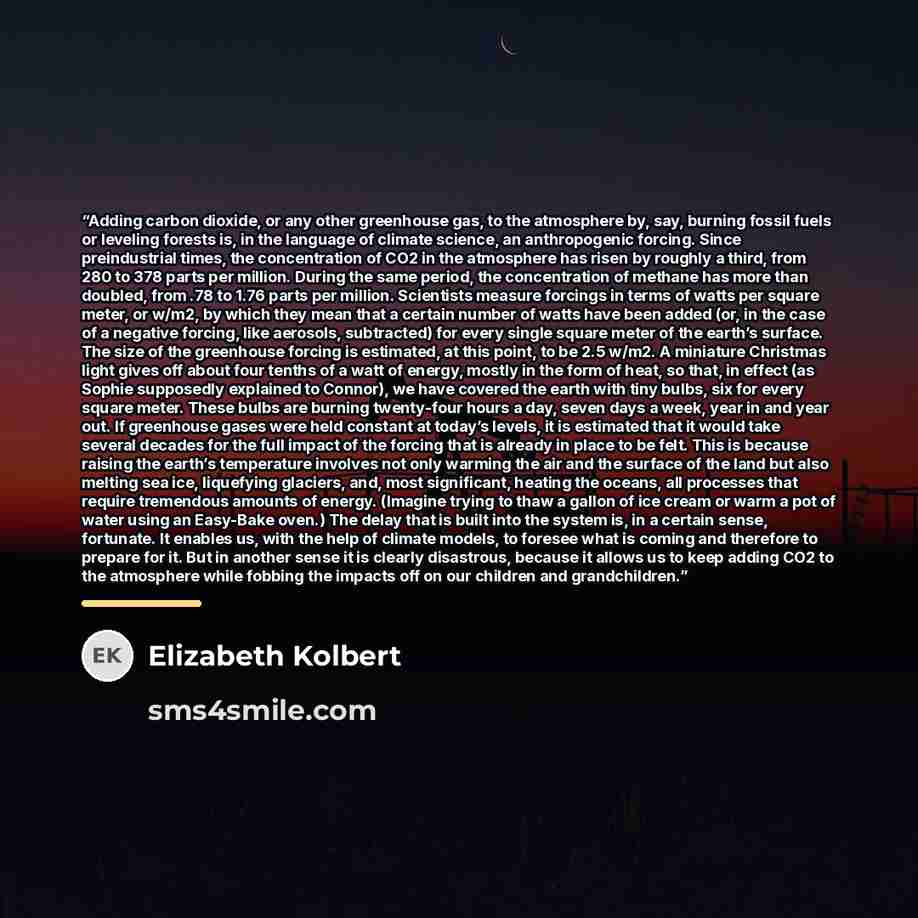
““Adding carbon dioxide, or any other greenhouse gas, to the atmosphere by, say, burning fossil fuels or leveling forests is, in the language of climate science, an anthropogenic forcing. Since preindustrial times, the concentration of CO2 in the atmosphere has risen by roughly a third, from 280 to 378 parts per million. During the same period, the concentration of methane has more than doubled, from .78 to 1.76 parts per million. Scientists measure forcings in terms of watts per square meter, or w/m2, by which they mean that a certain number of watts have been added (or, in the case of a negative forcing, like aerosols, subtracted) for every single square meter of the earth’s surface. The size of the greenhouse forcing is estimated, at this point, to be 2.5 w/m2. A miniature Christmas light gives off about four tenths of a watt of energy, mostly in the form of heat, so that, in effect (as Sophie supposedly explained to Connor), we have covered the earth with tiny bulbs, six for every square meter. These bulbs are burning twenty-four hours a day, seven days a week, year in and year out. If greenhouse gases were held constant at today’s levels, it is estimated that it would take several decades for the full impact of the forcing that is already in place to be felt. This is because raising the earth’s temperature involves not only warming the air and the surface of the land but also melting sea ice, liquefying glaciers, and, most significant, heating the oceans, all processes that require tremendous amounts of energy. (Imagine trying to thaw a gallon of ice cream or warm a pot of water using an Easy-Bake oven.) The delay that is built into the system is, in a certain sense, fortunate. It enables us, with the help of climate models, to foresee what is coming and therefore to prepare for it. But in another sense it is clearly disastrous, because it allows us to keep adding CO2 to the atmosphere while fobbing the impacts off on our children and grandchildren.””
About This Quote
Source Article: “The Sixth Extinction? What the Climate Crisis Means for the Future” by Elizabeth Kolbert, The New Yorker, 2015
Human activities release greenhouse gases, creating a measurable warming force that will manifest over decades, giving both warning and risk of delayed damage.
In simple terms: Human actions warm the planet, effects will appear later.
Key Takeaway
Act now to reduce emissions.
Themes
climate change
anthropogenic forcing
delayed impact
intergenerational responsibility
Mood
concerned
urgent
reflective
Type
scientific
policy
educational
When to use this quote
- policy making
- education
- personal lifestyle changes
- infrastructure planning
Key Concepts
greenhouse effect
climate modeling
energy balance
thermal inertia
Questions to Reflect On
- What policies can accelerate emission cuts?
- How can individuals influence systemic change?
A Different Perspective
Mitigation requires immediate action despite delayed visible effects.


![“[The doctrine of air] I was led into in consequence of inhabiting a house adjoining to a public brewery, where I at first amused myself with making experiments on the fixed air [carbon dioxide] which I found ready made in the process of fermentation . When I removed from that house I was under the…” quote by Joseph Priestley](https://sms4smile.com/quotes/img-quotes/42a/joseph-priestley-17782_air_the-doctrine-of-air-i-was-led-into-in-co_74416.jpg)