Apologetics Quote by Douglas Groothuis
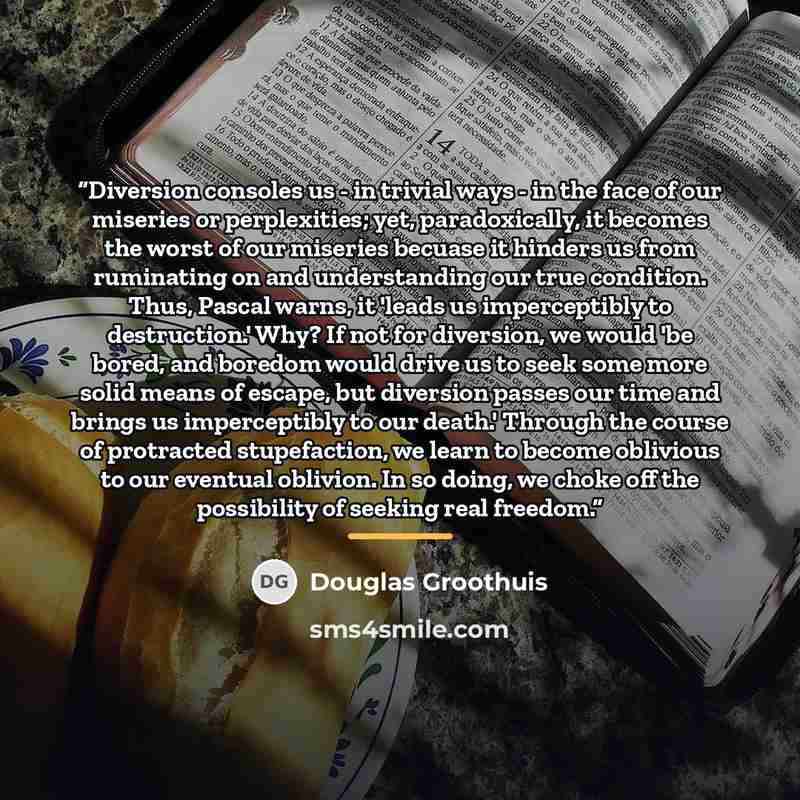
““Diversion consoles us - in trivial ways - in the face of our miseries or perplexities; yet, paradoxically, it becomes the worst of our miseries becuase it hinders us from ruminating on and understanding our true condition. Thus, Pascal warns, it 'leads us imperceptibly to destruction.' Why? If not for diversion, we would 'be bored, and boredom would drive us to seek some more solid means of escape, but diversion passes our time and brings us imperceptibly to our death.' Through the course of protracted stupefaction, we learn to become oblivious to our eventual oblivion. In so doing, we choke off the possibility of seeking real freedom.””
About This Quote
Diversion distracts us from confronting suffering, leading to a gradual loss of self‑awareness and freedom as we avoid deep reflection on our true condition.
In simple terms: Distraction masks existential truth.
Key Takeaway
Avoiding reflection breeds hidden destruction.
Themes
existentialism
psychology
freedom
distraction
mortality
Mood
contemplative
somber
critical
Type
philosophical
reflective
When to use this quote
- facing personal crisis
- navigating boredom
- seeking entertainment
- coping with anxiety
Key Concepts
human consciousness
meaning of life
self‑deception
Practical Applications
- mindfulness practice
- philosophical counseling
Questions to Reflect On
- How does distraction shape our perception of freedom?
- What practices can replace harmful diversion with constructive reflection?
A Different Perspective
Some argue that distraction can provide necessary mental breaks that prevent overwhelm, fostering resilience rather than destruction.










![“In a culture where image is more important than information, style more important than substance it is not enough to possess the truth. [Christian] case makers must also master the media.” quote by J. Warner Wallace](https://sms4smile.com/quotes/img-quotes/a24/j-warner-wallace-40233_apologetics_in-a-culture-where-image-is-more-importa_212832.jpg)