Desire for power Quote by Doris Lessing
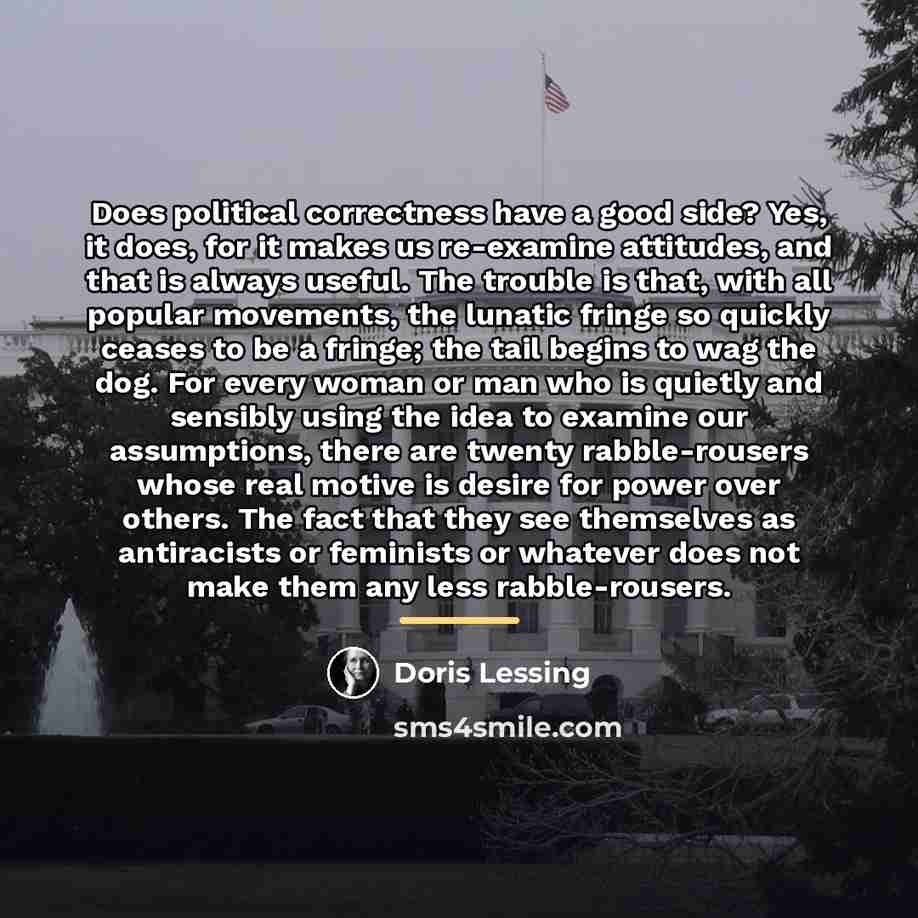
““That a work of the imagination has to be “really” about some problem is, again, an heir of Socialist Realism. To write a story for the sake of storytelling is frivolous, not to say reactionary. The demand that stories must be “about” something is from Communist thinking and, further back, from religious thinking, with its desire for self-improvement books as simple-minded as the messages on samplers. The phrase “political correctness” was born as Communism was collapsing. I do not think this was chance. I am not suggesting that the torch of Communism has been handed on to the political correctors. I am suggesting that habits of mind have been absorbed, often without knowing it. There is obviously something very attractive about telling other people what to do: I am putting it in this nursery way rather than in more intellectual language because I see it as nursery behavior. Art — the arts generally — are always unpredictable, maverick, and tend to be, at their best, uncomfortable. Literature, in particular, has always inspired the House committees, the Zhdanovs, the fits of moralizing, but, at worst, persecution. It troubles me that political correctness does not seem to know what its exemplars and predecessors are; it troubles me more that it may know and does not care. Does political correctness have a good side? Yes, it does, for it makes us re-examine attitudes, and that is always useful. The trouble is that, with all popular movements, the lunatic fringe so quickly ceases to be a fringe; the tail begins to wag the dog. For every woman or man who is quietly and sensibly using the idea to examine our assumptions, there are 20 rabble-rousers whose real motive is desire for power over others, no less rabble-rousers because they see themselves as anti-racists or feminists or whatever.””
About This Quote
Source Essay: The Politics of Art, 1995
The author argues that demanding art serve a specific agenda stems from authoritarian traditions, and that political correctness can both reveal bias and be weaponized.
In simple terms: Art should be free, not forced to teach a lesson.
Key Takeaway
Beware of imposing ideology on creativity.
Themes
art
politics
ideology
freedom
culture
Mood
critical
concerned
analytical
Type
philosophical
political
When to use this quote
- literary criticism
- academic debate
- media analysis
- public policy
- education
Key Concepts
authoritarianism
political correctness
creative autonomy
Questions to Reflect On
- How can art challenge power without becoming propaganda?
- When does critique become censorship?
A Different Perspective
The critique may overlook genuine efforts to address injustice through art.