Identity Quote by Dan P. McAdams
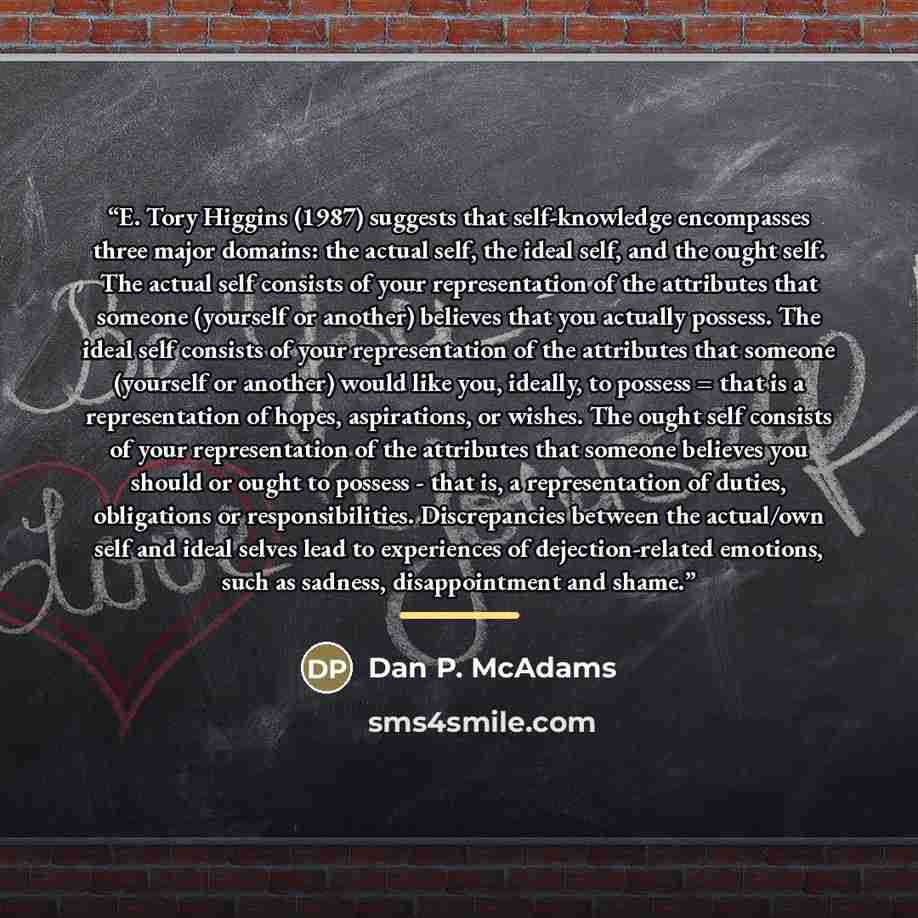
““E. Tory Higgins (1987) suggests that self-knowledge encompasses three major domains: the actual self, the ideal self, and the ought self. The actual self consists of your representation of the attributes that someone (yourself or another) believes that you actually possess. The ideal self consists of your representation of the attributes that someone (yourself or another) would like you, ideally, to possess = that is a representation of hopes, aspirations, or wishes. The ought self consists of your representation of the attributes that someone believes you should or ought to possess - that is, a representation of duties, obligations or responsibilities. Discrepancies between the actual/own self and ideal selves lead to experiences of dejection-related emotions, such as sadness, disappointment and shame.””
About This Quote
Source Book: Personality Development, Dan P. McAdams, 1996
Self‑knowledge involves three selves—actual, ideal, ought—each representing what we are, want to be, and should be; gaps cause negative emotions like sadness or shame.
In simple terms: Knowing three selves reveals why we feel disappointment when we fall short of hopes or duties.
Key Takeaway
Identify and align your self‑views to reduce emotional distress.
Themes
self‑knowledge
identity
emotion
psychology
Mood
reflective
analytical
motivational
Type
philosophical
inspirational
When to use this quote
- career planning
- personal therapy
- relationship counseling
- goal setting
- self‑reflection
Key Concepts
actual self
ideal self
ought self
self‑discrepancy
Questions to Reflect On
- What discrepancies exist between your actual and ideal selves?
- How can you set realistic ought‑self expectations?
A Different Perspective
Ideal and ought selves may be unrealistic, creating chronic dissatisfaction.
![“[To] know oneself is, above all, to know what one lacks. It is to measure oneself against Truth, and not the other way around. The first product of self-knowledge is humility . . .” quote by Flannery O'Connor](https://sms4smile.com/quotes/img-quotes/78d/flannery-o-connor-639_firsts_to-know-oneself-is-above-all-to-know-wha_1930035.jpg)


![“In the worldly life, due to maadakta (intoxication of the ego of ‘I am Chandubhai’), one has completely lost awareness of everything about one’s self. Everything in the worldly life is nothing but intoxication. The food is intoxicating, the senses are intoxicating. [Therefore] Go to the one, who…” quote by Dada Bhagwan](https://sms4smile.com/quotes/img-quotes/2b3/dada-bhagwan-31_absolute_in-the-worldly-life-due-to-maadakta-into_3662.jpg)