Character Quote by Christopher Hitchens
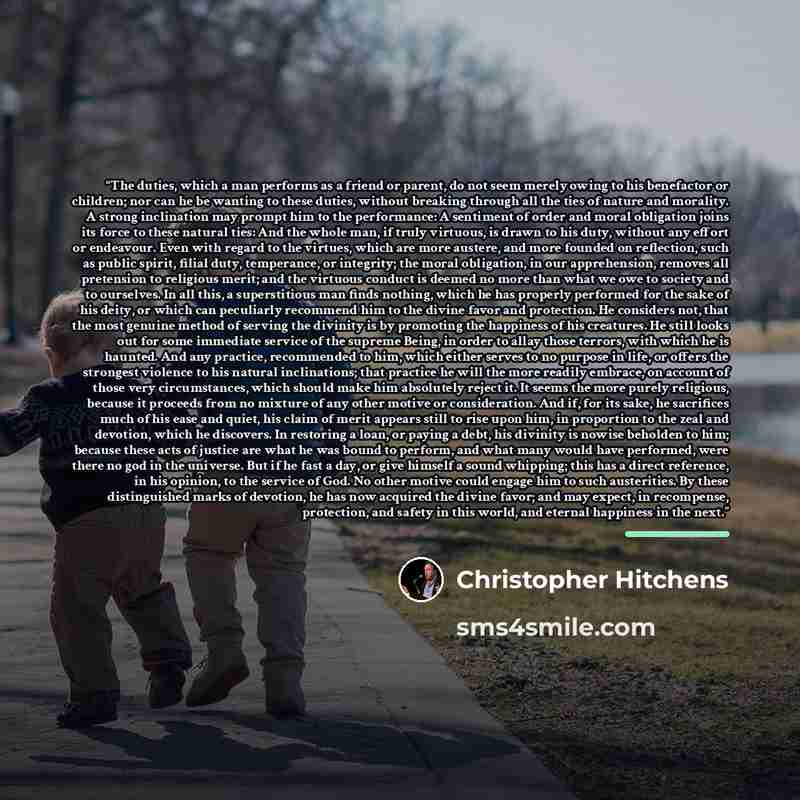
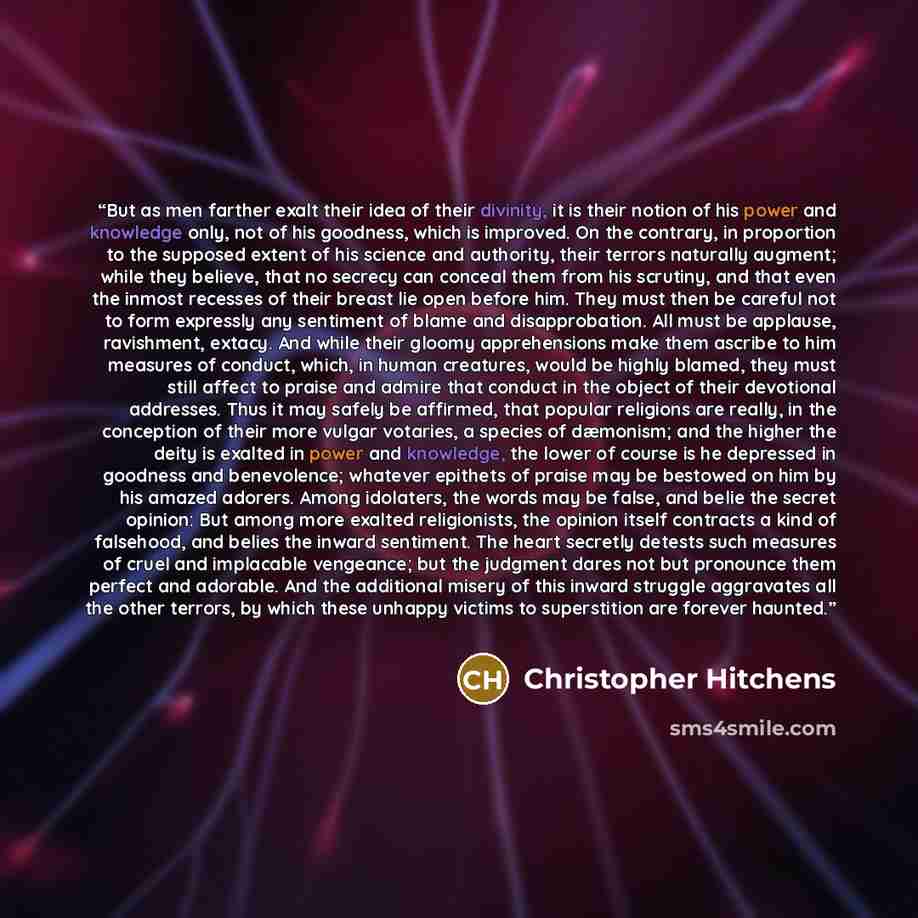
““The duties, which a man performs as a friend or parent, do not seem merely owing to his benefactor or children; nor can he be wanting to these duties, without breaking through all the ties of nature and morality. A strong inclination may prompt him to the performance: A sentiment of order and moral obligation joins its force to these natural ties: And the whole man, if truly virtuous, is drawn to his duty, without any effort or endeavour. Even with regard to the virtues, which are more austere, and more founded on reflection, such as public spirit, filial duty, temperance, or integrity; the moral obligation, in our apprehension, removes all pretension to religious merit; and the virtuous conduct is deemed no more than what we owe to society and to ourselves. In all this, a superstitious man finds nothing, which he has properly performed for the sake of his deity, or which can peculiarly recommend him to the divine favor and protection. He considers not, that the most genuine method of serving the divinity is by promoting the happiness of his creatures. He still looks out for some immediate service of the supreme Being, in order to allay those terrors, with which he is haunted. And any practice, recommended to him, which either serves to no purpose in life, or offers the strongest violence to his natural inclinations; that practice he will the more readily embrace, on account of those very circumstances, which should make him absolutely reject it. It seems the more purely religious, because it proceeds from no mixture of any other motive or consideration. And if, for its sake, he sacrifices much of his ease and quiet, his claim of merit appears still to rise upon him, in proportion to the zeal and devotion, which he discovers. In restoring a loan, or paying a debt, his divinity is nowise beholden to him; because these acts of justice are what he was bound to perform, and what many would have performed, were there no god in the universe. But if he fast a day, or give himself a sound whipping; this has a direct reference, in his opinion, to the service of God. No other motive could engage him to such austerities. By these distinguished marks of devotion, he has now acquired the divine favor; and may expect, in recompense, protection, and safety in this world, and eternal happiness in the next.””
About This Quote
Source Book: God Is Not Great, Christopher Hitchens, 2007
Moral duty arises from natural and societal ties, not from religious merit; virtue is service to humanity.
In simple terms: Duty comes from humanity, not divine reward.
Key Takeaway
Act from moral obligation, not for divine favor.
Themes
ethics
humanism
duty
virtue
Mood
critical
analytical
Type
philosophical
ethical
When to use this quote
- public service
- charitable work
- personal integrity
- education
Key Concepts
moral philosophy
secularism
social contract
Questions to Reflect On
- What motivates you to act morally?
- Can secular duty replace religious devotion?
A Different Perspective
Religious individuals may find this view dismissive of faith.
![“There are two ways whereby men may be guilty of the neglect of this heavenly favour:--[1.] They are so when the gift itself is not valued nor sought after, nor endeavoured to be attained. And this is done under various pretences. Some imagine that it is no gift of the Spirit, and so despise it…” quote by John Owen](https://sms4smile.com/quotes/img-quotes/800/john-owen-1415_quote_there-are-two-ways-whereby-men-may-be-gu_1064765.jpg)
![“[A man] finds in himself a talent which with the help of some culture might make him a useful man in many respects. But he finds himself in comfortable circumstances and prefers to indulge in pleasure rather than to take pains in enlarging and improving his happy natural capacities. He asks…” quote by Immanuel Kant](https://sms4smile.com/quotes/img-quotes/82f/immanuel-kant-532_growth_a-man-finds-in-himself-a-talent-which-wi_2644239.jpg)
![“It's [Los Angeles] mostly full of nonsense and delusion and egomania. They think they'll be young and beautiful forever, even though most of them aren't even young and beautiful now.” quote by Christopher Hitchens](https://sms4smile.com/quotes/img-quotes/a86/christopher-hitchens-117_beautiful_it-s-los-angeles-mostly-full-of-nonsense_10462.jpg)
![“[Religion] attacks us in our deepest integrity - the core of our self-respect. Religion says that we would not know right from wrong, we would not know an evil, wicked act from a decent human act without divine permission, without divine authority or without, even worse, either the fear of a…” quote by Christopher Hitchens](https://sms4smile.com/quotes/img-quotes/ab6/christopher-hitchens-117_action_religion-attacks-us-in-our-deepest-integ_23299.jpg)