Anti war Quote by Christopher Hitchens
![“That war [Bosnian war] in the early 1990s changed a lot for me. I never thought I would see, in Europe, a full-dress reprise of internment camps, the mass murder of civilians, the reinstiutution of torture and rape as acts of policy. And I didn't expect so many of my comrades to be indifferent…” quote by Christopher Hitchens](https://sms4smile.com/quotes/img-quotes/872/christopher-hitchens-117_anti-war_that-war-bosnian-war-in-the-early-1990s_3077861.jpg)
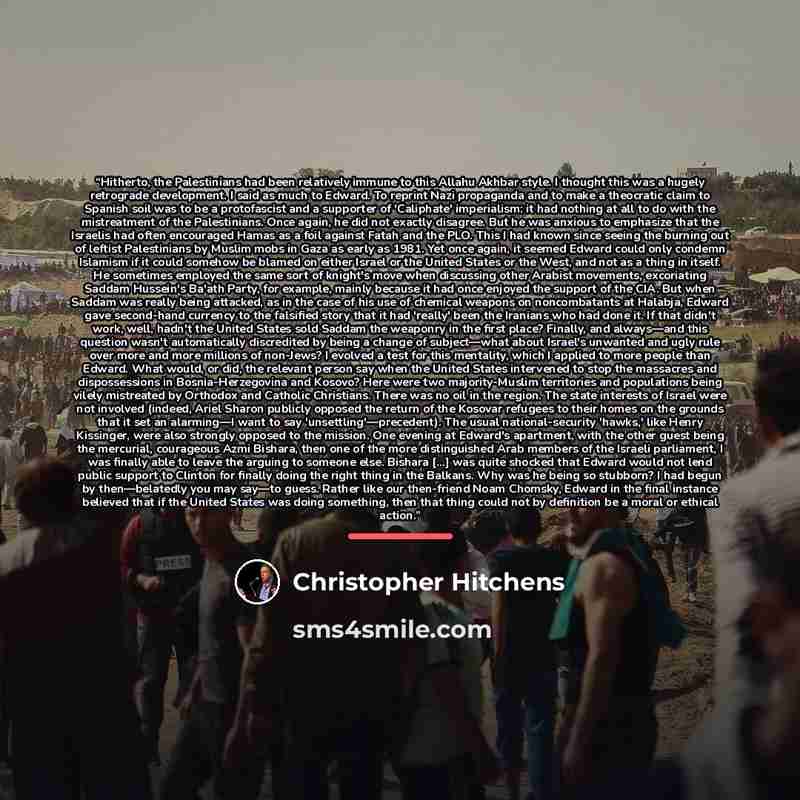
““That war [Bosnian war] in the early 1990s changed a lot for me. I never thought I would see, in Europe, a full-dress reprise of internment camps, the mass murder of civilians, the reinstiutution of torture and rape as acts of policy. And I didn't expect so many of my comrades to be indifferent - or even take the side of the fascists. It was a time when many people on the left were saying 'Don't intervene, we'll only make things worse' or, 'Don't intervene, it might destabilise the region. And I thought - destabilisation of fascist regimes is a good thing. Why should the left care about the stability of undemocratic regimes? Wasn't it a good thing to destabilise the regime of General Franco? It was a time when the left was mostly taking the conservative, status quo position - leave the Balkans alone, leave Milosevic alone, do nothing. And that kind of conservatism can easily mutate into actual support for the aggressors. Weimar-style conservatism can easily mutate into National Socialism. So you had people like Noam Chomsky's co-author Ed Herman go from saying 'Do nothing in the Balkans', to actually supporting Milosevic, the most reactionary force in the region. That's when I began to first find myself on the same side as the neocons. I was signing petitions in favour of action in Bosnia, and I would look down the list of names and I kept finding, there's Richard Perle. There's Paul Wolfowitz. That seemed interesting to me. These people were saying that we had to act. Before, I had avoided them like the plague, especially because of what they said about General Sharon and about Nicaragua. But nobody could say they were interested in oil in the Balkans, or in strategic needs, and the people who tried to say that - like Chomsky - looked ridiculous. So now I was interested.””
About This Quote
Source Essay: “The Bosnian War and the Left,” 1995
The author reflects on how the Bosnian war revealed moral failures on the left, including indifference and support for oppressive regimes, leading him to reconsider his political stance.
In simple terms: The war exposed leftist complacency and moral contradictions, prompting a shift in the author’s views.
Key Takeaway
Question personal and political convictions when faced with injustice.
Themes
politics
morality
war
ideology
activism
Mood
reflective
critical
serious
Type
political
philosophical
ethical
When to use this quote
- humanitarian crises
- political activism
- policy debates
- academic discourse
Key Concepts
moral responsibility
political realignment
human rights
interventionism
Questions to Reflect On
- What responsibilities do intellectuals have during humanitarian crises?
- How can one balance anti-interventionist principles with moral imperatives?
A Different Perspective
The perspective is heavily influenced by personal experience and may not represent all viewpoints.
![“It's [Los Angeles] mostly full of nonsense and delusion and egomania. They think they'll be young and beautiful forever, even though most of them aren't even young and beautiful now.” quote by Christopher Hitchens](https://sms4smile.com/quotes/img-quotes/a86/christopher-hitchens-117_beautiful_it-s-los-angeles-mostly-full-of-nonsense_10462.jpg)
![“[Religion] attacks us in our deepest integrity - the core of our self-respect. Religion says that we would not know right from wrong, we would not know an evil, wicked act from a decent human act without divine permission, without divine authority or without, even worse, either the fear of a…” quote by Christopher Hitchens](https://sms4smile.com/quotes/img-quotes/ab6/christopher-hitchens-117_action_religion-attacks-us-in-our-deepest-integ_23299.jpg)