Absolute freedom Quote by Chad Harbach
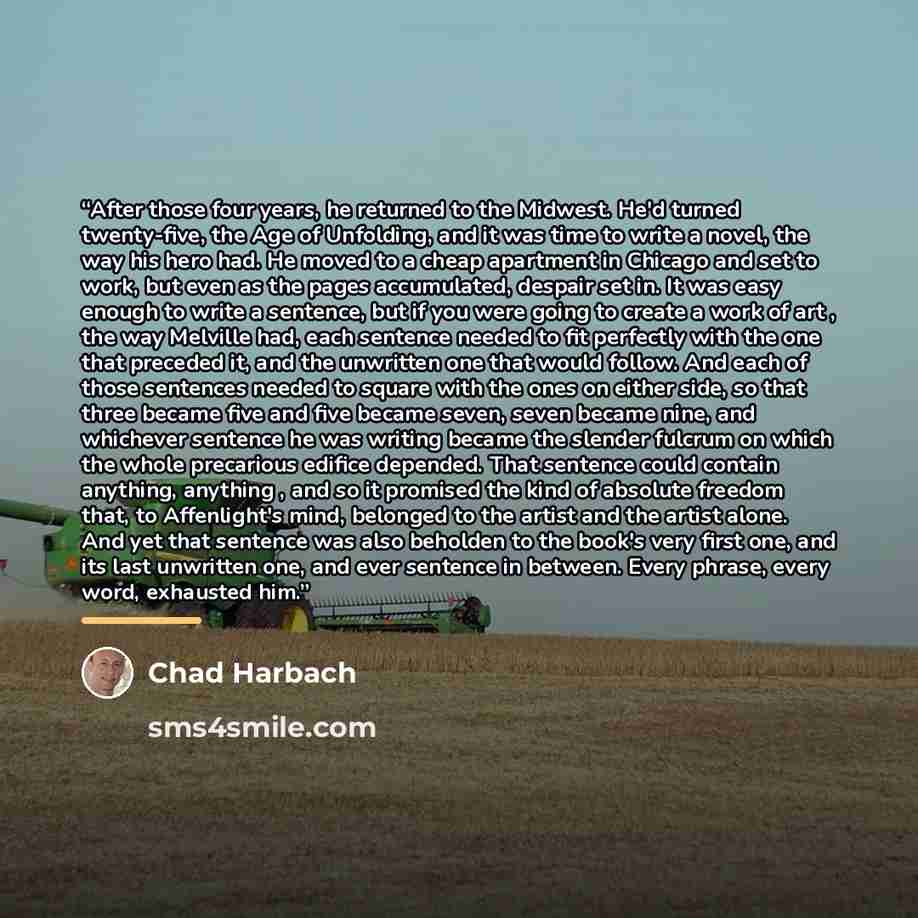
““After those four years, he returned to the Midwest. He'd turned twenty-five, the Age of Unfolding, and it was time to write a novel, the way his hero had. He moved to a cheap apartment in Chicago and set to work, but even as the pages accumulated, despair set in. It was easy enough to write a sentence, but if you were going to create a work of art , the way Melville had, each sentence needed to fit perfectly with the one that preceded it, and the unwritten one that would follow. And each of those sentences needed to square with the ones on either side, so that three became five and five became seven, seven became nine, and whichever sentence he was writing became the slender fulcrum on which the whole precarious edifice depended. That sentence could contain anything, anything , and so it promised the kind of absolute freedom that, to Affenlight's mind, belonged to the artist and the artist alone. And yet that sentence was also beholden to the book's very first one, and its last unwritten one, and ever sentence in between. Every phrase, every word, exhausted him.””
About This Quote
The creative process demands each part to align perfectly with past and future, making every sentence a critical balance point that can feel both liberating and oppressive.
In simple terms: Writing a novel requires each sentence to fit with those before and after, creating tension and freedom.
Key Takeaway
Every sentence is a crucial fulcrum.
Themes
creativity
writing
artistic pressure
perfectionism
Mood
anxious
determined
Type
inspirational
philosophical
When to use this quote
- novel writing
- artistic projects
- academic dissertations
Key Concepts
structural integrity
creative freedom
Practical Applications
- plan each chapter's structure before writing
- accept imperfect drafts as part of process
Questions to Reflect On
- How do you balance freedom and structure in your work?
- What strategies help you overcome paralysis from perfectionism?
A Different Perspective
The need for flawless coherence can stall progress; artistic freedom is limited by narrative constraints