Desire Quote by Augustine of Hippo
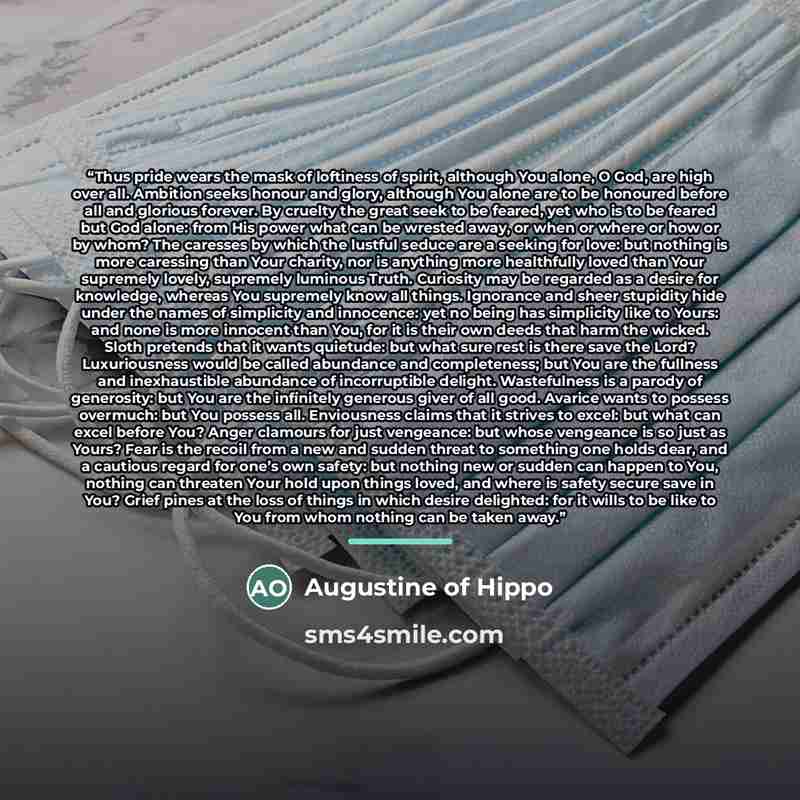
““Thus pride wears the mask of loftiness of spirit, although You alone, O God, are high over all. Ambition seeks honour and glory, although You alone are to be honoured before all and glorious forever. By cruelty the great seek to be feared, yet who is to be feared but God alone: from His power what can be wrested away, or when or where or how or by whom? The caresses by which the lustful seduce are a seeking for love: but nothing is more caressing than Your charity, nor is anything more healthfully loved than Your supremely lovely, supremely luminous Truth. Curiosity may be regarded as a desire for knowledge, whereas You supremely know all things. Ignorance and sheer stupidity hide under the names of simplicity and innocence: yet no being has simplicity like to Yours: and none is more innocent than You, for it is their own deeds that harm the wicked. Sloth pretends that it wants quietude: but what sure rest is there save the Lord? Luxuriousness would be called abundance and completeness; but You are the fullness and inexhaustible abundance of incorruptible delight. Wastefulness is a parody of generosity: but You are the infinitely generous giver of all good. Avarice wants to possess overmuch: but You possess all. Enviousness claims that it strives to excel: but what can excel before You? Anger clamours for just vengeance: but whose vengeance is so just as Yours? Fear is the recoil from a new and sudden threat to something one holds dear, and a cautious regard for one’s own safety: but nothing new or sudden can happen to You, nothing can threaten Your hold upon things loved, and where is safety secure save in You? Grief pines at the loss of things in which desire delighted: for it wills to be like to You from whom nothing can be taken away.””
About This Quote
Source Book: Confessions by Augustine of Hippo, c. 397–400
The passage contrasts human vices—pride, ambition, cruelty, lust, curiosity, ignorance, sloth, luxury, wastefulness, greed, envy, anger, fear, grief—with divine perfection, showing that all these flaws are meaningless before God’s all‑encompassing, immutable goodness.
In simple terms: Human flaws are powerless against God’s perfect, infinite goodness.
Key Takeaway
Recognize divine sovereignty over personal shortcomings.
Themes
theity
humility
spirituality
ethics
theology
Mood
humble
reflective
reverent
Type
scriptural
philosophical
spiritual
When to use this quote
- personal prayer
- confession
- ethical decision‑making
- comfort in grief
- overcoming envy
Key Concepts
Divine omnipotence
human frailty
moral contrast
spiritual introspection
Questions to Reflect On
- How do you confront personal pride in daily life?
- What does trusting God’s abundance change your view of material desire?
A Different Perspective
Human effort cannot match divine perfection; humility may be difficult to attain.












![“Time takes no holiday. It does not roll idly by, but through our senses works its own wonders in the mind. Time came and went from one day to the next; in its coming and its passing it brought me other hopes and other memories. [quoted in Peter Brown, Augustine of Hippo, p. 54]” quote by Augustine of Hippo](https://sms4smile.com/quotes/img-quotes/7c2/augustine-of-hippo-2589_change_time-takes-no-holiday-it-does-not-roll-i_22609.jpg)










![“Teaching might even be the greatest of the arts since the medium is the human mind and spirit. My three [great teachers] did not tell - they catalyzed a burning desire to know. Under their influence, the horizons sprung wide and fear went away and the unknown became knowable. But most important of…” quote by John Steinbeck](https://sms4smile.com/quotes/img-quotes/84c/john-steinbeck-71_art_teaching-might-even-be-the-greatest-of-t_1738.jpg)