Defense-policy Quote by Ashton Carter
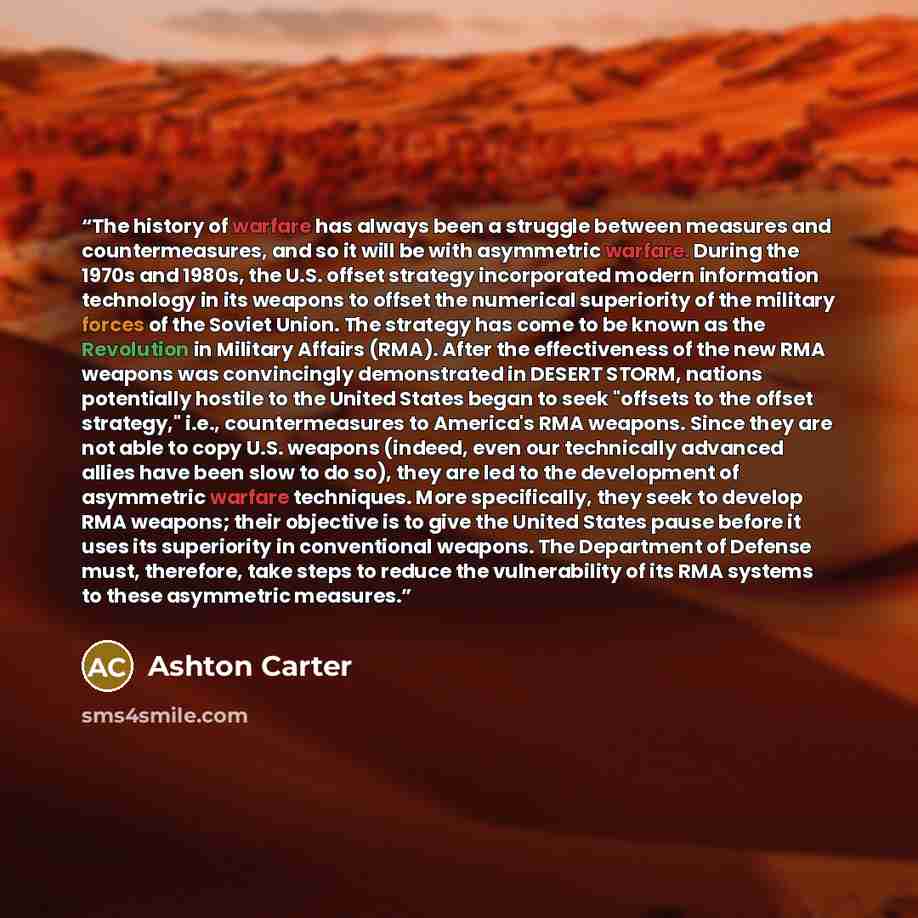
““The history of warfare has always been a struggle between measures and countermeasures, and so it will be with asymmetric warfare. During the 1970s and 1980s, the U.S. offset strategy incorporated modern information technology in its weapons to offset the numerical superiority of the military forces of the Soviet Union. The strategy has come to be known as the Revolution in Military Affairs (RMA). After the effectiveness of the new RMA weapons was convincingly demonstrated in DESERT STORM, nations potentially hostile to the United States began to seek "offsets to the offset strategy," i.e., countermeasures to America's RMA weapons. Since they are not able to copy U.S. weapons (indeed, even our technically advanced allies have been slow to do so), they are led to the development of asymmetric warfare techniques. More specifically, they seek to develop RMA weapons; their objective is to give the United States pause before it uses its superiority in conventional weapons. The Department of Defense must, therefore, take steps to reduce the vulnerability of its RMA systems to these asymmetric measures.””
About This Quote
Source Speech: Department of Defense briefing on Revolution in Military Affairs, 2003
The quote explains that warfare evolves as each side creates measures and countermeasures, and that modern U.S. technology (RMA) faces asymmetric challenges from adversaries who cannot copy it directly but develop alternative tactics.
In simple terms: War evolves through measure and countermeasure cycles, especially with high tech.
Key Takeaway
Adapt defenses to anticipate asymmetric threats.
Themes
military strategy
technology
asymmetry
defense
innovation
Mood
cautious
strategic
analytical
Type
policy
strategic
military
When to use this quote
- Strategic planning
- defense procurement
- allied technology sharing
- military education
- policy development
Key Concepts
RMA
offset strategy
countermeasures
technological diffusion
Questions to Reflect On
- How can the U.S. stay ahead of asymmetric threats?
- What investments best reduce RMA vulnerability?
A Different Perspective
Adversaries may find unexpected ways to neutralize high‑tech advantages, making adaptation costly.






![“In the absence of expert [senior military] advice, we have seen each successive administration fail in the business of strategy - yielding a United States twice as rich as the Soviet Union but much less strong. Only the manner of the failure has changed. In the 1960s, under Robert S. McNamara, we…” quote by Edward Luttwak](https://sms4smile.com/quotes/img-quotes/b55/edward-luttwak-63709_art-of-war_in-the-absence-of-expert-senior-military_133876.jpg)