Identity politics Quote by Andrew Solomon
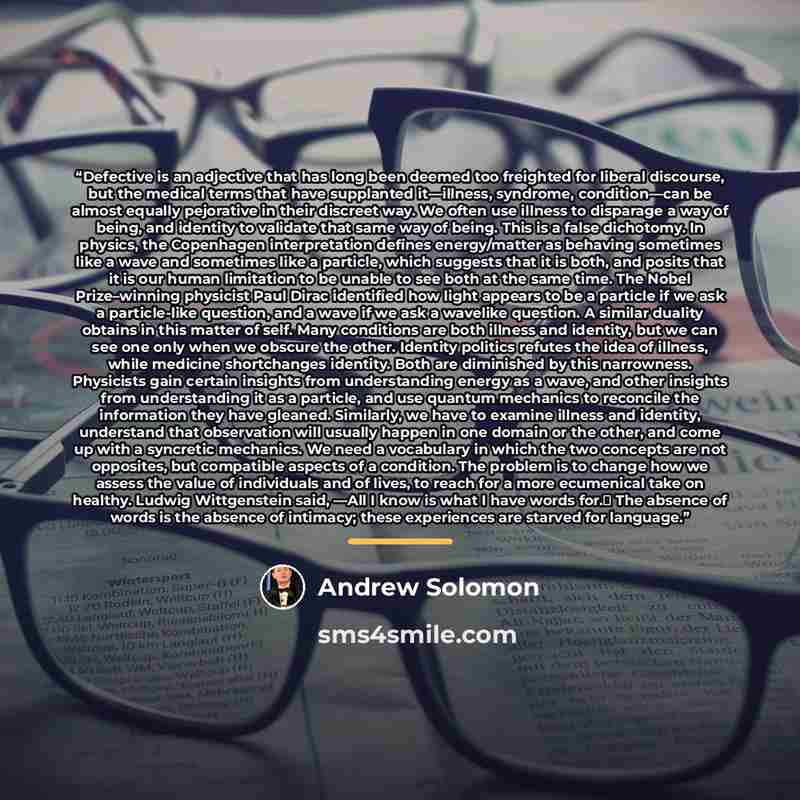
““Defective is an adjective that has long been deemed too freighted for liberal discourse, but the medical terms that have supplanted it—illness, syndrome, condition—can be almost equally pejorative in their discreet way. We often use illness to disparage a way of being, and identity to validate that same way of being. This is a false dichotomy. In physics, the Copenhagen interpretation defines energy/matter as behaving sometimes like a wave and sometimes like a particle, which suggests that it is both, and posits that it is our human limitation to be unable to see both at the same time. The Nobel Prize–winning physicist Paul Dirac identified how light appears to be a particle if we ask a particle-like question, and a wave if we ask a wavelike question. A similar duality obtains in this matter of self. Many conditions are both illness and identity, but we can see one only when we obscure the other. Identity politics refutes the idea of illness, while medicine shortchanges identity. Both are diminished by this narrowness. Physicists gain certain insights from understanding energy as a wave, and other insights from understanding it as a particle, and use quantum mechanics to reconcile the information they have gleaned. Similarly, we have to examine illness and identity, understand that observation will usually happen in one domain or the other, and come up with a syncretic mechanics. We need a vocabulary in which the two concepts are not opposites, but compatible aspects of a condition. The problem is to change how we assess the value of individuals and of lives, to reach for a more ecumenical take on healthy. Ludwig Wittgenstein said, ―All I know is what I have words for.‖ The absence of words is the absence of intimacy; these experiences are starved for language.””
About This Quote
Source Essay: The New Yorker, “The Language of Illness and Identity”, 2023
The quote argues that labeling conditions as either illness or identity creates a false binary; both perspectives are needed, like wave‑particle duality in physics, to fully understand human experience.
In simple terms: Illness and identity shouldn't be opposed; they’re complementary aspects of a condition.
Key Takeaway
Adopt a nuanced view that integrates both medical and identity perspectives.
Themes
identity
illness
duality
language
politics
Mood
thoughtful
critical
Type
analytical
philosophical
When to use this quote
- healthcare policy
- identity activism
- personal self‑understanding
- public discourse
Key Concepts
wave‑particle duality
semantic framing
intersectionality
Questions to Reflect On
- How can we create language that honors both medical and identity aspects?
- What policies reflect both perspectives without reducing individuals to labels?
A Different Perspective
Overemphasis on one side can marginalize the other, limiting empathy and effective support.