Absolute truth Quote by Aleksandr Solzhenitsyn
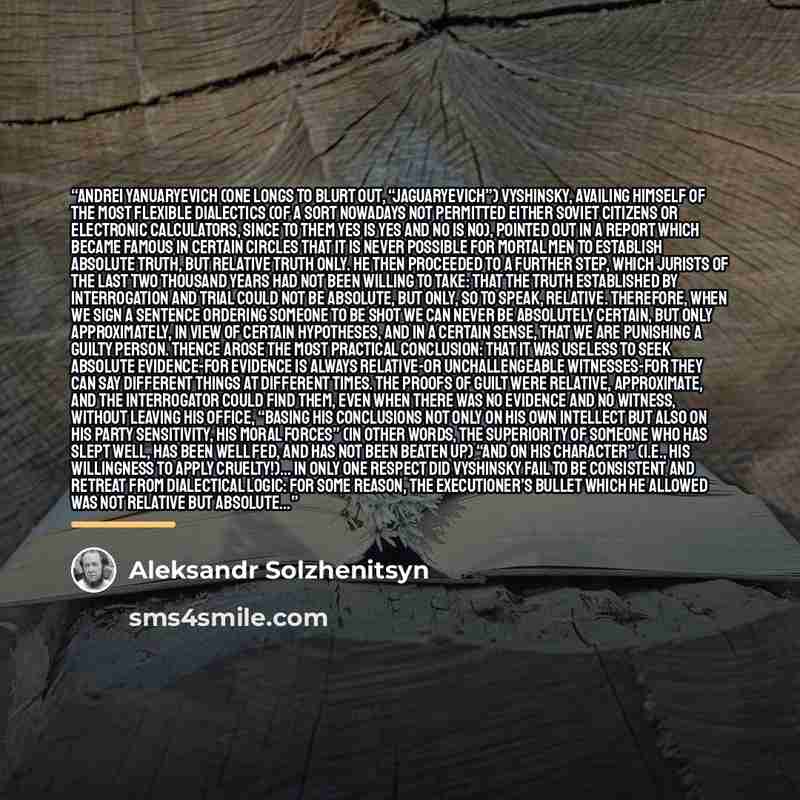
““Andrei Yanuaryevich (one longs to blurt out, “Jaguaryevich”) Vyshinsky, availing himself of the most flexible dialectics (of a sort nowadays not permitted either Soviet citizens or electronic calculators, since to them yes is yes and no is no), pointed out in a report which became famous in certain circles that it is never possible for mortal men to establish absolute truth, but relative truth only. He then proceeded to a further step, which jurists of the last two thousand years had not been willing to take: that the truth established by interrogation and trial could not be absolute, but only, so to speak, relative. Therefore, when we sign a sentence ordering someone to be shot we can never be absolutely certain, but only approximately, in view of certain hypotheses, and in a certain sense, that we are punishing a guilty person. Thence arose the most practical conclusion: that it was useless to seek absolute evidence-for evidence is always relative-or unchallengeable witnesses-for they can say different things at different times. The proofs of guilt were relative, approximate, and the interrogator could find them, even when there was no evidence and no witness, without leaving his office, “basing his conclusions not only on his own intellect but also on his Party sensitivity, his moral forces” (in other words, the superiority of someone who has slept well, has been well fed, and has not been beaten up) “and on his character” (i.e., his willingness to apply cruelty!)… In only one respect did Vyshinsky fail to be consistent and retreat from dialectical logic: for some reason, the executioner’s bullet which he allowed was not relative but absolute…””
About This Quote
Source Book: The Gulag Archipelago, Aleksandr Solzhenitsyn, 1973
Vyshinsky argues that truth is always relative, especially in legal judgments, making absolute certainty impossible and leading to pragmatic but morally ambiguous decisions.
In simple terms: Truth is relative, not absolute.
Key Takeaway
Question the certainty of judgments.
Themes
law
ethics
relativism
political power
justice
Mood
critical
thoughtful
Type
philosophical
political
When to use this quote
- courtroom decisions
- policy making
- historical analysis
- ethical debates
Key Concepts
dialectics
legal theory
moral philosophy
Questions to Reflect On
- Can relative truth ever ensure fairness?
- What safeguards can limit abuse?
A Different Perspective
It ignores the need for objective standards in law.