A reader's emotions can be sparked with few words. That's the power of dialogue. — Sol Stein Copy Share Image
The biggest difference between a writer and a would-be writer is their attitude toward rewriting. . . . Unwillingness to revise usually signals an amateur. — Sol Stein Copy Share Image
Most of the time, tough, combative, adversarial dialogue is much more exciting than physical action. — Sol Stein Copy Share Image
To create tension, dialogue needs to be stretched out. That is, characters should not be immediately responsive. — Sol Stein Copy Share Image
“It can be said that one slip of point of view by a writer can hurt a story badly, and several slips… — Sol Stein Copy Share Image
Our instinct as human beings is to provide answers, to ease tension. As writers our job is the opposite, to create tension… — Sol Stein Copy Share Image
Dialogue, contrary to popular view, is not a recording of actual speech; it is a semblance of speech, an invented language of… — Sol Stein Copy Share Image
Readers take in dialogue one thought at a time. A frequent mistake of beginners is to combine thoughts, which may be suitable… — Sol Stein Copy Share Image
“The novelist is like the conductor of an orchestra, his back to the audience, his face invisible, summoning the experience of music… — Sol Stein Copy Share Image
I see manuscripts and books that are spoiled for the literary reader because they are one long stream of top-of-the-head writing, a… — Sol Stein Copy Share Image
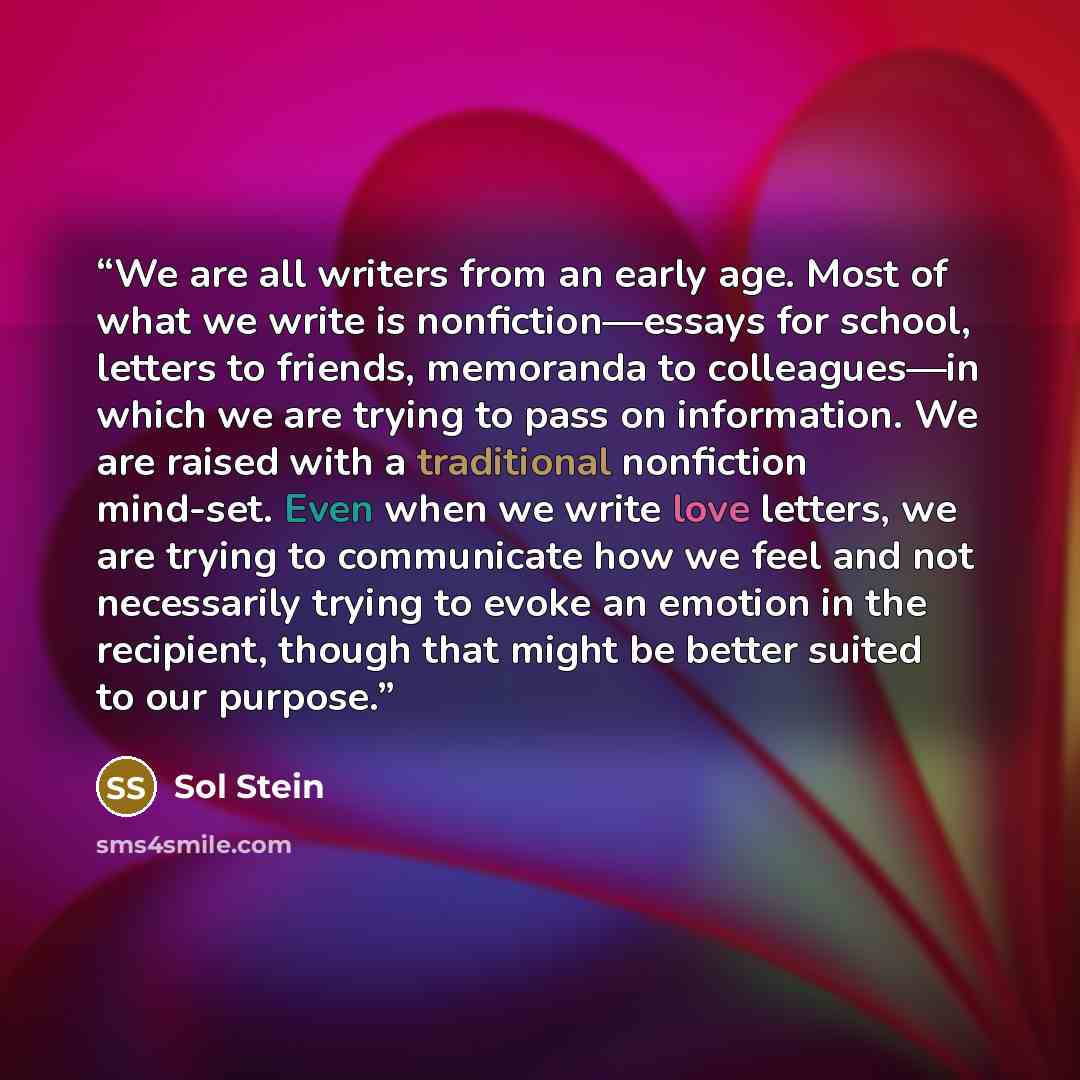
“We are all writers from an early age. Most of what we write is nonfiction—essays for school, letters to friends, memoranda to… — Sol Stein Copy Share Image
Readers take in dialogue one thought at a time. A frequent mistake of beginners is to combine thoughts, which may be suitable for other… — Sol Stein Copy Share Image
To create tension, dialogue needs to be stretched out. That is, characters should not be immediately responsive. — Sol Stein Copy Share Image
The biggest difference between a writer and a would-be writer is their attitude toward rewriting. . . . Unwillingness to revise usually signals an amateur. — Sol Stein Copy Share Image
“It can be said that one slip of point of view by a writer can hurt a story badly, and several slips can be… — Sol Stein Copy Share Image
Most of the time, tough, combative, adversarial dialogue is much more exciting than physical action. — Sol Stein Copy Share Image
“The novelist is like the conductor of an orchestra, his back to the audience, his face invisible, summoning the experience of music for the… — Sol Stein Copy Share Image
Dialogue, contrary to popular view, is not a recording of actual speech; it is a semblance of speech, an invented language of exchanges that… — Sol Stein Copy Share Image
I see manuscripts and books that are spoiled for the literary reader because they are one long stream of top-of-the-head writing, a writer telling… — Sol Stein Copy Share Image
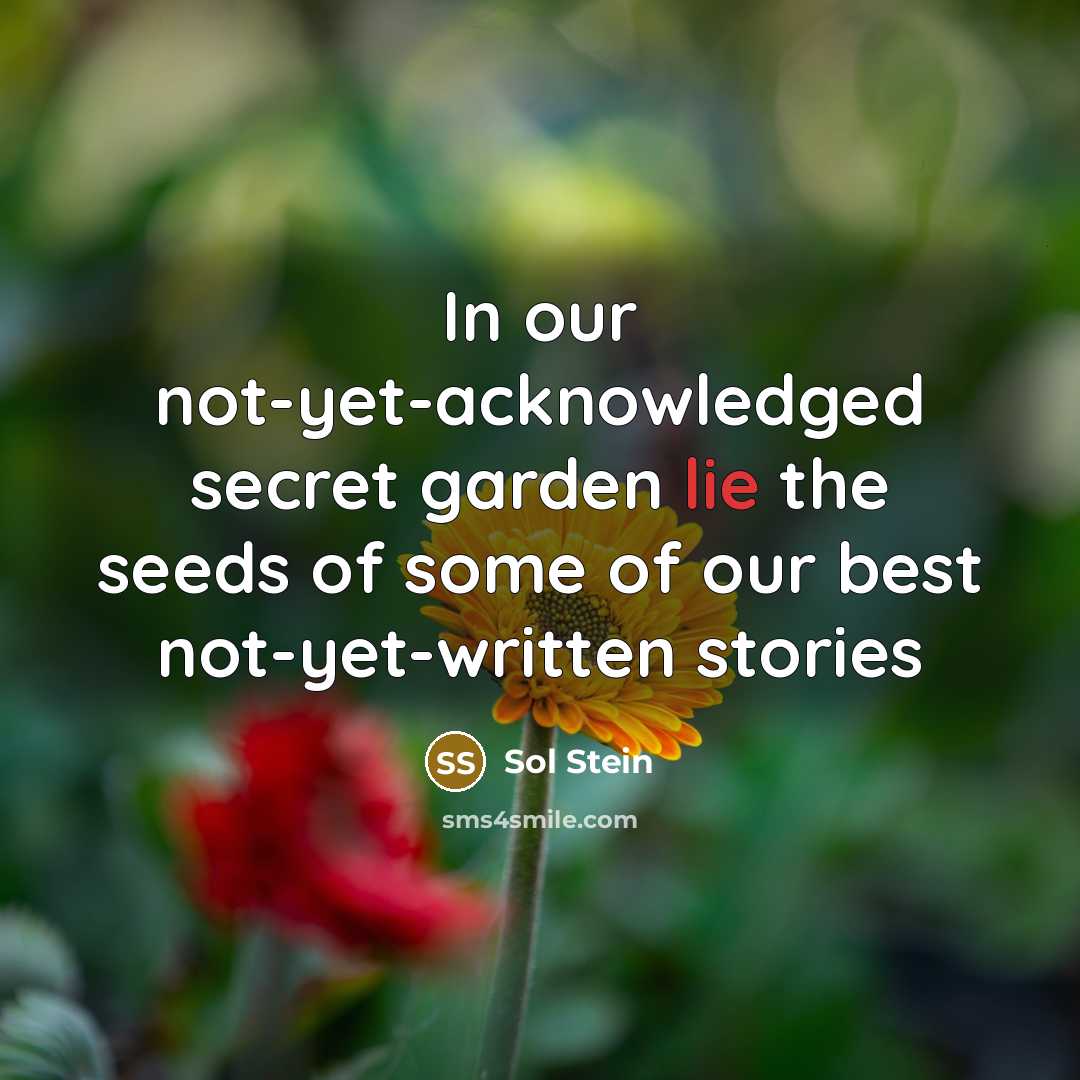
In our not-yet-acknowledged secret garden lie the seeds of some of our best not-yet-written stories — Sol Stein Copy Share Image
Our instinct as human beings is to provide answers, to ease tension. As writers our job is the opposite, to create tension and not… — Sol Stein Copy Share Image
A reader's emotions can be sparked with few words. That's the power of dialogue. — Sol Stein Copy Share Image