It is also amazing to find just how religious and occult-minded some of the leading political and military players of the war… — Philip Jenkins Copy Share Image
The typical WW1 soldier was not an intellectual like Ernst Jünger or Wilfred Owen, but was a peasant draftee from Galicia or… — Philip Jenkins Copy Share Image
Famine, plague, death and war... that's a pretty good description of 1917-18. The war was meant to end quickly, but by 1917… — Philip Jenkins Copy Share Image
“the Armenian genocide of the First World War years, which represented an escalation in intensity, rather than a departure from previous tolerance.… — Philip Jenkins Copy Share Image
“The deeply rooted Christianity of Africa and Asia did not simply fade away through lack of zeal, or theological confusion: it was… — Philip Jenkins Copy Share Image
“Far from anti-Christian purges ceasing with the official end of war in 1918, they actually intensified during the ensuing war between Greece… — Philip Jenkins Copy Share Image
“Looking at a situation like the Israel-Palestine conflict, Americans are likely to react with puzzlement when they see ever more violent and… — Philip Jenkins Copy Share Image
When the war started, religion and superstition (whatever the difference is) permeated the lives of ordinary soldiers, who lived in a thought… — Philip Jenkins Copy Share Image
“the “politicians who took us to war should have been given the guns and told to settle their differences themselves, instead of… — Philip Jenkins Copy Share Image
“Yet even when such languages did not face direct official sanction, speakers of older tongues knew that they had little chance of getting on… — Philip Jenkins Copy Share Image
“Christianity offers similar stories, and the global Christianity that perished in the late Middle Ages has revived in the past century. China offers an… — Philip Jenkins Copy Share Image
“Where the African church failed was in not carrying Christianity beyond the Romanized inhabitants of the cities and the great estates, and not sinking… — Philip Jenkins Copy Share Image
“Christians believe that God speaks through history; and only by knowing that history can we hope to interpret momentous events like the Japanese persecutions… — Philip Jenkins Copy Share Image
“Perhaps theological attempts to explain the destruction of churches or of “Christian nations” are asking the wrong question, if they judge success and failure… — Philip Jenkins Copy Share Image
“Another difficulty with the reservation scheme was that it reinforced the popular association of Christianity with foreign imperialism, and thus with enmity to the… — Philip Jenkins Copy Share Image
“Far from anti-Christian purges ceasing with the official end of war in 1918, they actually intensified during the ensuing war between Greece and Turkey.… — Philip Jenkins Copy Share Image
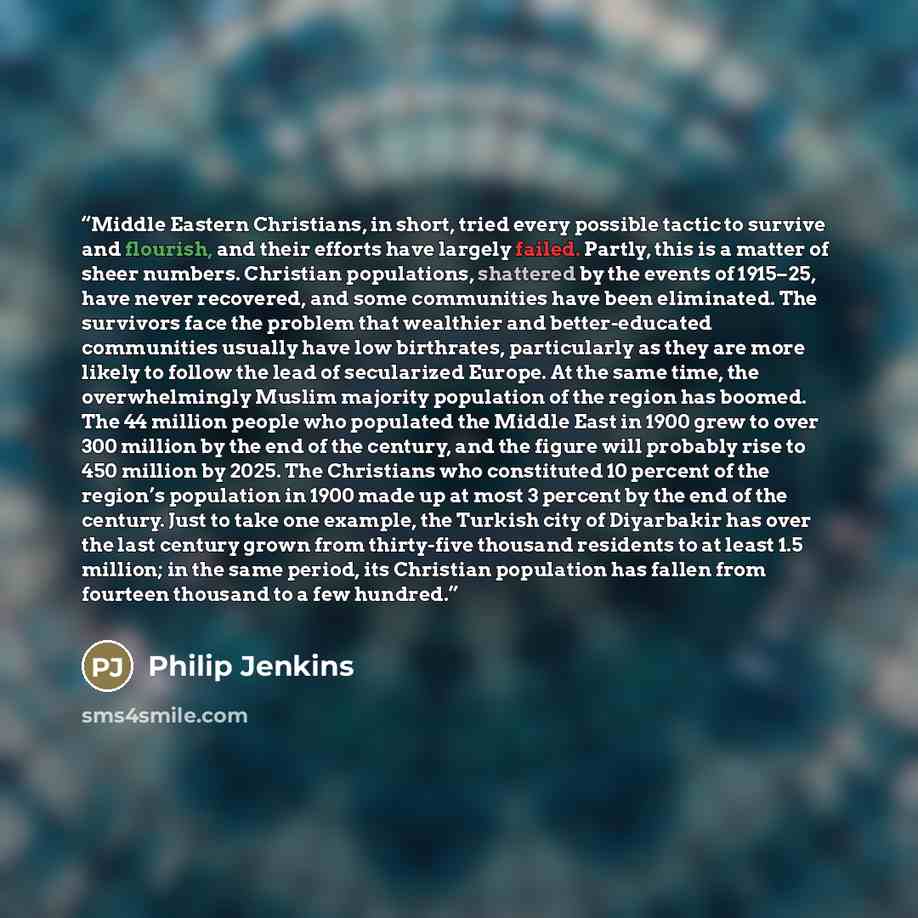
“Middle Eastern Christians, in short, tried every possible tactic to survive and flourish, and their efforts have largely failed. Partly, this is a matter… — Philip Jenkins Copy Share Image
“Besides the missionary theology cultivated by many churches, we also need a theology of extinction.” — Philip Jenkins Copy Share Image
“Our accepted chronology of the ancient church is wrong: ancient Semitic Christianity dies out not in the fourth century, but in the fourteenth.8” — Philip Jenkins Copy Share Image
“Christianity in this region remained as much a colonists’ religion as it would be once again during the French Empire of the twentieth century,… — Philip Jenkins Copy Share Image
“Any acquaintance with recent history made nonsense of any claim that God was on the side of Christian states. As one scholar suggests, what… — Philip Jenkins Copy Share Image