Even if you must have regard to wealth, in order to secure leisure, yet it is surely a bad thing that the… — Aristotle Copy Share Image
Moral virtue is ... a mean between two vices, that of excess and that of defect, and ... it is no small… — Aristotle Copy Share Image
Greatness of Soul seems therefore to be as it were a crowning ornament of the virtues; it enhances their greatness, and it… — Aristotle Copy Share Image
...the life which is best for men, both separately, as individuals, and in the mass, as states, is the life which has… — Aristotle Copy Share Image
Hence both women and children must be educated with an eye to the constitution, if indeed it makes any difference to the… — Aristotle Copy Share Image
Excellence or virtue is a settled disposition of the mind that determines our choice of actions and emotions and consists essentially in… — Aristotle Copy Share Image
¢Some identify Happiness with virtue, some with practical wisdom, others with a kind of philosophical wisdom, others add or exclude pleasure and… — Aristotle Copy Share Image
One citizen differs from another, but the salvation of the community is the common business of them all. This community is the… — Aristotle Copy Share Image
Our virtues are voluntary (and in fact we are in a sense ourselves partly the cause of our moral dispositions, and it… — Aristotle Copy Share Image
But the virtues we get by first exercising them, as also happens in the case of the arts as well. For the… — Aristotle Copy Share Image
The virtue of a faculty is related to the special function which that faculty performs. Now there are three elements in the… — Aristotle Copy Share Image
The life of theoretical philosophy is the best and happiest a man can lead. Few men are capable of it and then… — Aristotle Copy Share Image
Virtue means doing the right thing, in relation to the right person, at the right time, to the right extent, in the… — Aristotle Copy Share Image
. .we would have to say that hereditary succession is harmful. You may say the king, having sovereign power, will not in… — Aristotle Copy Share Image
[Prudence] is the virtue of that part of the intellect [the calculative] to which it belongs; and . . . our choice… — Aristotle Copy Share Image
The government of freemen is nobler and implies more virtue than despotic government. Neither is a city to be deemed happy or… — Aristotle Copy Share Image
...happiness does not consist in amusement. In fact, it would be strange if our end were amusement, and if we were to… — Aristotle Copy Share Image
The happy man . . . will be always or at least most often employed in doing and contemplating the things that… — Aristotle Copy Share Image
Happiness, then, is co-extensive with contemplation, and the more people contemplate, the happier they are; not incidentally, but in virtue of their… — Aristotle Copy Share Image
Error is multiform (for evil is a form of the unlimited, as in the old Pythagorean imagery, and good of the limited),… — Aristotle Copy Share Image
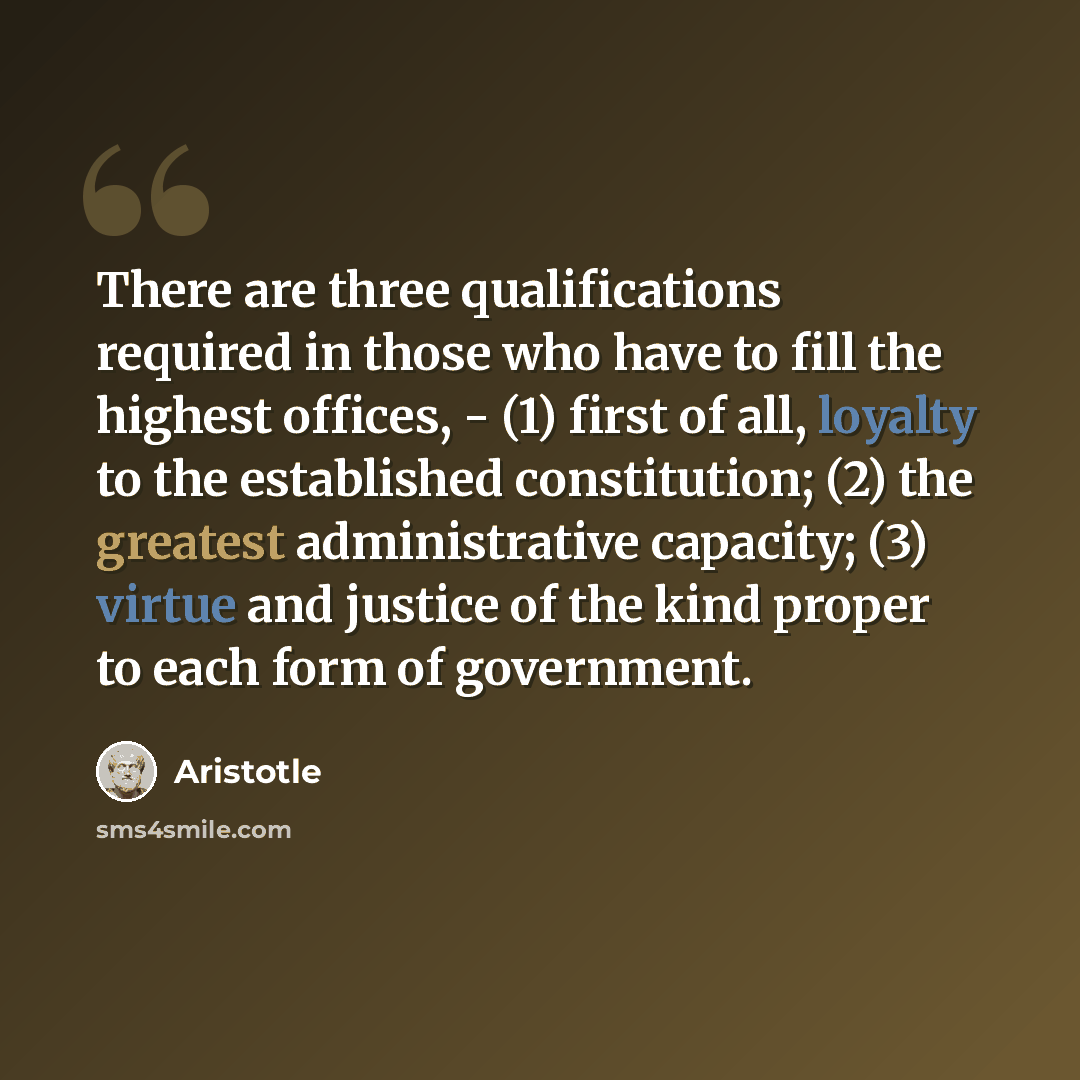
There are three qualifications required in those who have to fill the highest offices, - (1) first of all, loyalty to the… — Aristotle Copy Share Image
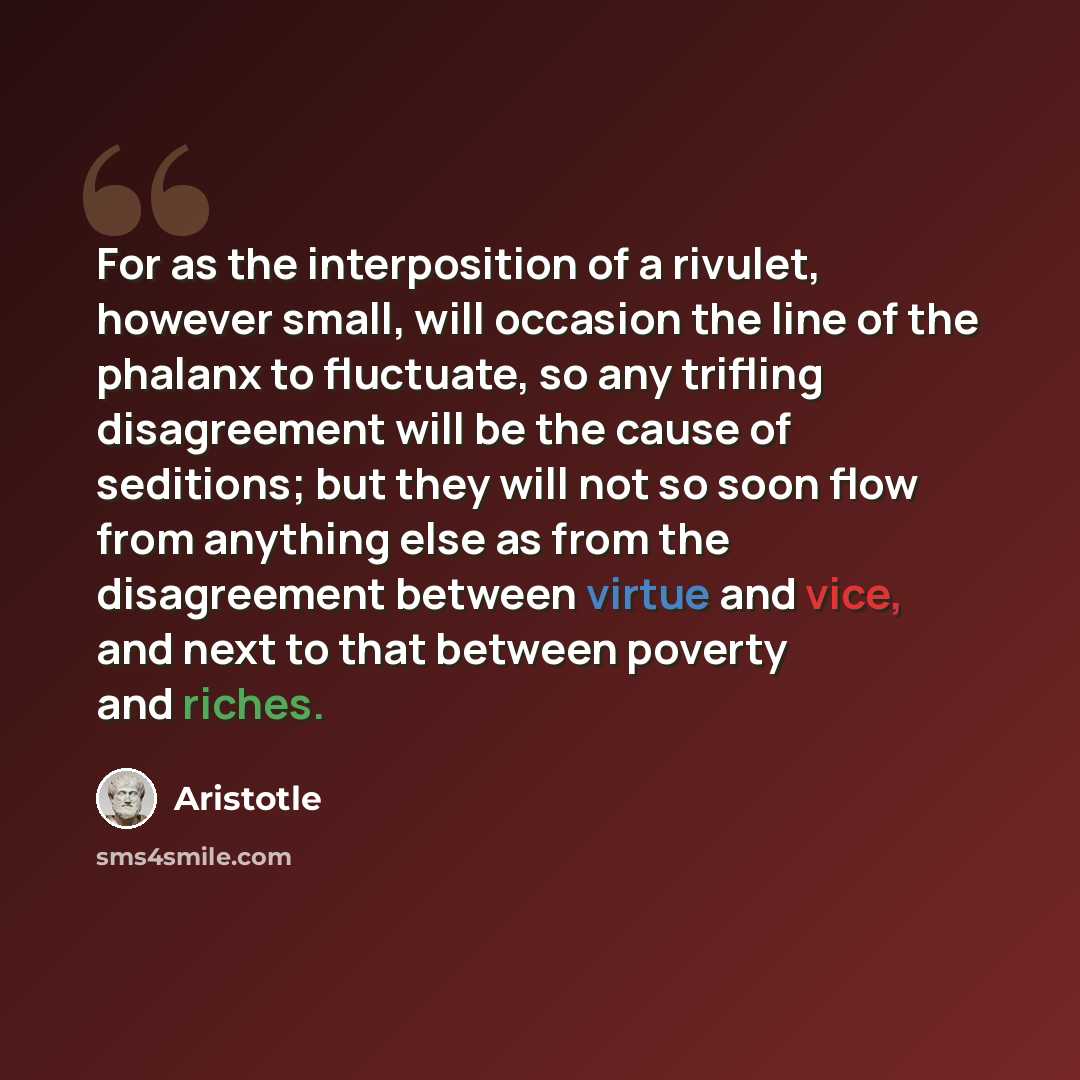
For as the interposition of a rivulet, however small, will occasion the line of the phalanx to fluctuate, so any trifling disagreement… — Aristotle Copy Share Image
The knowledge of the soul admittedly contributes greatly to the advance of truth in general, and, above all, to our understanding of Nature, for… — Aristotle Copy Share
Young men have strong passions and tend to gratify them indiscriminately. Of the bodily desires, it is the sexual by which they are most… — Aristotle Copy Share
The body is at its best between the ages of thirty and thirty-five; the mind is at its best about the age of forty-nine. — Aristotle Copy Share
The ensouled is distinguished from the unsouled by its being alive. Now since being alive is spoken of in many ways, even if only… — Aristotle Copy Share
Although it may be difficult in theory to know what is just and equal, the practical difficulty of inducing those to forbear who can,… — Aristotle Copy Share
The true forms of government, therefore, are those in which the one, or the few, or the many, govern with a view to the… — Aristotle Copy Share
All persons ought to endeavor to follow what is right, and not what is established. — Aristotle Copy Share
Give a man a fish, you feed him for a day. Give a man a poisoned fish, you feed him for the rest of… — Aristotle Copy Share
Obstinate people can be divided into the opinionated, the ignorant, and the boorish. — Aristotle Copy Share
Happiness does not consist in pastimes and amusements but in virtuous activities. — Aristotle Copy Share
To learn is a natural pleasure, not confined to philosophers, but common to all men. — Aristotle Copy Share