The seat of the soul and the control of voluntary movement - in fact, of nervous functions in general, - are to… — Aristotle Copy Share Image
These virtues are formed in man by his doing the actions ... The good of man is a working of the soul… — Aristotle Copy Share Image
The good of man is the active exercise of his soul's faculties. This exercise must occupy a complete lifetime. One swallow does… — Aristotle Copy Share Image
This body is not a home, but an inn; and that only for a short time. Seneca Friendship is composed of a… — Aristotle Copy Share Image
Where your talents and the needs of the world cross, therein lies your vocation. These two, your talents and the needs of… — Aristotle Copy Share Image
“The female is, as it were, a mutilated male, and the catamenia are semen, only not pure; for there is only one… — Aristotle Copy Share Image
Music has the power of producing a certain effect on the moral character of the soul, and if it has the power… — Aristotle Copy Share Image
... the good for man is an activity of the soul in accordance with virtue, or if there are more kinds of… — Aristotle Copy Share Image
In [the soul] one part naturally rules, and the other is subject, and the virtue of the ruler we maintain to be… — Aristotle Copy Share Image
The soul is the cause or source of the living body. The terms cause and source have many senses. But the soul… — Aristotle Copy Share Image
Great and frequent reverses can crush and mar our bliss both by the pain they cause and by the hindrance they offer… — Aristotle Copy Share Image
Now the soul of man is divided into two parts, one of which has a rational principle in itself, and the other,… — Aristotle Copy Share Image
The beauty of the soul shines out when a man bears with composure one heavy mischance after another, not because he does… — Aristotle Copy Share Image
The soul of animals is characterized by two faculties, (a) the faculty of discrimination which is the work of thought and sense,… — Aristotle Copy Share Image
All food must be capable of being digested, and that what produces digestion is warmth; that is why everything that has soul… — Aristotle Copy Share Image
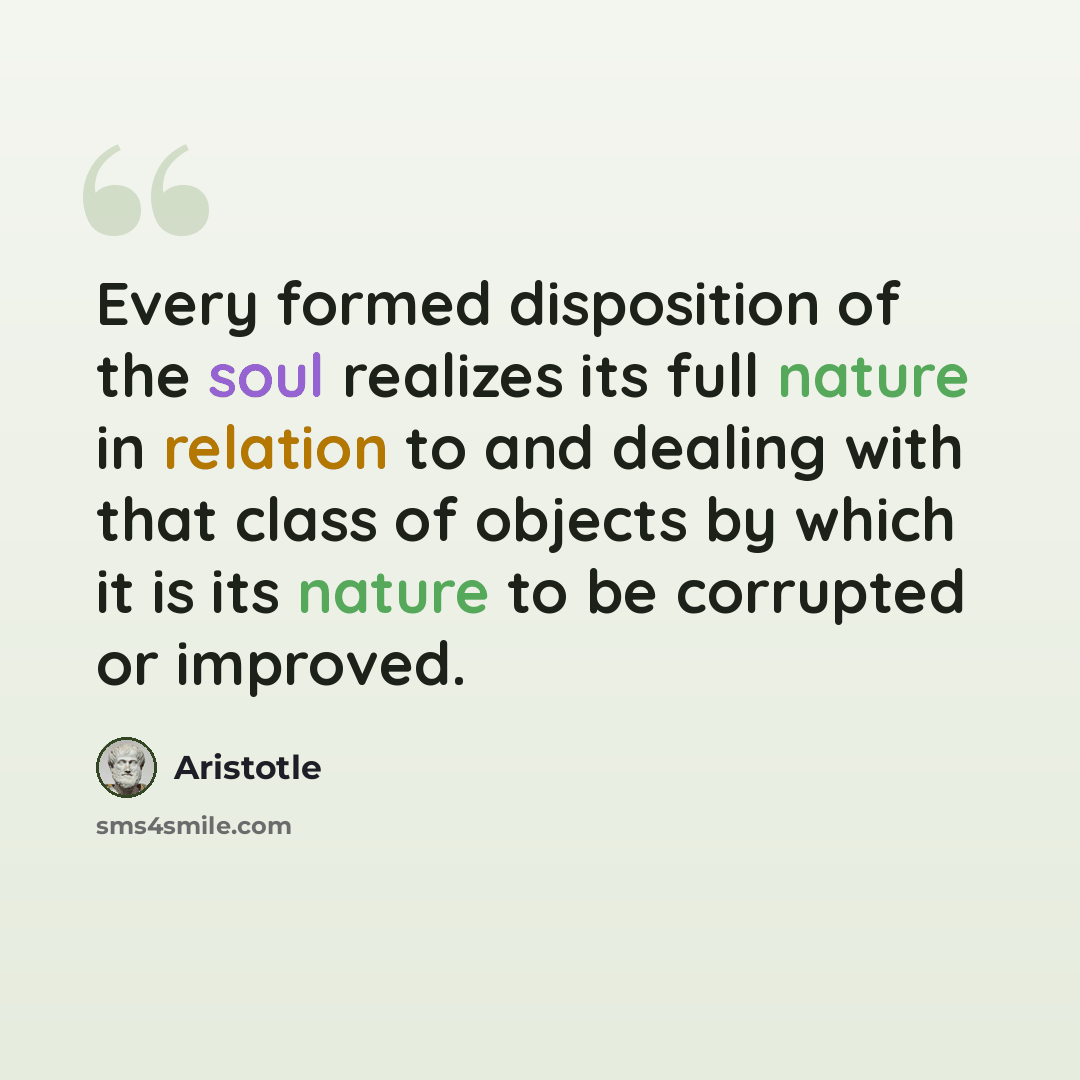
Every formed disposition of the soul realizes its full nature in relation to and dealing with that class of objects by which… — Aristotle Copy Share Image
The knowledge of the soul admittedly contributes greatly to the advance of truth in general, and, above all, to our understanding of Nature, for… — Aristotle Copy Share
Young men have strong passions and tend to gratify them indiscriminately. Of the bodily desires, it is the sexual by which they are most… — Aristotle Copy Share
The body is at its best between the ages of thirty and thirty-five; the mind is at its best about the age of forty-nine. — Aristotle Copy Share
The ensouled is distinguished from the unsouled by its being alive. Now since being alive is spoken of in many ways, even if only… — Aristotle Copy Share
Although it may be difficult in theory to know what is just and equal, the practical difficulty of inducing those to forbear who can,… — Aristotle Copy Share
The true forms of government, therefore, are those in which the one, or the few, or the many, govern with a view to the… — Aristotle Copy Share
All persons ought to endeavor to follow what is right, and not what is established. — Aristotle Copy Share
Give a man a fish, you feed him for a day. Give a man a poisoned fish, you feed him for the rest of… — Aristotle Copy Share
Obstinate people can be divided into the opinionated, the ignorant, and the boorish. — Aristotle Copy Share
Happiness does not consist in pastimes and amusements but in virtuous activities. — Aristotle Copy Share
To learn is a natural pleasure, not confined to philosophers, but common to all men. — Aristotle Copy Share