Once causes are determined, then there is talk of "social injustice" and the privileged begin to resist. — Gustavo Gutiérrez Copy Share Image
“The unqualified affirmation of the univeral will of salvation has radically changed the way of conceiving the mission of the Church in the world.… — Gustavo Gutierrez Copy Share Image
But the poor person does not exist as an inescapable fact of destiny. His or her existence is not politically neutral, and it is not ethically innocent. The poor are a by-product of the system in which we live and for which we are responsible. They are marginalized by our social and cultural world. They are the oppressed, exploited proletariat,… — Gustavo Gutiérrez Copy Share
The God of Exodus is the God of history and of political liberation more than he is the God of nature. — Gustavo Gutiérrez Copy Share Image
Liberation from every form of exploitation, the possibility of a more human and dignified life, the creation of a new humankind - all pass… — Gustavo Gutiérrez Copy Share Image
The poverty of the poor is not a call to generous relief action, but a demand that we go and build a different social… — Gustavo Gutiérrez Copy Share Image
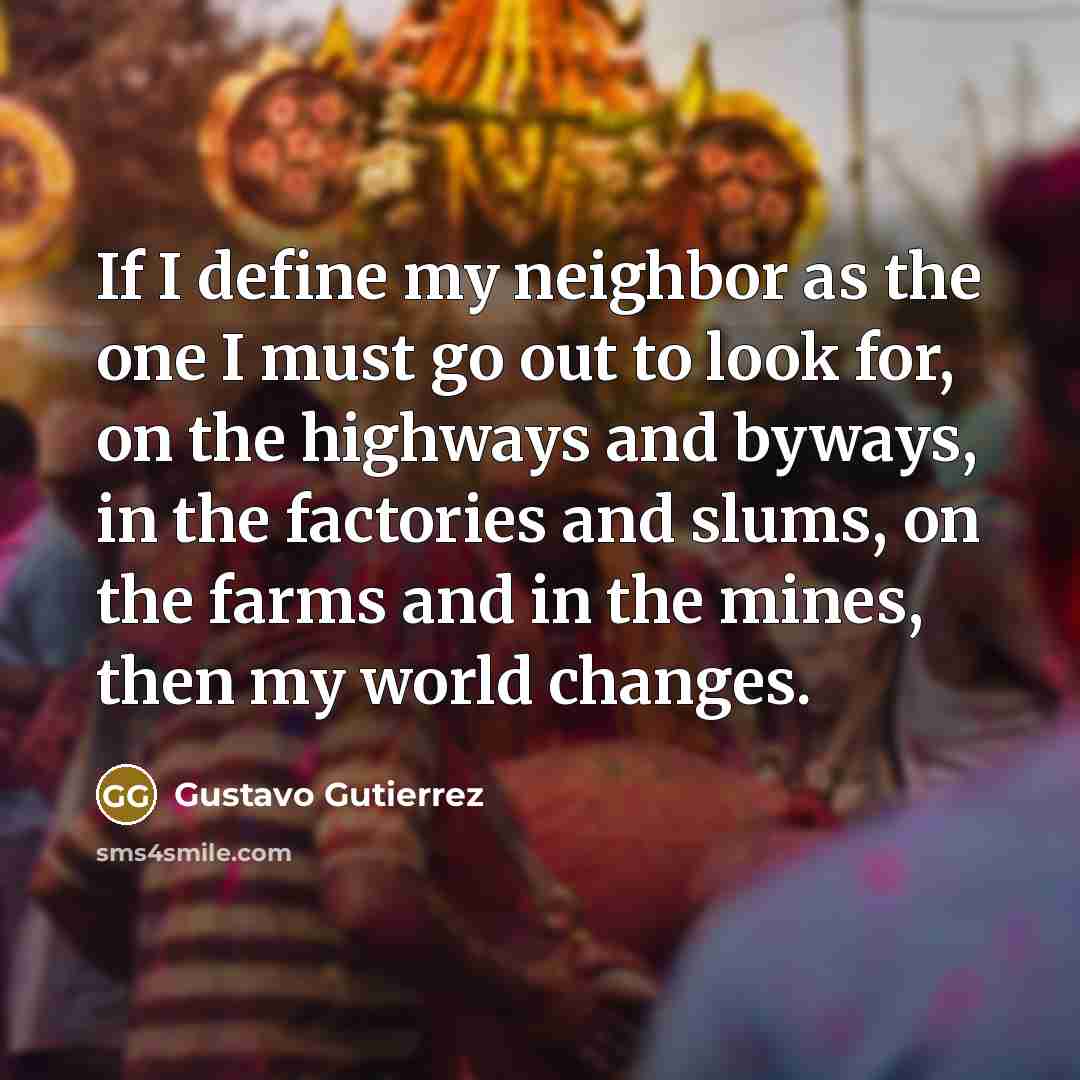
If I define my neighbor as the one I must go out to look for, on the highways and byways, in the factories and… — Gustavo Gutiérrez Copy Share Image
“An essential clue to the understanding of poverty in liberation theology is the distinction, made in the Medellín document "Poverty of the Church," between three meanings of the term "poverty": real poverty as an evil—that is something that God does not want; spiritual poverty, in the sense of a readiness to do God's will; and solidarity with the poor, along… — Gustavo Gutiérrez Copy Share
If there is no friendship with them [the poor] and no sharing of the life of the poor, then there is no authentic commitment… — Gustavo Gutiérrez Copy Share Image
[Neighbor is] not he whom I find in my path, but rather he in whose path I place myself, he whom I approach and… — Gustavo Gutiérrez Copy Share Image
We take it for granted that Jesus was not interested in political life: his mission was purely religious. Indeed we have witnessed . . . the 'iconization' of the life of Jesus: 'This is a Jesus of hieratic, stereotyped gestures, all representing theological themes. In this way, the life of Jesus is no longer a human life, submerged in history,… — Gustavo Gutiérrez Copy Share
Theology is reflection, a critical attitude. The commitment of love, of service, comes first. Theology follows; it is the second step. — Gustavo Gutiérrez Copy Share Image


![“If there is no friendship with them [the poor] and no sharing of the life of the poor, then there is no authentic commitment to liberation, because love exists only among equals.” quote by Gustavo Gutiérrez](https://sms4smile.com/quotes/img-quotes/a37/gustavo-gutierrez-16501_commitment_if-there-is-no-friendship-with-them-the_523070.jpg)
![“[Neighbor is] not he whom I find in my path, but rather he in whose path I place myself, he whom I approach and actively seek.” quote by Gustavo Gutiérrez](https://sms4smile.com/quotes/img-quotes/dbf/gustavo-gutierrez-16501_approach_neighbor-is-not-he-whom-i-find-in-my-pat_643201.jpg)