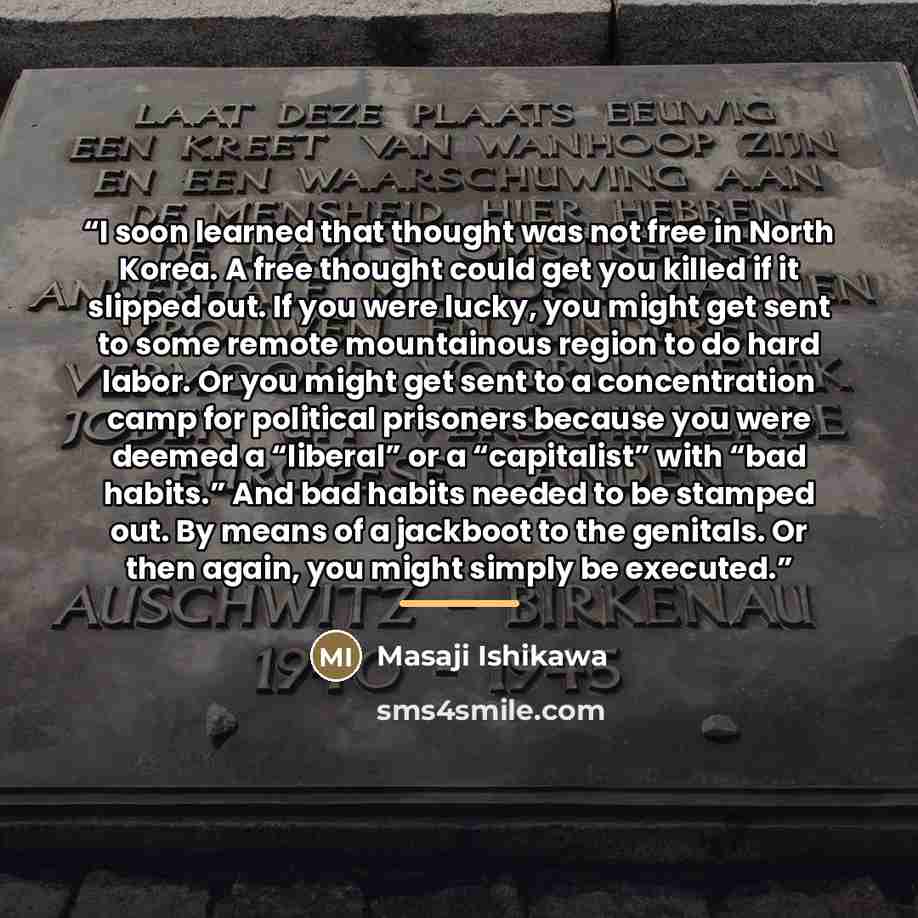
“I soon learned that thought was not free in North Korea. A free thought could get you killed if it slipped out.” — Masaji Ishikawa Copy Share Image
“Ever since moving to North Korea, I’d never felt truly alive; part of me had been walled off, silenced.” — Masaji Ishikawa Copy Share Image
“In the West, I guess you’d call it corruption. In North Korea, it was just standard operating procedure.” — Masaji Ishikawa Copy Share Image
“Oddly enough, I never heard him complain about or blame the political system of North Korea. I finally realized that he’d never… — Masaji Ishikawa Copy Share Image
“I was amazed we’d got through the checkpoint so easily. I couldn’t help asking about it. “Well, these soldiers, you see .… — Masaji Ishikawa Copy Share Image
“Ever since setting foot in North Korea more than thirty years before, I’d known nothing but hunger. Everyone had been halfway to… — Masaji Ishikawa Copy Share Image
“But the trouble is that some people really do end up brainwashed. They come to believe all the bullshit. But, thankfully, there… — Masaji Ishikawa Copy Share Image
“The Yalu River separates China and North Korea. A lot of people cross over it, and even more try to. Bizarrely, some… — Masaji Ishikawa Copy Share Image
“According to the Japanese government, people like me who’d moved to North Korea but not changed their nationality were still Japanese citizens.… — Masaji Ishikawa Copy Share Image
“This is the year of agriculture,” he announced in 1992. “The nation must realize the people’s century-long dream to eat white rice… — Masaji Ishikawa Copy Share Image
“I soon learned that thought was not free in North Korea. A free thought could get you killed if it slipped out.… — Masaji Ishikawa Copy Share Image
“Even now, I sometimes wonder why my father was so different in North Korea from the man he’d been in Japan. I… — Masaji Ishikawa Copy Share Image
“There was a sentence, buried somewhere in the paperwork, that stated, “Once you have settled in North Korea, you will not be… — Masaji Ishikawa Copy Share Image
“A dog. What was it doing, leaping about like that, racing around this strange guy’s feet? Wagging its tail. Barking. The man… — Masaji Ishikawa Copy Share Image
“The village farms were administered by local “instruction committees.” These committees were in charge of everything—machinery, irrigation, materials. Farmers had no choice… — Masaji Ishikawa Copy Share Image
“Did the International Committee of the Red Cross know anything about this? Did the United States? The UN? Yes, yes, and yes.… — Masaji Ishikawa Copy Share Image
“We placed her in her coffin the following afternoon. I tried to hammer the lid down, but the stupid nails were inferior… — Masaji Ishikawa Copy Share Image
“of me if I’d stayed in North Korea. I would probably have starved too. But at least I’d have died in someone’s… — Masaji Ishikawa Copy Share Image
“I looked around and wanted to weep at what I saw. The telephone on the table. A radio. Some fruit in a… — Masaji Ishikawa Copy Share Image
“My father, however, seemed quite content with our new life. He never hit my mother. He started working as an agricultural laborer… — Masaji Ishikawa Copy Share Image
“April 15, 1964, was Kim Il-sung’s birthday, therefore one of the year’s biggest holidays. That particular year, it was a total catastrophe… — Masaji Ishikawa Copy Share Image
“Oddly enough, I never heard him complain about or blame the political system of North Korea. I finally realized that he’d never… — Masaji Ishikawa Copy Share Image
“People came to our house from far and wide. Party and military bigwigs, some guy known as the “combat commander,” the village headman, and… — Masaji Ishikawa Copy Share Image
“This was laughable, of course, but that’s always the way with totalitarian regimes. Language gets turned on its head. Serfdom is freedom. Repression is… — Masaji Ishikawa Copy Share Image
“I was amazed we’d got through the checkpoint so easily. I couldn’t help asking about it. “Well, these soldiers, you see . . .… — Masaji Ishikawa Copy Share Image
“My family was poor, but my childhood days in Mizonokuchi were the happiest of my life. Even now, when I think about my hometown,… — Masaji Ishikawa Copy Share Image
“People ridiculed me. “What on earth are you doing?” they asked. “Why are you working so hard?” They didn’t understand that driving that tractor… — Masaji Ishikawa Copy Share Image
“I mean, this was the second half of the twentieth century, for pity’s sake, and they still saw communism as the road to utopia.” — Masaji Ishikawa Copy Share Image
“But the reality hit home late that night. I had a wife. And now two children. And however hard I worked, I would always… — Masaji Ishikawa Copy Share Image
“So we became masters at faking it. Everyone did. To do anything else could have gotten us killed.” — Masaji Ishikawa Copy Share Image
“I still hope to rescue my remaining children. It is a terrible curse to not even know if they are still alive. But I… — Masaji Ishikawa Copy Share Image
“But that’s the trouble with propaganda. It constantly contradicts itself.” — Masaji Ishikawa Copy Share Image
“The consul was at a loss for words the first time he set eyes on me. “My God! How could they treat you like… — Masaji Ishikawa Copy Share Image
“We were nothing but a bunch of ravenous ghosts. The barely living dead.” — Masaji Ishikawa Copy Share Image