The mandala describes balance. This is so whatever the pictorial form. — Stephen Gardiner Copy Share Image
“I'll tell you a story, far, far from here where blades of grass are fluent in sentient knowledge and trees are a… — Carolyn Riker Copy Share Image
“[T]he Enneagram is, at its most abstract, a universal mandala of the self—a symbol of each of us.” — Don Richard Riso Copy Share Image
The mandalas were meant to be objects of contemplation, aids to meditation, their proportions magically balanced to purify and calm the mind.… — Douglas Preston Copy Share Image
In the products of the unconscious we discover mandala symbols, that is, circular and quaternity figures which express wholeness, and whenever we… — Carl Jung Copy Share Image
My mandalas were cryptograms concerning the state of the self which was presented to me anew each day...I guarded them like precious… — Carl Jung Copy Share Image
In Buddhist practice a great deal of time is spent practicing mandala meditation. You learn to visualize and hold simultaneous concepts in… — Frederick Lenz Copy Share Image
The mandala is an archetypal image whose occurrence is attested throughout the ages. It signifies the wholeness of the self. This circular… — Carl Jung Copy Share Image
Each person's life is like a mandala - a vast, limitless circle. We stand in the center of our own circle, and… — Pema Chodron Copy Share Image
I saw that everything, all paths I had been following, all steps I had taken, were leading back to a single point… — Carl Jung Copy Share Image
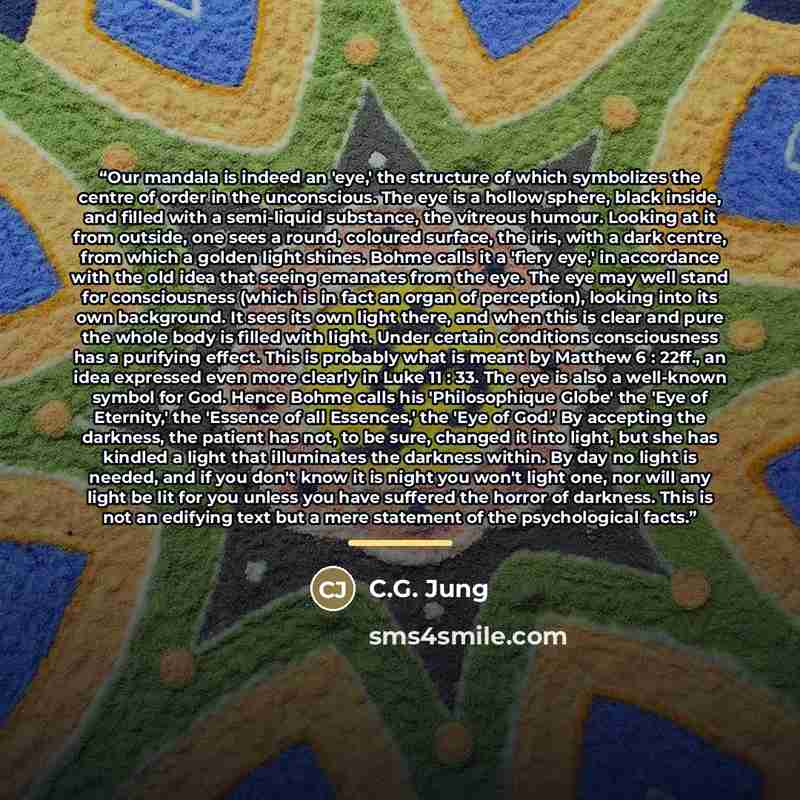
“Our mandala is indeed an 'eye,' the structure of which symbolizes the centre of order in the unconscious. The eye is a… — C.G. Jung Copy Share Image