“A sixteenth-century poet, especially one who knew that he ought to be a curious and universal scholar, would possess some notions, perhaps… — Frank Kermode Copy Share Image
“A turning point in the criticism of Hardy’s poetry came in his centenary year, in which W. H. Auden (1940) recorded his… — Geoffrey Harvey Copy Share Image
Literary criticism can be no more than a reasoned account of the feeling produced upon the critic by the book he is… — DH Lawrence Copy Share Image
“As Solomon himself had remarked, 'We can be sure of talent, we can only pray for genius.' But it was a reasonable… — Arthur C. Clarke Copy Share Image
“For more than half a century I have tried to confront greatness directly, hardly a fashionable stance, but I see no other… — Harold Bloom Copy Share Image
“I often have the feeling that even at the best of times literary criticism is fraudulent, since in the absence of any… — George Orwell Copy Share Image
“John Milton has, since his own lifetime, always been one of the major figures in English literature, but his reputation has changed… — Ronald Carter Copy Share Image
“The 1950s and 1960s: philosophy, psychology, myth There was considerable critical interest in Woolf ’s life and work in this period, fuelled… — Jane Goldman Copy Share Image
“In my freshman and sophomore years of college, I read dozens of books by the great thinkers of Western civilization. From Plato… — Stefanie Weisman Copy Share Image
“Literary criticism, as I attempt to practice it, is in the first place 'literary', which is to say personal and passionate. It… — Harold Bloom Copy Share Image
“The novel, then, provides a reduction of the world different from that of the treatise. It has to lie. Words, thoughts, patterns… — Frank Kermode Copy Share Image
“Novels, says Sartre, are not life, but they owe our power upon us, as upon himself as an infant, to the fact… — Frank Kermode Copy Share Image
“Life, of course, never gets anyone's entire attention. Death always remains interesting, pulls us, draws us. As sleep is necessary to our… — Janet Malcolm Copy Share Image
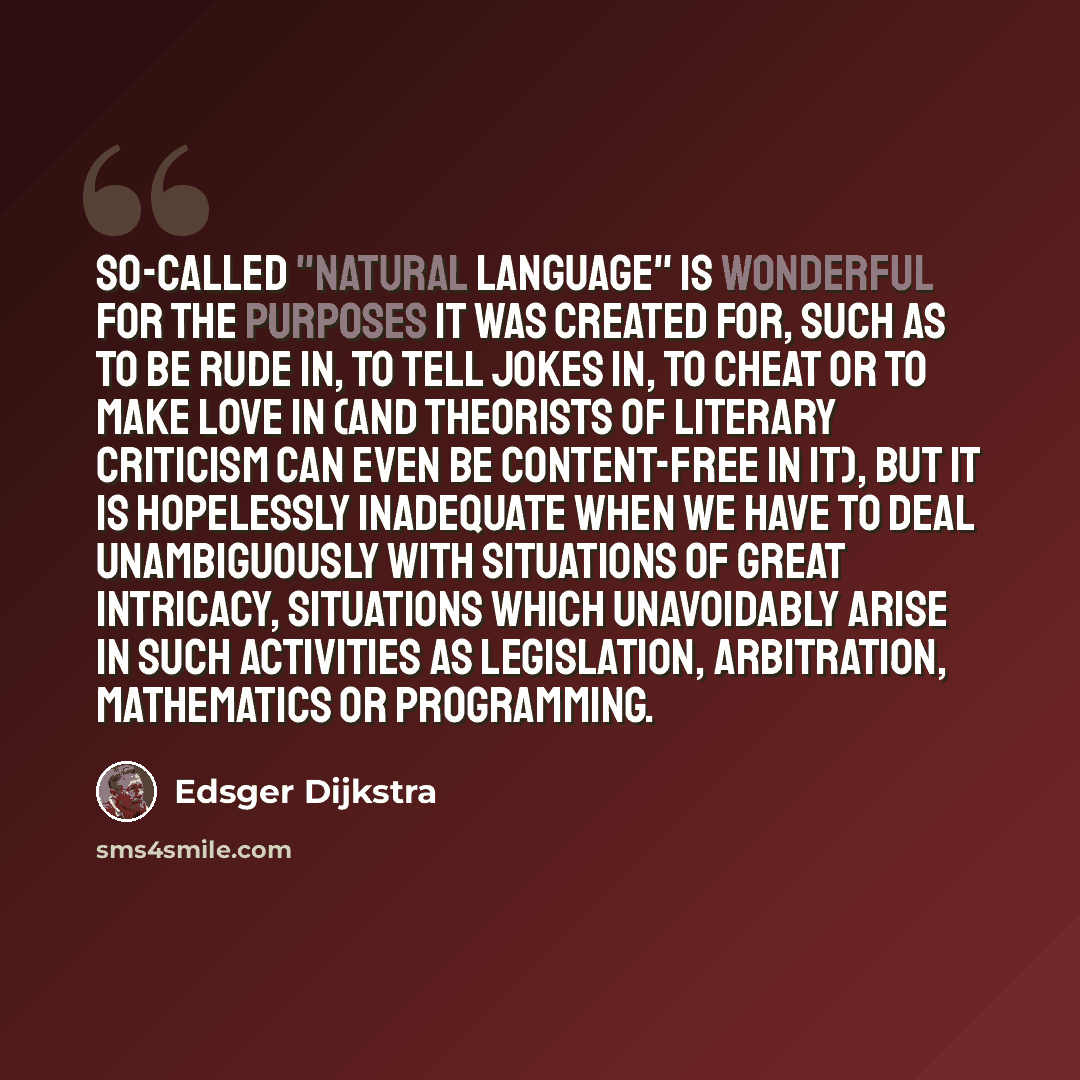
So-called "natural language" is wonderful for the purposes it was created for, such as to be rude in, to tell jokes in,… — Edsger Dijkstra Copy Share Image
“Henry Fielding, a highly successful satiric dramatist until the introduction of censorship in 1737, began his novel-writing career with Shamela, a pastiche… — Ronald Carter Copy Share Image