A city is composed of different kinds of men; similar people cannot bring a city into existence. — Aristotle Copy Share Image
It is best to rise from life as from a banquet, neither thirsty nor drunken. — Aristotle Copy Share Image
In poverty and other misfortunes of life, true friends are a sure refuge. — Aristotle Copy Share Image
It is possible to fail in many ways...while to succeed is possible only in one way. — Aristotle Copy Share Image
Today you can start forming habits for overcoming all obstacles in life... even nicotine cravings — Aristotle Copy Share Image
The Life of the intellect is the best and pleasantest for man, because the intellect more than anything else is the man.… — Aristotle Copy Share Image
Man is a goal-seeking animal. His life only has meaning if he is reaching out and striving for his goals. — Aristotle Copy Share Image
Life is full of chances and changes, and the most prosperous of men may...meet with great misfortunes. — Aristotle Copy Share Image
If you see a man approaching with the obvious intent of doing you good, run for your life. Consider pleasures as they… — Aristotle Copy Share Image
We are what we repeatedly do... excellence, therefore, isn't just an act, but a habit and life isn't just a series of… — Aristotle Copy Share Image
Teachers, who educate children, deserve more honour than parents, who merely gave them birth; for the latter provided mere life, while the… — Aristotle Copy Share Image
Teachers who educate children deserve more honor than parents who merely gave birth; for bare life is furnished by the one, the… — Aristotle Copy Share Image
The vigorous are no better than the lazy during one half of life, for all men are alike when asleep. — Aristotle Copy Share Image
Our account does not rob mathematicians of their science, by disproving the actual existence of the infinite in the direction of increase,… — Aristotle Copy Share Image
When several villages are united in a single complete community, large enough to be nearly or quite self-sufficing, the state comes into… — Aristotle Copy Share Image
The wise man does not expose himself needlessly to danger, since there are few things for which he cares sufficiently; but he… — Aristotle Copy Share Image
“These are the three things—volume of sound, modulation of pitch, and rhythm—that a speaker bears in mind. It is those who do… — Aristotle Copy Share Image
The life of theoretical philosophy is the best and happiest a man can lead. Few men are capable of it and then… — Aristotle Copy Share Image
“It was at this point that the transition was first made to the conception that rhetoric was a teachable skill, that it… — Aristotle Copy Share Image
The business of every art is to bring something into existence, and the practice of an art involves the study of how… — Aristotle Copy Share Image
...the life which is best for men, both separately, as individuals, and in the mass, as states, is the life which has… — Aristotle Copy Share Image
At first he who invented any art that went beyond the common perceptions of man was naturally admired by men, not only… — Aristotle Copy Share Image
You'll understand what life is if you think about the act of dying. When I die, how will I be different from… — Aristotle Copy Share Image
Tools may be animate as well as inanimate; for instance, a ship's captain uses a lifeless rudder, but a living man for… — Aristotle Copy Share Image
The ideal man bears the accidents of life with dignity and grace, making the best of circumstances. — Aristotle Copy Share Image
Comedy aims at representing men as worse, Tragedy as better than in actual life. — Aristotle Copy Share Image
The mass of mankind are evidently slavish in their tastes, preferring a life suitable to beasts — Aristotle Copy Share Image
The educated differ from the uneducated as much as the living from the dead. — Aristotle Copy Share Image
The truly good and wise man will bear all kinds of fortune in a seemly way, and will always act in the… — Aristotle Copy Share Image
Women should marry when they are about eighteen years of age, and men at seven and thirty; then they are in the… — Aristotle Copy Share Image
A state is an association of similar persons whose aim is the best life possible. What is best is happiness, and to… — Aristotle Copy Share Image
The happy life is thought to be one of excellence; now an excellent life requires exertion, and does not consist in amusement. — Aristotle Copy Share Image
The society that loses its grip on the past is in danger, for it produces men who know nothing but the present,… — Aristotle Copy Share Image
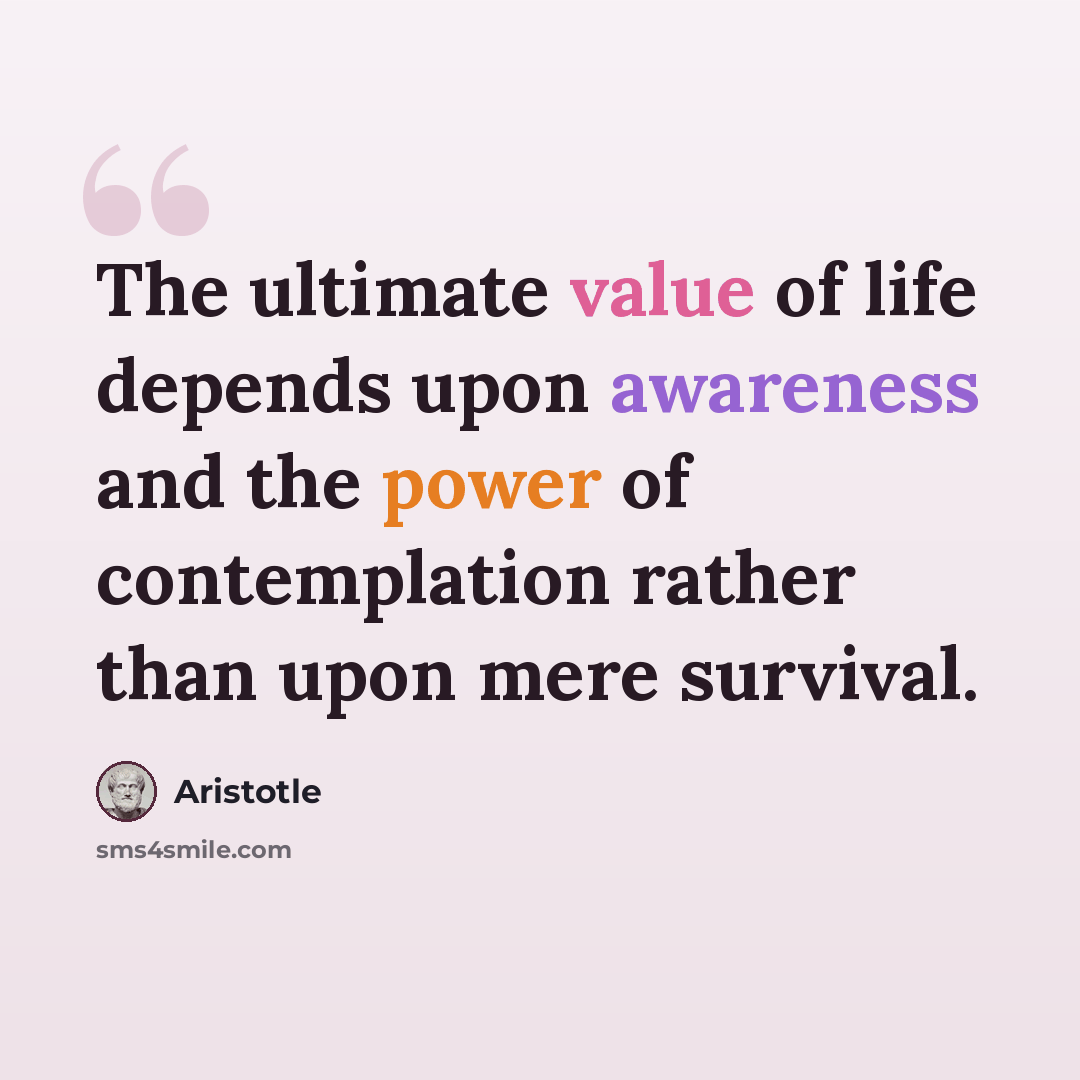
The ultimate value of life depends upon awareness and the power of contemplation rather than upon mere survival. — Aristotle Copy Share Image
The knowledge of the soul admittedly contributes greatly to the advance of truth in general, and, above all, to our understanding of Nature, for… — Aristotle Copy Share
Young men have strong passions and tend to gratify them indiscriminately. Of the bodily desires, it is the sexual by which they are most… — Aristotle Copy Share
The body is at its best between the ages of thirty and thirty-five; the mind is at its best about the age of forty-nine. — Aristotle Copy Share
The ensouled is distinguished from the unsouled by its being alive. Now since being alive is spoken of in many ways, even if only… — Aristotle Copy Share
Although it may be difficult in theory to know what is just and equal, the practical difficulty of inducing those to forbear who can,… — Aristotle Copy Share
The true forms of government, therefore, are those in which the one, or the few, or the many, govern with a view to the… — Aristotle Copy Share
All persons ought to endeavor to follow what is right, and not what is established. — Aristotle Copy Share
Give a man a fish, you feed him for a day. Give a man a poisoned fish, you feed him for the rest of… — Aristotle Copy Share
Obstinate people can be divided into the opinionated, the ignorant, and the boorish. — Aristotle Copy Share
Happiness does not consist in pastimes and amusements but in virtuous activities. — Aristotle Copy Share
To learn is a natural pleasure, not confined to philosophers, but common to all men. — Aristotle Copy Share