“Land ownership is an entry monopoly: Land is naturally scarce for each location since its supply can't be increased... When people buy a piece of land, their ownership gives them the right to exclude the rest of society from the… — Martin Adams Copy Share Image
“As long as people and institutions are allowed to profit from land at the expense of other people, we're enabling a system that incentivizes the destruction of our own habitat. This happens in three ways: First, since human beings are… — Martin Adams Copy Share Image
“In theory, capitalism is an economic system that allows people to freely trade goods and services in a competitive free market. But since the outright ownership of land creates an entry monopoly, it restricts the operation of the free market... Consequently, our current implementation of capitalism is deeply responsible for the exploitation of nature and the decline of social well-being.” — Martin Adams Copy Share
“What causes recessions? Many economists talk about the need for a consumer economy, but we can't have a consumer economy if people can't afford to consume, and the only way they can afford to consume over the long run is if they create new wealth to either consume at that time or to defer as investments for later consumption. Simply… — Martin Adams Copy Share
“The ability of individuals to extract wealth from society by profiting from land also leads to cultural degeneration and a loss of social cohesion over time... In general, as the value of land increases, the return on capital tends to decrease comparatively, which discourages business owners from investing in capital goods and private enterprise... Resources flow away from endeavours that… — Martin Adams Copy Share
“Progressive taxes are inherently flawed in that they fund public services which are often location-dependent, thus adding to the value of owned land. Thus,… — Martin Adams Copy Share Image
“Our inability to share the gifts of nature causes much suffering in the world today... We mistakenly believe that a free market should allow people and corporations to profit from nature, yet we've failed to consider the immense cost to life that occurs whenever people are allowed to reap what they haven't sown at the expense of others. While the… — Martin Adams Copy Share
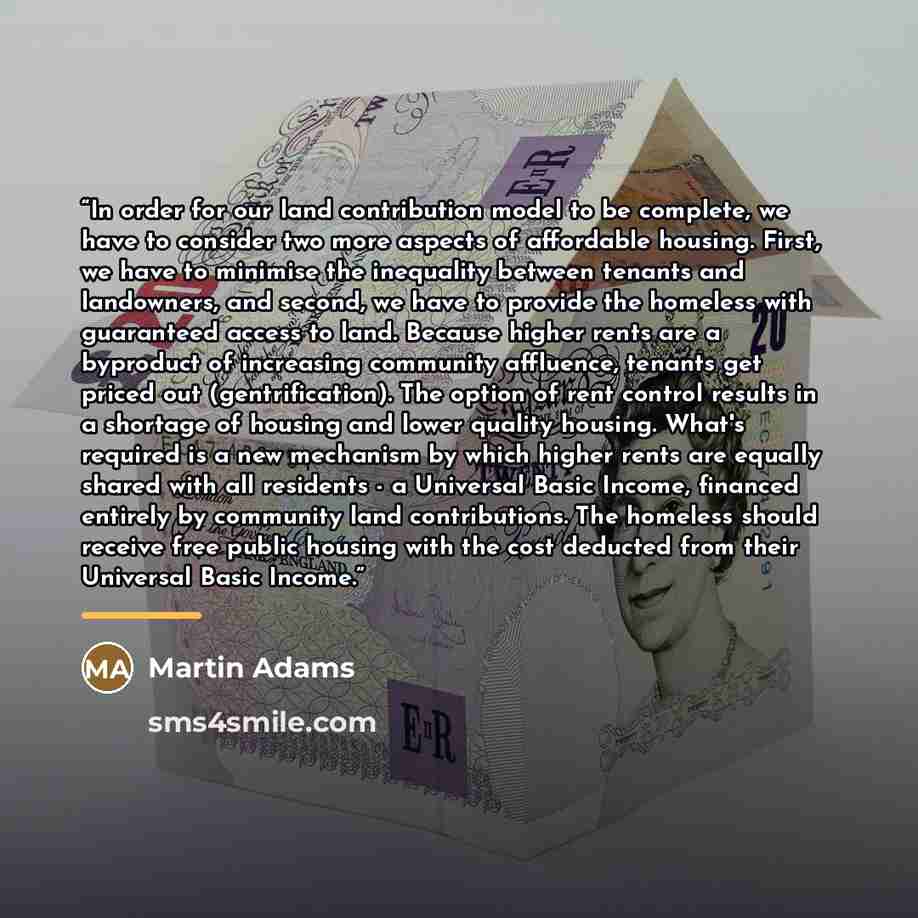
“In order for our land contribution model to be complete, we have to consider two more aspects of affordable housing. First, we have to… — Martin Adams Copy Share Image
“Due to its inherently limited supply for each location, land obtains its value from the natural, social, and cultural wealth that exists in its… — Martin Adams Copy Share Image
“Markets are free when human beings have equal opportunities to influence the production and trade of desirable goods and services... Some people attain market… — Martin Adams Copy Share Image
“The Law of Rent demonstrates that no single human being gives land and location its overall value - its rent. Land values arise from… — Martin Adams Copy Share Image
“It's important to distinguish the value of raw land from the value of improvements made to land. Land values are socially generated and belong… — Martin Adams Copy Share Image
“Economists Mason Gaffney and Fred Harrison claim in their work The Corruption of Economics that industrialists toward the end of the 19th century may… — Martin Adams Copy Share Image
“Tax systems are essentially the mechanisms by which societies decide what people have to share with each other versus what they can keep for… — Martin Adams Copy Share Image