To ask at what time a man has first any ideas is to ask when he begins to perceive; having ideas and… — John Locke Copy Share Image
Words, in their primary or immediate signification, stand for nothing but the ideas in the mind of him who uses them. — John Locke Copy Share Image
These two, I say, viz. external material things, as the objects of SENSATION, and the operations of our own minds within, as… — John Locke Copy Share Image
If we trace the progress of our minds, and with attention observe how it repeats, adds together, and unites its simple ideas… — John Locke Copy Share Image
In short, herein seems to lie the difference between idiots and madmen, that madmen put wrong ideas together, and so make wrong… — John Locke Copy Share Image
Let us suppose the mind to be, as we say, white paper, void of all characters, without any ideas; how comes it… — John Locke Copy Share Image
Brutes abstract not. -- If it may be doubted, whether beasts compound and enlarge their ideas, that way, to any degree; this,… — John Locke Copy Share Image
Truth then seems to me, in the proper import of the word, to signify nothing but the joining or separating of Signs,… — John Locke Copy Share Image
The Ideas of primary Qualities of Bodies, are Resemblances of them, and their Patterns do really exist in the Bodies themselves; but… — John Locke Copy Share Image
In all things, therefore, where we have clear evidence from our ideas, and those principles of knowledge I have above mentioned, reason… — John Locke Copy Share Image
Memory is the power to revive again in our minds those ideas which after imprinting have disappeared, or have been laid aside… — John Locke Copy Share Image
Not time is the measure of movement but: ...each constant periodic appearance of ideas. — John Locke Copy Share Image
We should have a great fewer disputes in the world if words were taken for what they are, the signs of our… — John Locke Copy Share Image
The thoughts that come often unsought, and, as it were, drop into the mind, are commonly the most valuable of any we… — John Locke Copy Share Image
Reverie is when ideas float in our mind without reflection or regard of the understanding. — John Locke Copy Share Image
When ideas float in our mind, without any reflection or regard of the understanding, it is that which the French call reverie. — John Locke Copy Share Image
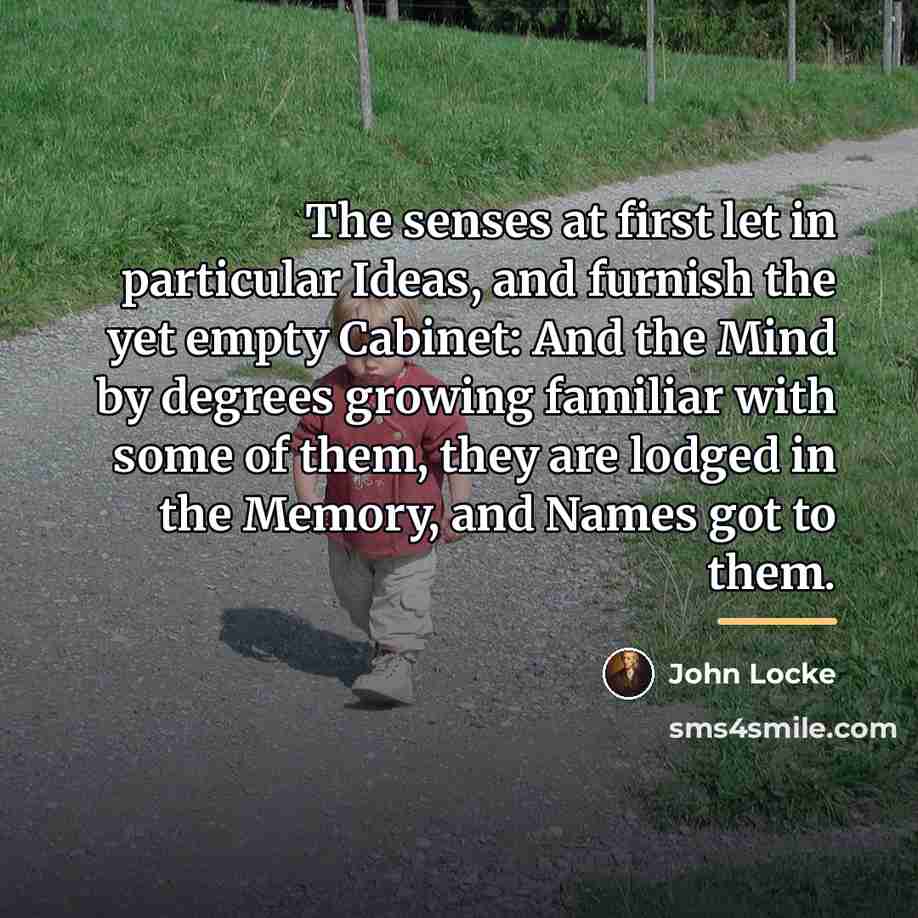
The senses at first let in particular Ideas, and furnish the yet empty Cabinet: And the Mind by degrees growing familiar with… — John Locke Copy Share Image
For those who either perceive but dully, or retain the ideas that come into their minds but ill, who cannot readily excite… — John Locke Copy Share Image
Every Man being conscious to himself, That he thinks, and that which his Mind is employ'd about whilst thinking, being the Ideas,… — John Locke Copy Share Image
The mind being, as I have declared, furnished with a great number of the simple ideas conveyed in by the senses, as… — John Locke Copy Share Image
The acts of the mind, wherein it exerts its power over simple ideas, are chiefly these three: 1. Combining several simple ideas… — John Locke Copy Share Image
I thought that I had no time for faith nor time to pray, then I saw an armless man saying his Rosary with his… — John Locke Copy Share Image
If we trace the progress of our minds, and with attention observe how it repeats, adds together, and unites its simple ideas received from… — John Locke Copy Share Image
Thus parents, by humouring and cockering them when little, corrupt the principles of nature in their children, and wonder afterwards to taste the bitter… — John Locke Copy Share Image
“[M]an is not permitted without censure to follow his own thoughts in the search of truth, when they lead him ever so little out… — John Locke Copy Share Image
When we know our own strength, we shall the better know what to undertake with hopes of success. — John Locke Copy Share Image
Every man has a property in his own person. This nobody has a right to, but himself. — John Locke Copy Share Image
“Earthly minds, like mud-walls, resist the strongest batteries: And though perhaps sometimes the force of a clear argument may make some impression, yet they… — John Locke Copy Share Image
“To avoid this state of war (wherein there is no appeal but to heaven, and wherein every the least difference is apt to end,… — John Locke Copy Share Image
If by gaining knowledge we destroy our health, we labour for a thing that will be useless in our hands. — John Locke Copy Share Image
“don’t let the things you don’t have prevent you from using the things you do have.” — John Locke Copy Share Image
![“[M]an is not permitted without censure to follow his own thoughts in the search of truth, when they lead him ever so little out of the common road.” quote by John Locke](https://sms4smile.com/quotes/img-quotes/9bd/john-locke-814_censorship_m-an-is-not-permitted-without-censure-to_60175.jpg)