“In the same year, William Henly, a Fellow of the Royal Society, wrote to the Humane Society with a suggestion that electricity be used to shock the heart and brain in ‘cases of Apparent Death from Drowning’. After all, he… — Lucy Inglis Copy Share Image
“Open ground was very important to the cloth industry: when large bolts of fabric were treated, they needed to be dried on the ‘tenter… — Lucy Inglis Copy Share Image
“By the early Victorian period, there were eighteen receiving houses in London, and the Illustrated London News estimated some 200,000 people were bathing in… — Lucy Inglis Copy Share Image
“In the same year, William Henly, a Fellow of the Royal Society, wrote to the Humane Society with a suggestion that electricity be used… — Lucy Inglis Copy Share Image
“The Royal Humane Society had taught resuscitation techniques to many Londoners, and the Society’s receiving houses formed the earliest model for what became Accident… — Lucy Inglis Copy Share Image
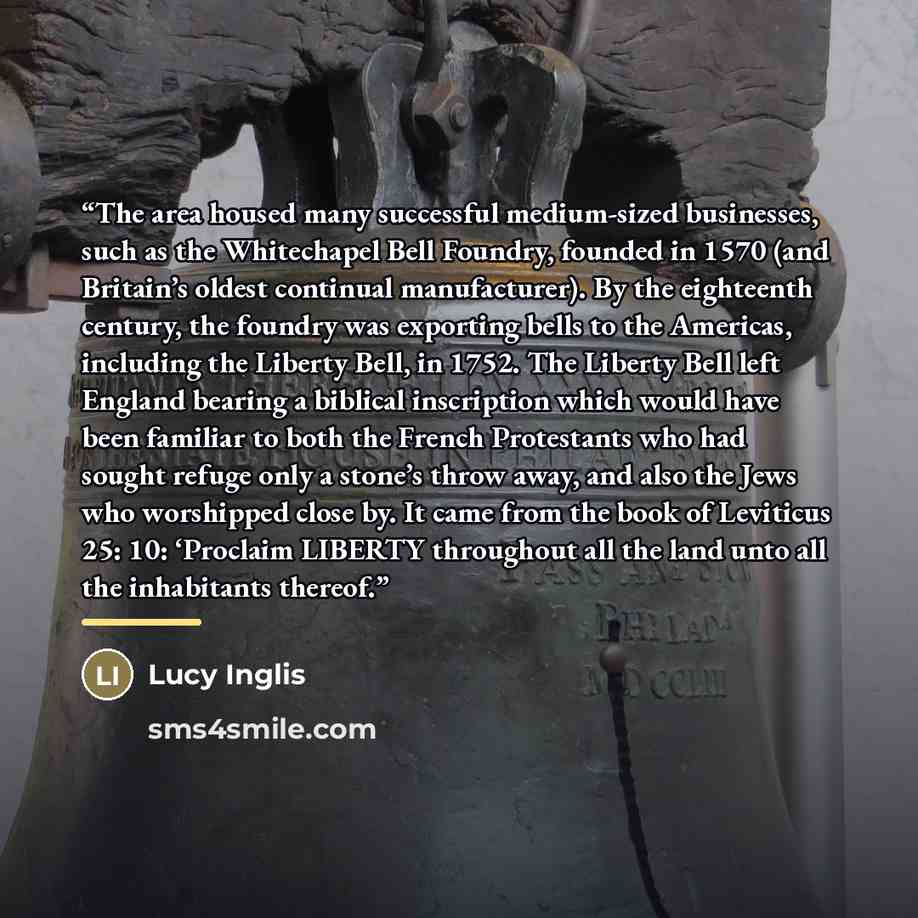
“The area housed many successful medium-sized businesses, such as the Whitechapel Bell Foundry, founded in 1570 (and Britain’s oldest continual manufacturer). By the eighteenth… — Lucy Inglis Copy Share Image
“By 1722, traffic on the bridge was so great that the wagons and carts were fined if they didn’t have their pennies ready to… — Lucy Inglis Copy Share Image
“Mansfield ruled that habeas corpus applied to anyone in England, even if they originated elsewhere. He was aware of the significance of his ruling,… — Lucy Inglis Copy Share Image