You can't judge a family's health by the form it's in at a given moment. — Stephanie Coontz Copy Share Image
The growing diversity of family life comes with new possibilities as well as new challenges. — Stephanie Coontz Copy Share Image
Rising inequality has changed family dynamics for all socioeconomic groups. — Stephanie Coontz Copy Share Image
In 1992, I critiqued the panic over growing family diversity. My skepticism about the doomsayers has since been proven correct. — Stephanie Coontz Copy Share Image
No single choice about how to organize work and family life is right or possible - for every family. And every choice… — Stephanie Coontz Copy Share Image
Nostalgia wouldn't begin to capture your sense of loss, ... The Way We Really Are Coming to Terms With America's Changing Families. — Stephanie Coontz Copy Share Image
Putting women's traditional needs at the center of social planning is not reverse sexism. It's the best way to reverse the increasing… — Stephanie Coontz Copy Share Image
Couples need time alone to renew their relationship. They also need to sustain supportive networks of friends and family. — Stephanie Coontz Copy Share Image
Turning back the inequality revolution may be difficult. But that would certainly help more families - at almost all income levels -… — Stephanie Coontz Copy Share Image
Putting women first would mean strengthening America's social safety net, because a higher proportion of single-mother families live in poverty here than… — Stephanie Coontz Copy Share Image
Liberal politicians, in celebrating the benefits of modernization, free trade, diverse families, and the rise of more women and minorities into political… — Stephanie Coontz Copy Share Image
When I speak on work-family issues to audiences around the country, some of the biggest complaints I hear come from individuals who… — Stephanie Coontz Copy Share Image
We need to push for work-family practices and policies that allow individuals to customize their work lives according to their changing individual… — Stephanie Coontz Copy Share Image
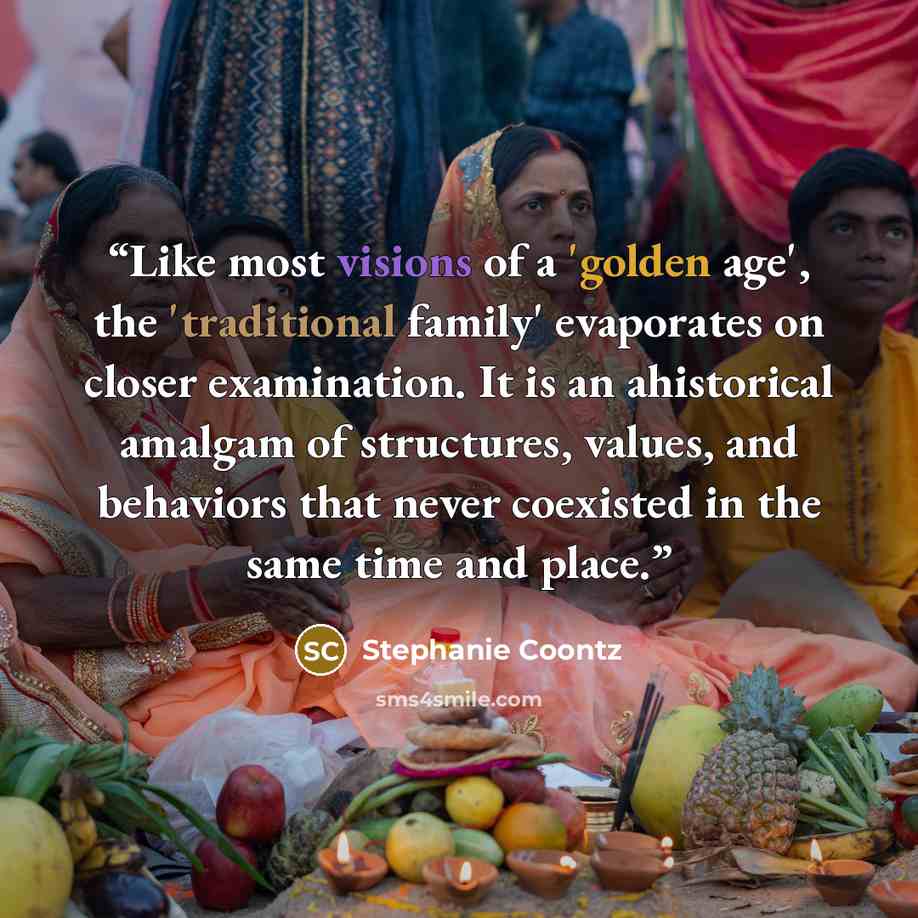
“Like most visions of a 'golden age', the 'traditional family' evaporates on closer examination. It is an ahistorical amalgam of structures, values,… — Stephanie Coontz Copy Share Image
A two-parent family based on love and commitment can be a wonderful thing, but historically speaking the "two-parent paradigm" has left an… — Stephanie Coontz Copy Share Image
In the 1970s, family history wasn't yet thought of a serious field for study. I was terrified of being laughed at by… — Stephanie Coontz Copy Share Image
Unemployment, low wages, and poverty discourage family formation and erode family stability, making it less likely that individuals will marry in the… — Stephanie Coontz Copy Share Image
Too often, tributes to the home-cooked meal assume every family has a schedule that gets everyone home by 5:30 P.M. And too… — Stephanie Coontz Copy Share Image
For every nineteenth-century middle-class family that protected its wife and child within the family circle, there was an Irish ora German girl… — Stephanie Coontz Copy Share Image
“Like it or not, today we are all pioneers, picking our way through uncharted and unstable territory. The old rules are no… — Stephanie Coontz Copy Share Image
“It wasn't until the 1920s that a bare majority of children grew up in families where the father's labor purchased the family's… — Stephanie Coontz Copy Share Image
We urgently need a debate about the best ways of supporting families in modern America, without blinders that prevent us from seeing… — Stephanie Coontz Copy Share Image
Extended families have never been the norm in America; the highest figure for extended-family households ever recorded in Americanhistory is 20 percent.… — Stephanie Coontz Copy Share Image
Families have always been in flux and often in crisis; they have never lived up to nostalgic notions about "the way things… — Stephanie Coontz Copy Share Image
It is ironic that so many politicians claim to defend traditional Christian values of 'faith and family.' In fact, a radical antifamily… — Stephanie Coontz Copy Share Image
In 1975, which was the height of the women's movement, I thought I'd write a book on women's history. But in searching… — Stephanie Coontz Copy Share Image
... what's been building since the 1980's is a new kind of social Darwinism that blames poverty and crime and the crisis… — Stephanie Coontz Copy Share Image
In personal life, the warm glow of nostalgia amplifies good memories and minimizes bad ones about experiences and relationships, encouraging us to… — Stephanie Coontz Copy Share Image
Feminism insists on women's right to make choices - about whether to marry, whether to have children, whether to combine work and… — Stephanie Coontz Copy Share Image
As an overly confident college freshman, the first time I received a below-average score on an exam was a needed wake-up call. — Stephanie Coontz Copy Share Image
For every nineteenth-century middle-class family that protected its wife and child within the family circle, there was an Irish ora German girl scrubbing floors… — Stephanie Coontz Copy Share Image
A primary motivation for introducing no-fault divorce was, in fact, to reduce perjury in the legal system. — Stephanie Coontz Copy Share Image
Graduating from high school is certainly a good idea, but it's no longer much protection against poverty. — Stephanie Coontz Copy Share Image
Almost all scholarly research carries practical and political implications. Better that we should spell these out ourselves than leave that task to people with… — Stephanie Coontz Copy Share Image
Investing in living-wage jobs and reducing the inequities between local school districts would give young people more, not less, incentive to postpone childbearing and… — Stephanie Coontz Copy Share Image
Hyper-parenting has many pitfalls. Overprotected and overpraised children may develop an inflated sense of entitlement. — Stephanie Coontz Copy Share Image
Social and economic policies constructed around the male breadwinner model have always disadvantaged women. — Stephanie Coontz Copy Share Image
When I speak on work-family issues to audiences around the country, some of the biggest complaints I hear come from individuals who are described… — Stephanie Coontz Copy Share Image
Extended families have never been the norm in America; the highest figure for extended-family households ever recorded in Americanhistory is 20 percent. Contrary to… — Stephanie Coontz Copy Share Image
Unilateral divorce has decreased the bargaining power of the person who wants the marriage to last and has not engaged in behavior that meets… — Stephanie Coontz Copy Share Image
The closer we get to achieving equality of opportunity between the sexes, the more clearly we can see that the next major obstacle to… — Stephanie Coontz Copy Share Image