We mostly don't get sick. Most often, bacteria are keeping us well. — Bonnie Bassler Copy Share Image
Biocides, for example, are designed to kill bacteria—it's not a benign material. — William Stringfellow Copy Share Image
Periodontal bacteria can easily slip into the bloodstream and cause infection elsewhere in the body. — Mallory Ortberg Copy Share Image
If you go far enough back, your genome connects you with bacteria, butterflies, and barracuda - the great chain of being linked… — Spencer Wells Copy Share Image
Am I simply a vehicle for numerous bacteria that inhabit my microbiome? Or are they hosting me? — Timothy Morton Copy Share Image
By weight, you are more human than bacteria, because your cells are bigger, but by numbers, it's not even close. — Bonnie Bassler Copy Share Image
“Conquering the Galaxy is what bacteria with spaceships would do – knowing no better, having no choice.” — Greg Egan Copy Share Image
Accidents at power plants are bad enough. But a leak from a bioreactor could be worse, since bacteria can learn new tricks… — Nancy Gibbs Copy Share Image
Every time someone uses a bathroom and they flush, all the bacteria is shot into the air. — Megan Fox Copy Share Image
It may be argued that to know one kind of beetle is to know them all. But a species is not like… — E. O. Wilson Copy Share Image
The aquifer [is] the water table people need to keep secure. Nature has this incredible system of water purification under the ground.… — Josh Fox Copy Share Image
“Biologists discovered the microbiome just over the past couple of decades. They are still puzzling out how the microbes in your body… — Bill Nye Copy Share Image
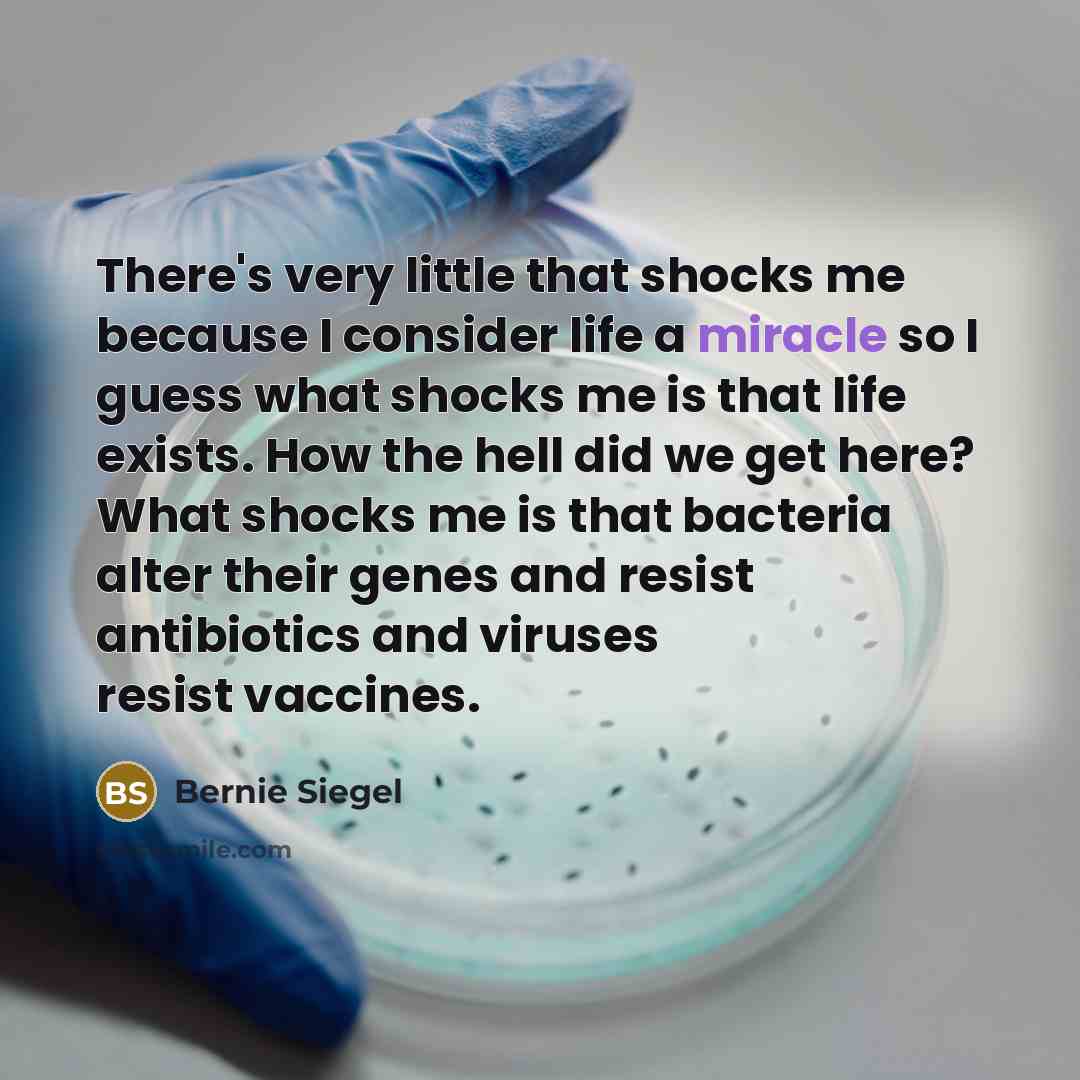
There's very little that shocks me because I consider life a miracle so I guess what shocks me is that life exists.… — Bernie Siegel Copy Share Image
“The citrus mealybug is a living matryoshka doll. It has bacteria living inside its cells, and those bacteria have more bacteria living… — Ed Yong Copy Share Image
Climate change and air pollution know no borders, and antibiotics resistance respects no boundaries. Bacteria from Africa can make people in America… — Rohini Nilekani Copy Share Image
Each of these [bacterial] species are masterpieces of evolution. Each has persisted for thousands to millions of years. Each is exquisitely adapted… — E. O. Wilson Copy Share Image
“So why, you are bound to ask at some point in your life, do microbes so often want to hurt us? What… — Bill Bryson Copy Share Image
We still think of human disease as the work of an organized, modernized kind of demonology, in which the bacteria are the… — Lewis Thomas Copy Share Image
“nine of every ten cells in our bodies belong not to us, but to these microbial species (most of them residents of… — Michael Pollan Copy Share Image
It has taken biologists some 230 years to identify and describe three quarters of a million insects; if there are indeed at… — Richard Leakey Copy Share Image
Without birds to feed on them, the insects would multiply catastrophically. ... The insects, not man or other proud species, are really… — H. Bentley Glass Copy Share Image
Nature is flexible and resilient. Nature likes redundancy and dispersion. It is approximate and deals in gradients. All boundaries are permeable. Nature… — Robert Frenay Copy Share Image
“Humans are actually reservoir hosts for countless bacteria and viruses that haven’t even been classified yet. About twenty percent of the genetic… — A.G. Riddle Copy Share Image
“The data might tell tales with preposterous plots, but they don't lie. They tell us that the citrus mealybug is a mash-up… — Ed Yong Copy Share Image
It's also hard for people to contend with the difficult possibility that we are simply overadvanced fungi and bacteria hurtling through a… — Douglas Rushkoff Copy Share Image
Most educated people are aware that we're the outcome of nearly 4 billion years of Darwinian selection, but many tend to think… — Martin Rees Copy Share Image
“For example, all three partners cooperate to make nutrients. To create the amino acid phenylalanine, they need nine enzymes. Tremblaya can build… — Ed Yong Copy Share Image
“Of course I'd long known that I was playing host to a massive collection of parasitic organisms, but I didn't much like… — John Green Copy Share Image
“When Hamiltonella's genome was sequenced, the real reason behind the bacterium's protective powers became apparent: about half of its DNA actually belonged… — Ed Yong Copy Share Image
“The Greek word for kernel is karys, so the word used to describe creatures without a nucleus is prokaryotic—the name, originally procariotique,… — William Rosen Copy Share Image
“Most animals can't tap into these open-source adaptations deliberately. The flies didn't seek out Spiroplasma to solve their worm problem. Woodrats didn't… — Ed Yong Copy Share Image
“We inherit every one of our genes, but we leave the womb without a single microbe. As we pass through our mother's… — Michael Specter Copy Share Image
“Dr. Richard Selzer is a surgeon and a favorite author of mine. He writes the most beautiful and compassionate descriptions of his… — James C. Dobson Copy Share Image
“Sixty years on, we know that HGT is one of the most profound aspects of bacterial life. It allows bacteria to evolve… — Ed Yong Copy Share Image