Atheism ... goes back to the Ancient Greek (a — a negative…
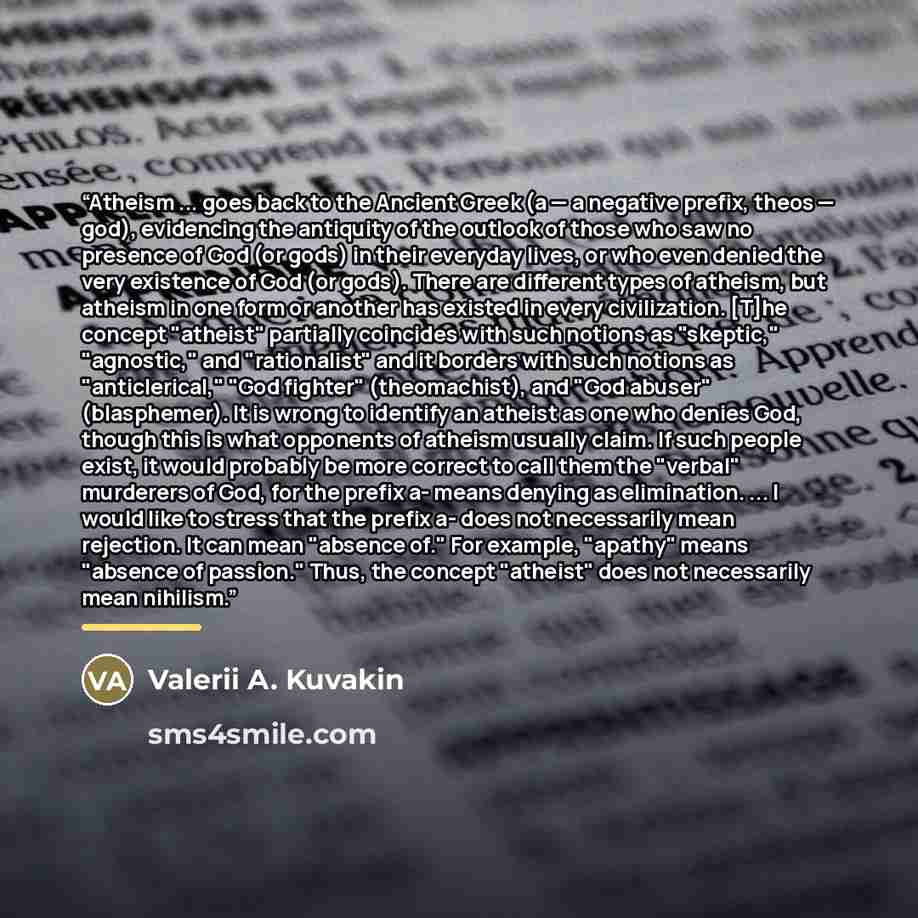
““Atheism ... goes back to the Ancient Greek (a — a negative prefix, theos — god), evidencing the antiquity of the outlook of those who saw no presence of God (or gods) in their everyday lives, or who even denied the very existence of God (or gods). There are different types of atheism, but atheism in one form or another has existed in every civilization. [T]he concept "atheist" partially coincides with such notions as "skeptic," "agnostic," and "rationalist" and it borders with such notions as "anticlerical," "God fighter" (theomachist), and "God abuser" (blasphemer). It is wrong to identify an atheist as one who denies God, though this is what opponents of atheism usually claim. If such people exist, it would probably be more correct to call them the "verbal" murderers of God, for the prefix a- means denying as elimination. ... I would like to stress that the prefix a- does not necessarily mean rejection. It can mean "absence of." For example, "apathy" means "absence of passion." Thus, the concept "atheist" does not necessarily mean nihilism.””
About This Quote
This interpretation was drafted with AI assistance. It is one reading of the quote, not the author's own explanation.
Atheism stems from ancient Greek roots; its meaning varies, not always implying nihilism.
In simple terms: Atheism's origins are Greek; meanings differ.
Key Takeaway
Explore nuanced definitions.
Themes
atheism
philosophy
history
language
belief
Mood
analytical
educational
Type
Ancient greek:1
Atheism:1
Atheist:1
Definition:1
Different types:0
Existence of god:0
Gods:0
Greece:0
Nihilism:0
Philosophy:1
Presence of god:0
Theos:0
Identify Atheist:0
Concept Atheist:0
Types Atheism:0
Atheist Denies:0
When to use this quote
- academic discourse
- personal belief formation
- interfaith dialogue
Key Concepts
etymology
cultural anthropology
religious studies
Questions to Reflect On
- How does language shape belief concepts?
- Can atheism coexist with moral frameworks?
A Different Perspective
Simplification may overlook cultural contexts.