Most people don’t “choose” fiery tempers or alcoholic…
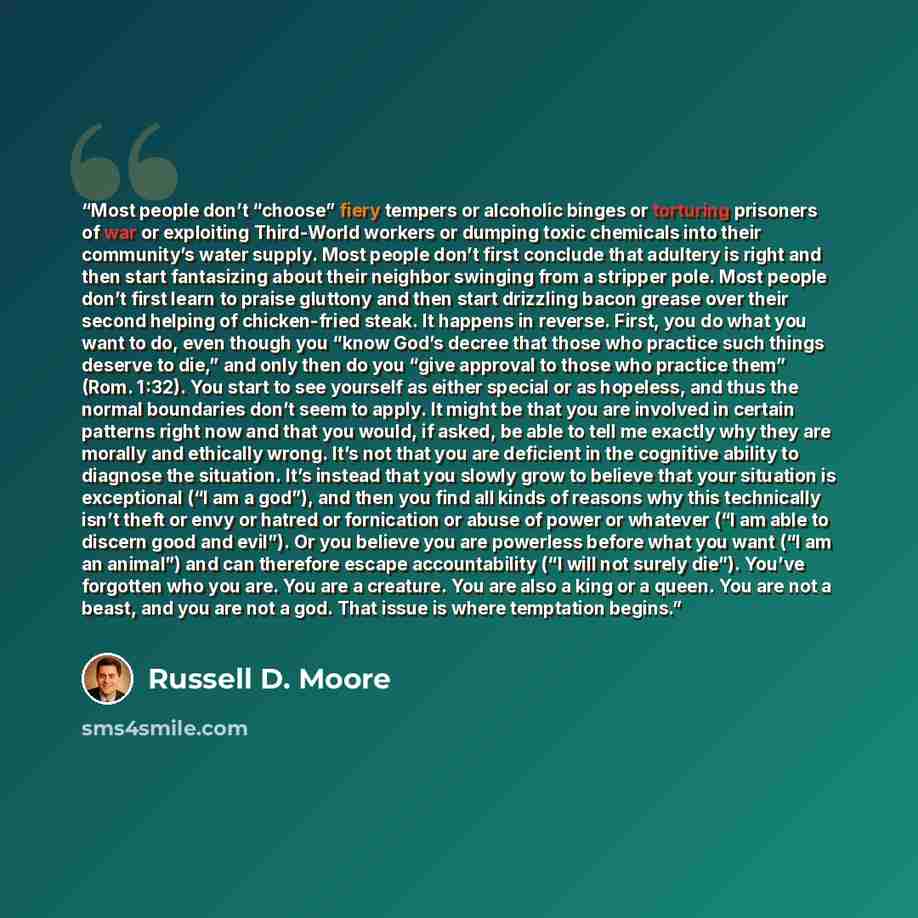
““Most people don’t “choose” fiery tempers or alcoholic binges or torturing prisoners of war or exploiting Third-World workers or dumping toxic chemicals into their community’s water supply. Most people don’t first conclude that adultery is right and then start fantasizing about their neighbor swinging from a stripper pole. Most people don’t first learn to praise gluttony and then start drizzling bacon grease over their second helping of chicken-fried steak. It happens in reverse. First, you do what you want to do, even though you “know God’s decree that those who practice such things deserve to die,” and only then do you “give approval to those who practice them” (Rom. 1:32). You start to see yourself as either special or as hopeless, and thus the normal boundaries don’t seem to apply. It might be that you are involved in certain patterns right now and that you would, if asked, be able to tell me exactly why they are morally and ethically wrong. It’s not that you are deficient in the cognitive ability to diagnose the situation. It’s instead that you slowly grow to believe that your situation is exceptional (“I am a god”), and then you find all kinds of reasons why this technically isn’t theft or envy or hatred or fornication or abuse of power or whatever (“I am able to discern good and evil”). Or you believe you are powerless before what you want (“I am an animal”) and can therefore escape accountability (“I will not surely die”). You’ve forgotten who you are. You are a creature. You are also a king or a queen. You are not a beast, and you are not a god. That issue is where temptation begins.””
About This Quote
This interpretation was drafted with AI assistance. It is one reading of the quote, not the author's own explanation.
People rationalize harmful actions by first indulging desires, then redefining morality to excuse them, leading to ethical decay.
In simple terms: Bad deeds start with desire, then moral twists.
Key Takeaway
Recognize and resist the rationalization of harmful impulses.
Themes
ethics
temptation
morality
self‑deception
responsibility
Mood
reflective
cautionary
Type
philosophical
inspirational
When to use this quote
- personal decision‑making
- leadership accountability
- social justice activism
Key Concepts
theology
psychology
behavioral ethics
Questions to Reflect On
- What desires do you notice rationalized?
- How can you maintain moral clarity under temptation?
A Different Perspective
Self‑justification can blind one to the true harm of actions.