In the twentieth century, astrophysicists in the United…
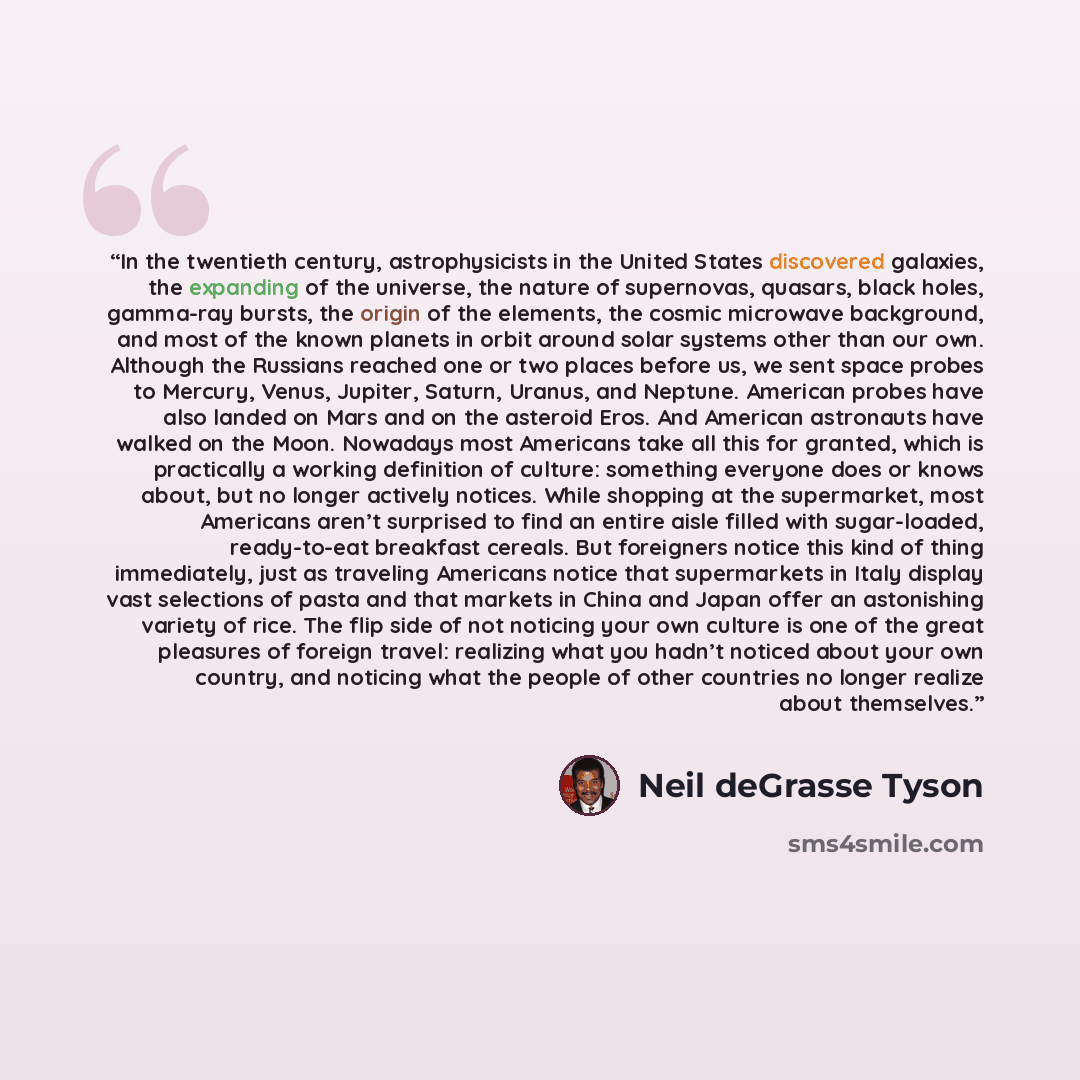
““In the twentieth century, astrophysicists in the United States discovered galaxies, the expanding of the universe, the nature of supernovas, quasars, black holes, gamma-ray bursts, the origin of the elements, the cosmic microwave background, and most of the known planets in orbit around solar systems other than our own. Although the Russians reached one or two places before us, we sent space probes to Mercury, Venus, Jupiter, Saturn, Uranus, and Neptune. American probes have also landed on Mars and on the asteroid Eros. And American astronauts have walked on the Moon. Nowadays most Americans take all this for granted, which is practically a working definition of culture: something everyone does or knows about, but no longer actively notices. While shopping at the supermarket, most Americans aren’t surprised to find an entire aisle filled with sugar-loaded, ready-to-eat breakfast cereals. But foreigners notice this kind of thing immediately, just as traveling Americans notice that supermarkets in Italy display vast selections of pasta and that markets in China and Japan offer an astonishing variety of rice. The flip side of not noticing your own culture is one of the great pleasures of foreign travel: realizing what you hadn’t noticed about your own country, and noticing what the people of other countries no longer realize about themselves.””
About This Quote
This interpretation was drafted with AI assistance. It is one reading of the quote, not the author's own explanation.
Our scientific achievements become invisible background part of everyday life, making cultural habits unnoticed until we compare them abroad.
In simple terms: Science becomes background; culture goes unnoticed.
Key Takeaway
Notice everyday cultural details.
Themes
culture
science
perspective
travel
awareness
Mood
reflective
curious
Type
observational
philosophical
When to use this quote
- shopping
- travel
- education
- cross‑cultural comparison
Key Concepts
cultural relativism
cognitive bias
globalization
Questions to Reflect On
- What cultural habits do you take for granted?
- How does travel change your perception of home?
A Different Perspective
Assumes all audiences share same baseline; may overlook socioeconomic differences.