The apparatus of corrective penality acts in a quite…
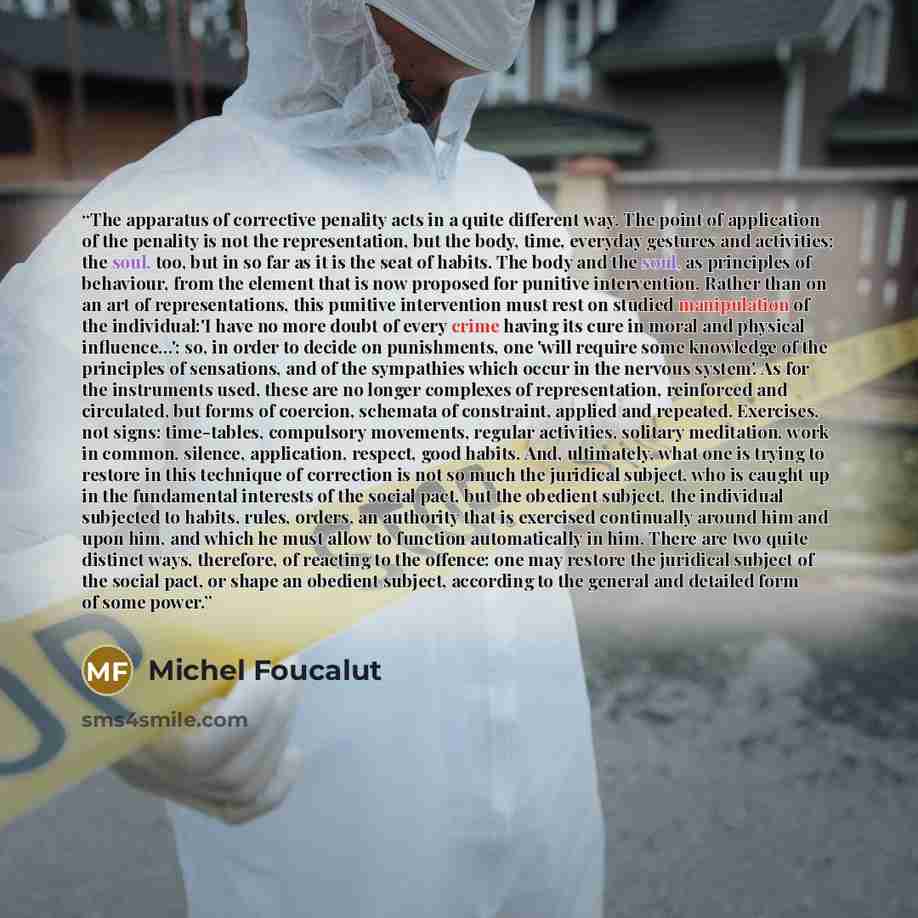
““The apparatus of corrective penality acts in a quite different way. The point of application of the penality is not the representation, but the body, time, everyday gestures and activities; the soul, too, but in so far as it is the seat of habits. The body and the soul, as principles of behaviour, from the element that is now proposed for punitive intervention. Rather than on an art of representations, this punitive intervention must rest on studied manipulation of the individual:'I have no more doubt of every crime having its cure in moral and physical influence...'; so, in order to decide on punishments, one 'will require some knowledge of the principles of sensations, and of the sympathies which occur in the nervous system'. As for the instruments used, these are no longer complexes of representation, reinforced and circulated, but forms of coercion, schemata of constraint, applied and repeated. Exercises, not signs: time-tables, compulsory movements, regular activities, solitary meditation, work in common, silence, application, respect, good habits. And, ultimately, what one is trying to restore in this technique of correction is not so much the juridical subject, who is caught up in the fundamental interests of the social pact, but the obedient subject, the individual subjected to habits, rules, orders, an authority that is exercised continually around him and upon him, and which he must allow to function automatically in him. There are two quite distinct ways, therefore, of reacting to the offence: one may restore the juridical subject of the social pact, or shape an obedient subject, according to the general and detailed form of some power.””
About This Quote
This interpretation was drafted with AI assistance. It is one reading of the quote, not the author's own explanation.
Punishment should target bodily and habitual behaviors rather than abstract representations, shaping obedient subjects through repeated disciplined actions.
In simple terms: Punishment works by reshaping habits and bodies, not just ideas.
Key Takeaway
Shape behavior through disciplined habits.
Themes
punishment
habit formation
obedience
social control
body‑mind
Mood
analytical
critical
philosophical
Type
Crime:1
Good habits:1
Habits:1
Punishments:1
Punitive Intervention:1
Penality Acts:0
Representations Punitive:0
Decide Punishments:0
When to use this quote
- prison reform
- behavioral therapy
- education systems
Key Concepts
philosophy
psychology
criminology
Questions to Reflect On
- How can punishment balance habit shaping with addressing root causes?
- What ethical limits exist for behavioral conditioning?
A Different Perspective
Focusing solely on habit may ignore underlying societal causes of crime.