Free Trade: The stage of trade policy that followed…
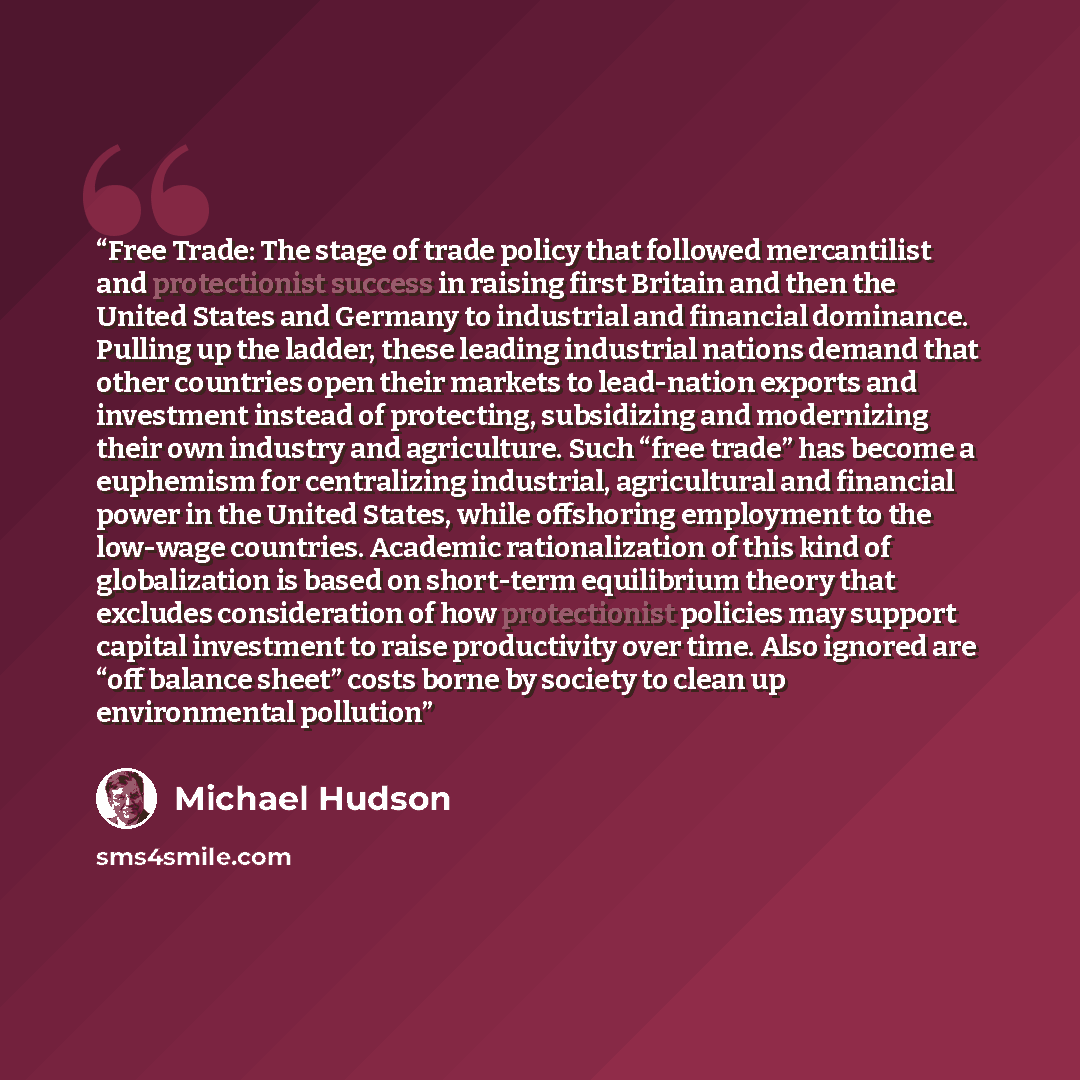
““Free Trade: The stage of trade policy that followed mercantilist and protectionist success in raising first Britain and then the United States and Germany to industrial and financial dominance. Pulling up the ladder, these leading industrial nations demand that other countries open their markets to lead-nation exports and investment instead of protecting, subsidizing and modernizing their own industry and agriculture. Such “free trade” has become a euphemism for centralizing industrial, agricultural and financial power in the United States, while offshoring employment to the low-wage countries. Academic rationalization of this kind of globalization is based on short-term equilibrium theory that excludes consideration of how protectionist policies may support capital investment to raise productivity over time. Also ignored are “off balance sheet” costs borne by society to clean up environmental pollution””
About This Quote
This interpretation was drafted with AI assistance. It is one reading of the quote, not the author's own explanation.
Free trade is portrayed as mutual benefit but actually serves dominant nations by opening markets for their exports while keeping others dependent and exploiting cheap labor, ignoring long‑term costs and societal harms.
In simple terms: Free trade benefits rich nations, harms others.
Key Takeaway
Recognize hidden costs of trade policies.
Themes
economics
globalization
power
inequality
environment
Mood
critical
analytical
Type
political
economic
environmental
When to use this quote
- policy analysis
- development planning
- environmental regulation
- labor rights
- public debate
Key Concepts
Neoliberalism
dependency theory
externalities
Questions to Reflect On
- How does free trade affect domestic workers?
- What alternatives protect local economies?
A Different Perspective
Assumes all parties benefit equally, overlooking asymmetries.