That night, I hated father. He smelt of cabbage. There was…
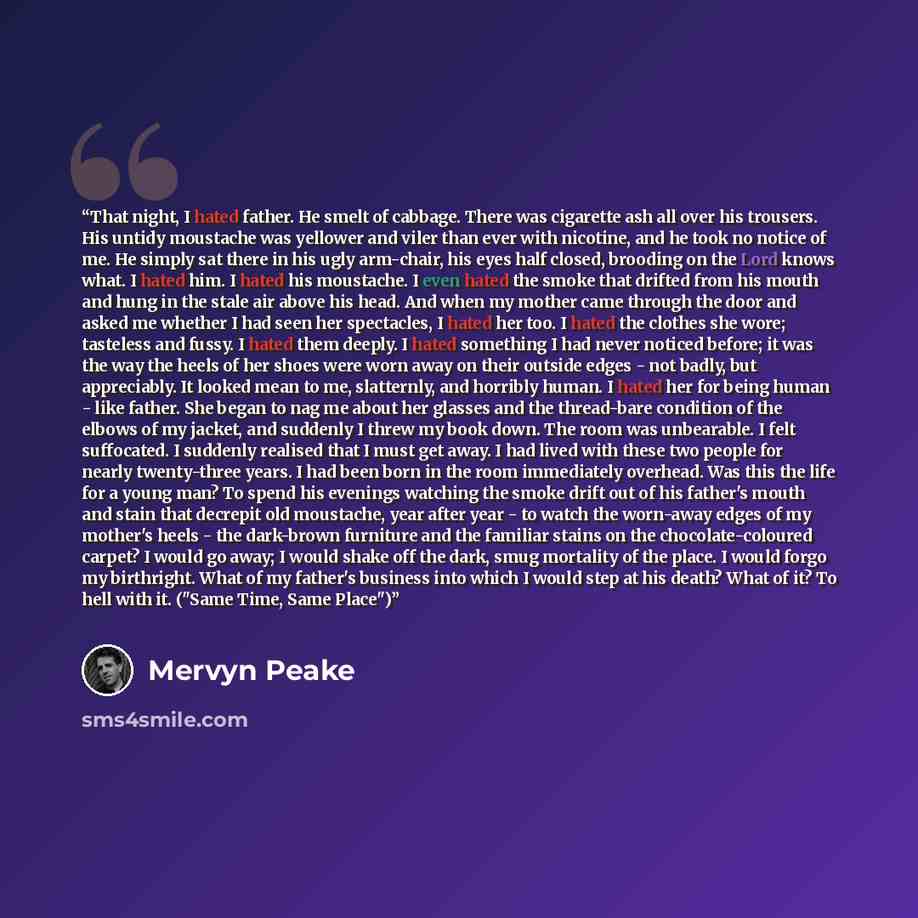
““That night, I hated father. He smelt of cabbage. There was cigarette ash all over his trousers. His untidy moustache was yellower and viler than ever with nicotine, and he took no notice of me. He simply sat there in his ugly arm-chair, his eyes half closed, brooding on the Lord knows what. I hated him. I hated his moustache. I even hated the smoke that drifted from his mouth and hung in the stale air above his head. And when my mother came through the door and asked me whether I had seen her spectacles, I hated her too. I hated the clothes she wore; tasteless and fussy. I hated them deeply. I hated something I had never noticed before; it was the way the heels of her shoes were worn away on their outside edges - not badly, but appreciably. It looked mean to me, slatternly, and horribly human. I hated her for being human - like father. She began to nag me about her glasses and the thread-bare condition of the elbows of my jacket, and suddenly I threw my book down. The room was unbearable. I felt suffocated. I suddenly realised that I must get away. I had lived with these two people for nearly twenty-three years. I had been born in the room immediately overhead. Was this the life for a young man? To spend his evenings watching the smoke drift out of his father's mouth and stain that decrepit old moustache, year after year - to watch the worn-away edges of my mother's heels - the dark-brown furniture and the familiar stains on the chocolate-coloured carpet? I would go away; I would shake off the dark, smug mortality of the place. I would forgo my birthright. What of my father's business into which I would step at his death? What of it? To hell with it. ("Same Time, Same Place")””
About This Quote
This interpretation was drafted with AI assistance. It is one reading of the quote, not the author's own explanation.
The narrator despises his parents and their domestic environment, feeling trapped and yearning for escape from familial expectations and the oppressive atmosphere of his childhood home.
In simple terms: Hate for family and home drives desire to flee.
Key Takeaway
Recognize and confront oppressive family dynamics.
Themes
family
rebellion
identity
escape
domestic oppression
Mood
conflicted
desperate
reflective
Type
literary
psychological
autobiographical
When to use this quote
- adolescent crisis
- family dinner
- inheritance decision
- personal liberation
Key Concepts
existential angst
generational conflict
psychological suffocation
Questions to Reflect On
- What would change if he faced his parents with empathy?
- Can hatred be transformed into constructive change?
A Different Perspective
The narrator’s hatred may be a temporary emotional surge rather than a rational assessment of his situation.