All those beings who revealed truths to me and who were no…
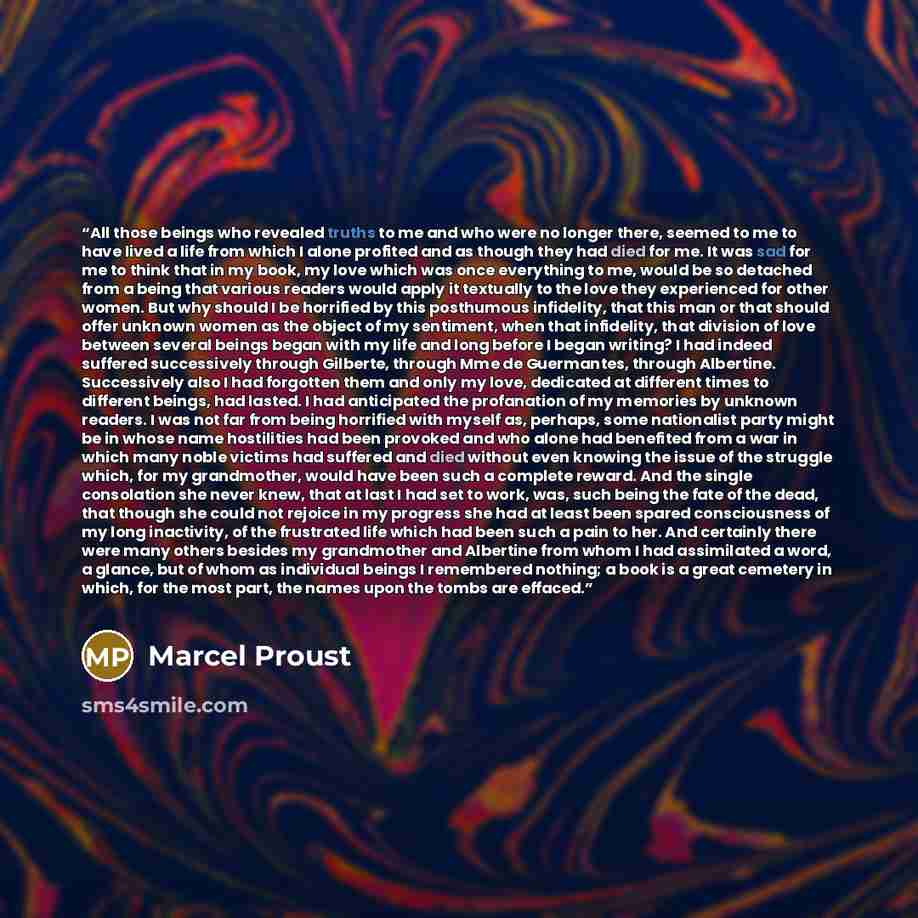
““All those beings who revealed truths to me and who were no longer there, seemed to me to have lived a life from which I alone profited and as though they had died for me. It was sad for me to think that in my book, my love which was once everything to me, would be so detached from a being that various readers would apply it textually to the love they experienced for other women. But why should I be horrified by this posthumous infidelity, that this man or that should offer unknown women as the object of my sentiment, when that infidelity, that division of love between several beings began with my life and long before I began writing? I had indeed suffered successively through Gilberte, through Mme de Guermantes, through Albertine. Successively also I had forgotten them and only my love, dedicated at different times to different beings, had lasted. I had anticipated the profanation of my memories by unknown readers. I was not far from being horrified with myself as, perhaps, some nationalist party might be in whose name hostilities had been provoked and who alone had benefited from a war in which many noble victims had suffered and died without even knowing the issue of the struggle which, for my grandmother, would have been such a complete reward. And the single consolation she never knew, that at last I had set to work, was, such being the fate of the dead, that though she could not rejoice in my progress she had at least been spared consciousness of my long inactivity, of the frustrated life which had been such a pain to her. And certainly there were many others besides my grandmother and Albertine from whom I had assimilated a word, a glance, but of whom as individual beings I remembered nothing; a book is a great cemetery in which, for the most part, the names upon the tombs are effaced.””
About This Quote
This interpretation was drafted with AI assistance. It is one reading of the quote, not the author's own explanation.
The narrator reflects on how past lovers and acquaintances become part of his inner world, yet their individual identities fade, leaving only the emotional imprint that persists beyond their deaths.
In simple terms: Past relationships become memories that shape us, even when the people are gone.
Key Takeaway
Recognize that love endures through memory, not presence.
Themes
memory
loss
identity
literature
reflection
Mood
melancholic
contemplative
Type
literary
philosophical
When to use this quote
- reading literature
- personal introspection
- grieving past relationships
- writing memoirs
Key Concepts
existentialism
subjectivity
temporal continuity
Questions to Reflect On
- How do you honor the influence of those who have passed?
- Can love persist without the person?
A Different Perspective
The view may romanticize loss, overlooking the pain of unresolved grief.