What do you learn at school, then?" "We learn about the…
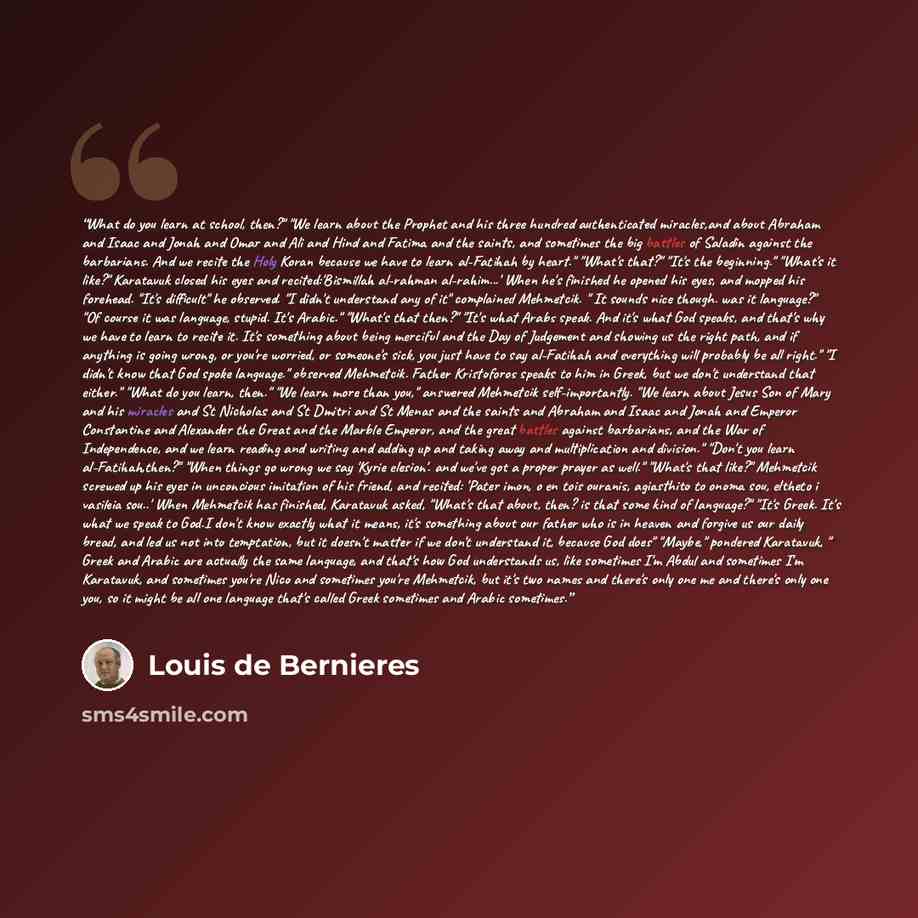
““What do you learn at school, then?" "We learn about the Prophet and his three hundred authenticated miracles,and about Abraham and Isaac and Jonah and Omar and Ali and Hind and Fatima and the saints, and sometimes the big battles of Saladin against the barbarians. And we recite the Holy Koran because we have to learn al-Fatihah by heart." "What's that?" "It's the beginning." "What's it like?" Karatavuk closed his eyes and recited:'Bismillah al-rahman al-rahim...' When he's finished he opened his eyes, and mopped his forehead. "It's difficult" he observed. "I didn't understand any of it" complained Mehmetcik. " It sounds nice though. was it language?" "Of course it was language, stupid. It's Arabic." "What's that then?" "It's what Arabs speak. And it's what God speaks, and that's why we have to learn to recite it. It's something about being merciful and the Day of Judgement and showing us the right path, and if anything is going wrong, or you're worried, or someone's sick, you just have to say al-Fatihah and everything will probably be all right." "I didn't know that God spoke language." observed Mehmetcik. Father Kristoforos speaks to him in Greek, but we don't understand that either." "What do you learn, then." "We learn more than you," answered Mehmetcik self-importantly. "We learn about Jesus Son of Mary and his miracles and St Nicholas and St Dmitri and St Menas and the saints and Abraham and Isaac and Jonah and Emperor Constantine and Alexander the Great and the Marble Emperor, and the great battles against barbarians, and the War of Independence, and we learn reading and writing and adding up and taking away and multiplication and division." "Don't you learn al-Fatihah,then?" "When things go wrong we say 'Kyrie elesion'. and we've got a proper prayer as well." "What's that like?" Mehmetcik screwed up his eyes in unconcious imitation of his friend, and recited: 'Pater imon, o en tois ouranis, agiasthito to onoma sou, eltheto i vasileia sou..' When Mehmetcik has finished, Karatavuk asked, "What's that about, then? is that some kind of language?" "It's Greek. It's what we speak to God.I don't know exactly what it means, it's something about our father who is in heaven and forgive us our daily bread, and led us not into temptation, but it doesn't matter if we don't understand it, because God does" "Maybe," pondered Karatavuk, " Greek and Arabic are actually the same language, and that's how God understands us, like sometimes I'm Abdul and sometimes I'm Karatavuk, and sometimes you're Nico and sometimes you're Mehmetcik, but it's two names and there's only one me and there's only one you, so it might be all one language that's called Greek sometimes and Arabic sometimes.””
About This Quote
This interpretation was drafted with AI assistance. It is one reading of the quote, not the author's own explanation.
The passage highlights how language, religion, and cultural narratives shape identity and understanding, often leading to confusion and conflict when different traditions intersect.
In simple terms: Languages and faith shape identity, causing confusion across cultures.
Key Takeaway
Recognize and respect diverse cultural narratives.
Themes
identity
culture
religion
conflict
understanding
Mood
reflective
thoughtful
inquisitive
Type
philosophical
inspirational
When to use this quote
- education
- interfaith dialogue
- multilingual settings
- conflict resolution
Key Concepts
intercultural communication
religious literacy
identity formation
Questions to Reflect On
- How do we navigate multiple cultural narratives?
- What role does language play in identity?
A Different Perspective
Assuming one tradition holds all truth can marginalize others.