There's one thing you ought to know about old people,"…
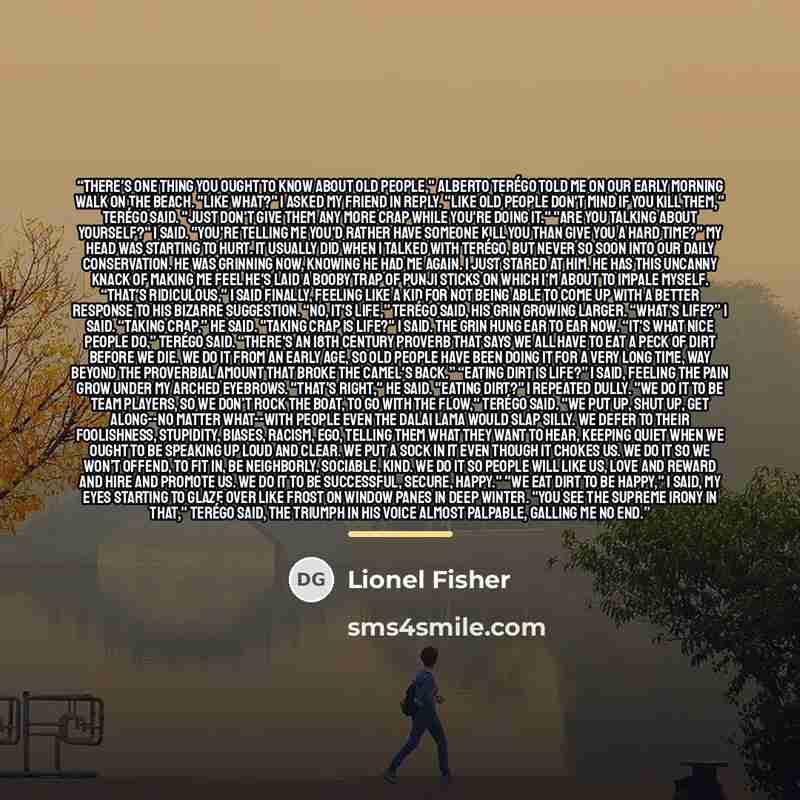
““There's one thing you ought to know about old people," Alberto Terégo told me on our early morning walk on the beach. "Like what?" I asked my friend in reply. "Like old people don't mind if you kill them," Terégo said. "Just don't give them any more crap while you're doing it." "Are you talking about yourself?" I said. "You're telling me you'd rather have someone kill you than give you a hard time?” My head was starting to hurt. It usually did when I talked with Terégo, but never so soon into our daily conservation. He was grinning now, knowing he had me again. I just stared at him. He has this uncanny knack of making me feel he's laid a booby trap of punji sticks on which I'm about to impale myself. “That's ridiculous," I said finally, feeling like a kid for not being able to come up with a better response to his bizarre suggestion. “No, it's life,” Terégo said, his grin growing larger. “What's life?” I said. “Taking crap,” he said. "Taking crap is life?" I said. The grin hung ear to ear now. “It's what nice people do,” Terégo said. “There's an 18th century proverb that says we all have to eat a peck of dirt before we die. We do it from an early age, so old people have been doing it for a very long time, way beyond the proverbial amount that broke the camel's back.” “Eating dirt is life?” I said, feeling the pain grow under my arched eyebrows. "That's right," he said. "Eating dirt?" I repeated dully. "We do it to be team players, so we don’t rock the boat, to go with the flow," Terégo said. "We put up, shut up, get along--no matter what--with people even the Dalai Lama would slap silly. We defer to their foolishness, stupidity, biases, racism, ego, telling them what they want to hear, keeping quiet when we ought to be speaking up loud and clear. We put a sock in it even though it chokes us. We do it so we won’t offend, to fit in, be neighborly, sociable, kind. We do it so people will like us, love and reward and hire and promote us. We do it to be successful, secure, happy." "We eat dirt to be happy," I said, my eyes starting to glaze over like frost on window panes in deep winter. "You see the supreme irony in that," Terégo said, the triumph in his voice almost palpable, galling me no end.””
About This Quote
This interpretation was drafted with AI assistance. It is one reading of the quote, not the author's own explanation.
The speaker argues that people endure hardship and suppress dissent to conform, avoid conflict, and gain social or professional benefits, likening it to consuming dirt as a necessary, unpleasant part of life.
In simple terms: People accept unpleasantness to fit in and succeed.
Key Takeaway
Question quiet, speak up when needed.
Themes
conformity
social pressure
self‑sacrifice
Mood
frustrated
reflective
Type
advice
philosophical
When to use this quote
- workplace
- family gatherings
- public discourse
- team projects
Key Concepts
psychology
social dynamics
Questions to Reflect On
- When have you compromised your values for acceptance?
- How can you balance cooperation with honesty?
A Different Perspective
Silencing oneself can harm mental health and authenticity.