History” has very little to say about this war other than…
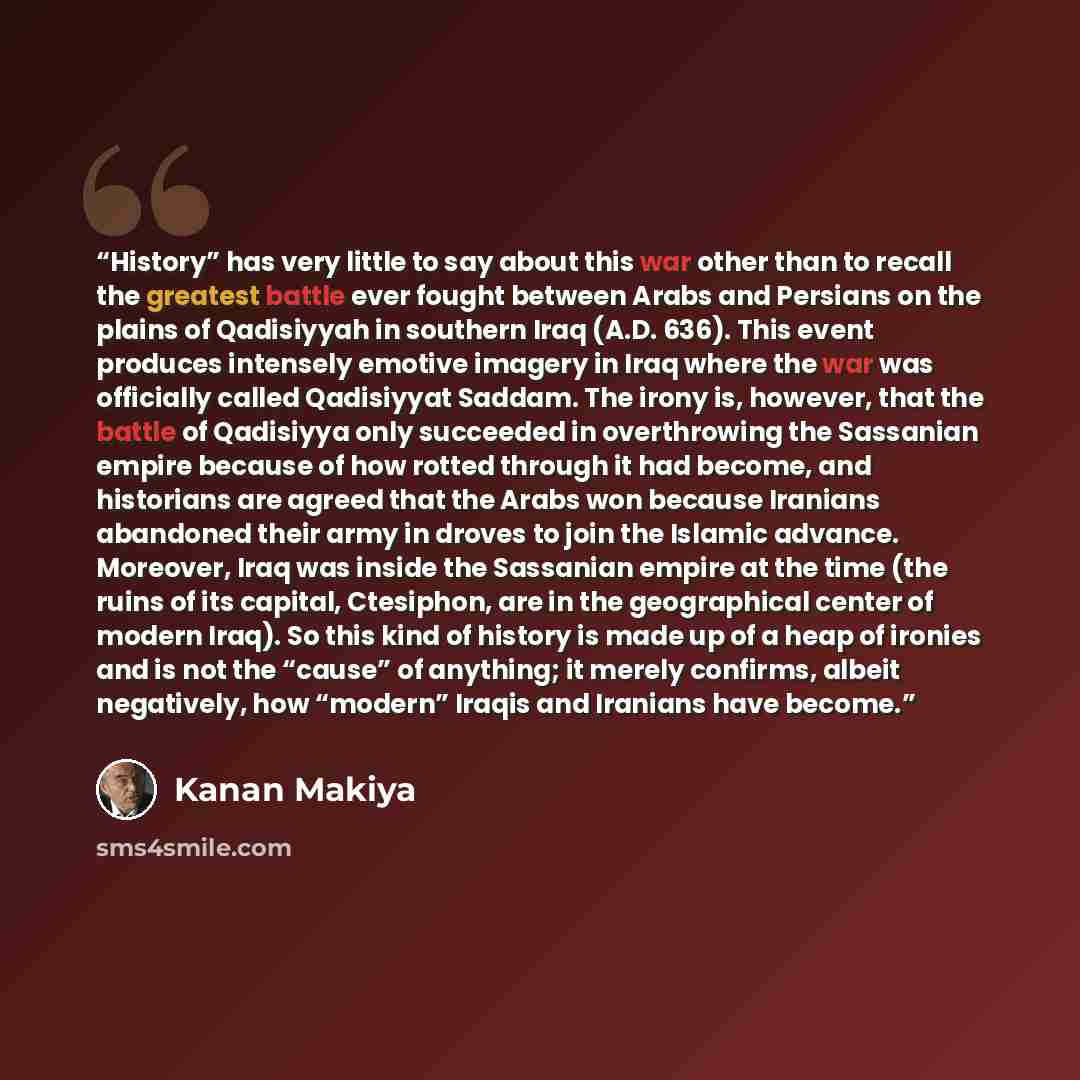
““History” has very little to say about this war other than to recall the greatest battle ever fought between Arabs and Persians on the plains of Qadisiyyah in southern Iraq (A.D. 636). This event produces intensely emotive imagery in Iraq where the war was officially called Qadisiyyat Saddam. The irony is, however, that the battle of Qadisiyya only succeeded in overthrowing the Sassanian empire because of how rotted through it had become, and historians are agreed that the Arabs won because Iranians abandoned their army in droves to join the Islamic advance. Moreover, Iraq was inside the Sassanian empire at the time (the ruins of its capital, Ctesiphon, are in the geographical center of modern Iraq). So this kind of history is made up of a heap of ironies and is not the “cause” of anything; it merely confirms, albeit negatively, how “modern” Iraqis and Iranians have become.””
About This Quote
This interpretation was drafted with AI assistance. It is one reading of the quote, not the author's own explanation.
The quote argues that historical parallels are superficial, using the 636 battle to illustrate that modern conflicts are shaped by internal decay rather than ancient causes, highlighting irony and the limited explanatory power of history.
In simple terms: History offers limited insight into current wars, serving more as a mirror of decay than a causal guide.
Key Takeaway
Historical analogies often mask present realities.
Themes
Irony
Historical determinism
Cultural decay
Geopolitical identity
Narrative construction
Mood
Reflective
Cautious
Critical
Type
Analytical
Historical
Political
When to use this quote
- Analyzing propaganda
- Teaching Middle Eastern history
- Policy brief on conflict roots
- Media commentary on war narratives
Key Concepts
Battle of Qadisiyyah
Sassanian empire
Arab conquest
Modern Iraq
Iranian dynamics
Practical Applications
- Designing curricula that contextualize historical analogies
- Crafting diplomatic briefs that avoid simplistic historical comparisons
Questions to Reflect On
- How does invoking ancient battles influence public perception of current wars?
- What alternative frameworks could better explain the causes of modern conflicts?
A Different Perspective
Some scholars argue that deep structural economic and political factors, not just historical decay, drive modern conflicts.