If I had to tell you how humans made their way to Earth…
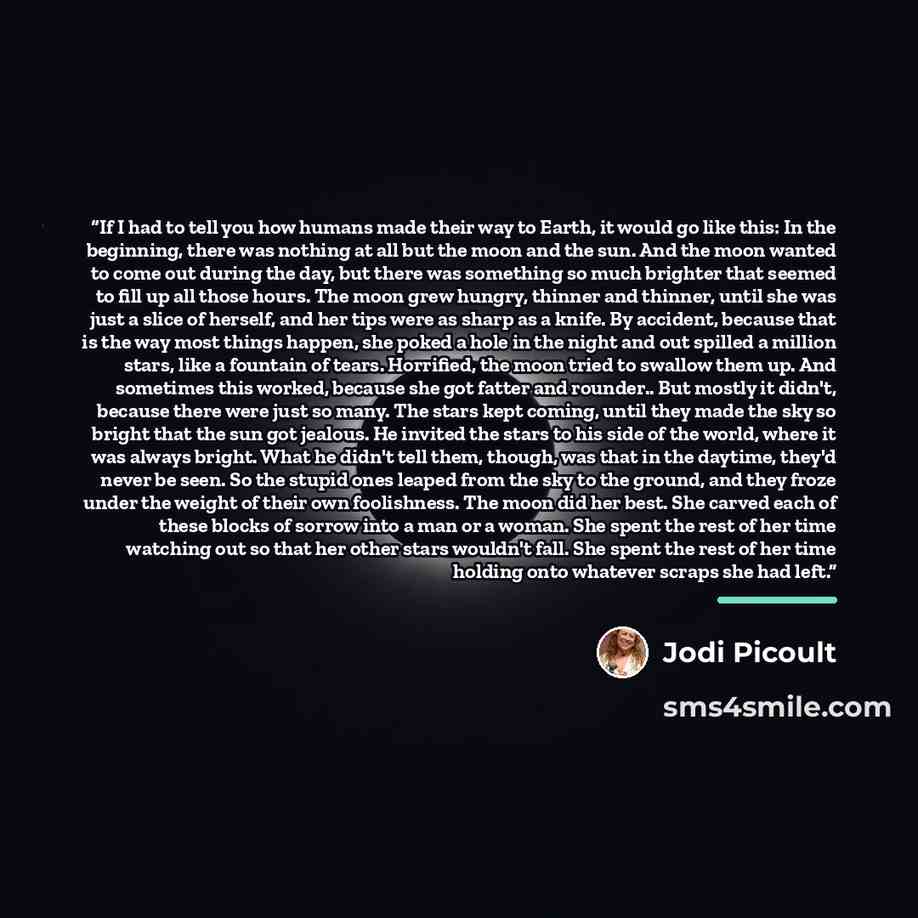
““If I had to tell you how humans made their way to Earth, it would go like this: In the beginning, there was nothing at all but the moon and the sun. And the moon wanted to come out during the day, but there was something so much brighter that seemed to fill up all those hours. The moon grew hungry, thinner and thinner, until she was just a slice of herself, and her tips were as sharp as a knife. By accident, because that is the way most things happen, she poked a hole in the night and out spilled a million stars, like a fountain of tears. Horrified, the moon tried to swallow them up. And sometimes this worked, because she got fatter and rounder.. But mostly it didn't, because there were just so many. The stars kept coming, until they made the sky so bright that the sun got jealous. He invited the stars to his side of the world, where it was always bright. What he didn't tell them, though, was that in the daytime, they'd never be seen. So the stupid ones leaped from the sky to the ground, and they froze under the weight of their own foolishness. The moon did her best. She carved each of these blocks of sorrow into a man or a woman. She spent the rest of her time watching out so that her other stars wouldn't fall. She spent the rest of her time holding onto whatever scraps she had left.””
About This Quote
This interpretation was drafted with AI assistance. It is one reading of the quote, not the author's own explanation.
A mythic tale explains cosmic origins, portraying the moon’s sacrifice and the stars’ fall, reflecting themes of loss, creation, and responsibility.
In simple terms: A story about how the moon and stars created the sky, showing sacrifice and duty.
Key Takeaway
Recognize the cost of creation and protect what you create.
Themes
creation
sacrifice
responsibility
Mood
reflective
melancholic
Type
mythic
inspirational
When to use this quote
- parenting
- environmental stewardship
- creative projects
Key Concepts
mythology
cosmology
humanity
Questions to Reflect On
- What responsibilities do creators have toward their creations?
- How does loss shape identity?
A Different Perspective
The narrative may oversimplify complex scientific concepts, leading to misconceptions.