If now we attend to ourselves on occasion of any…
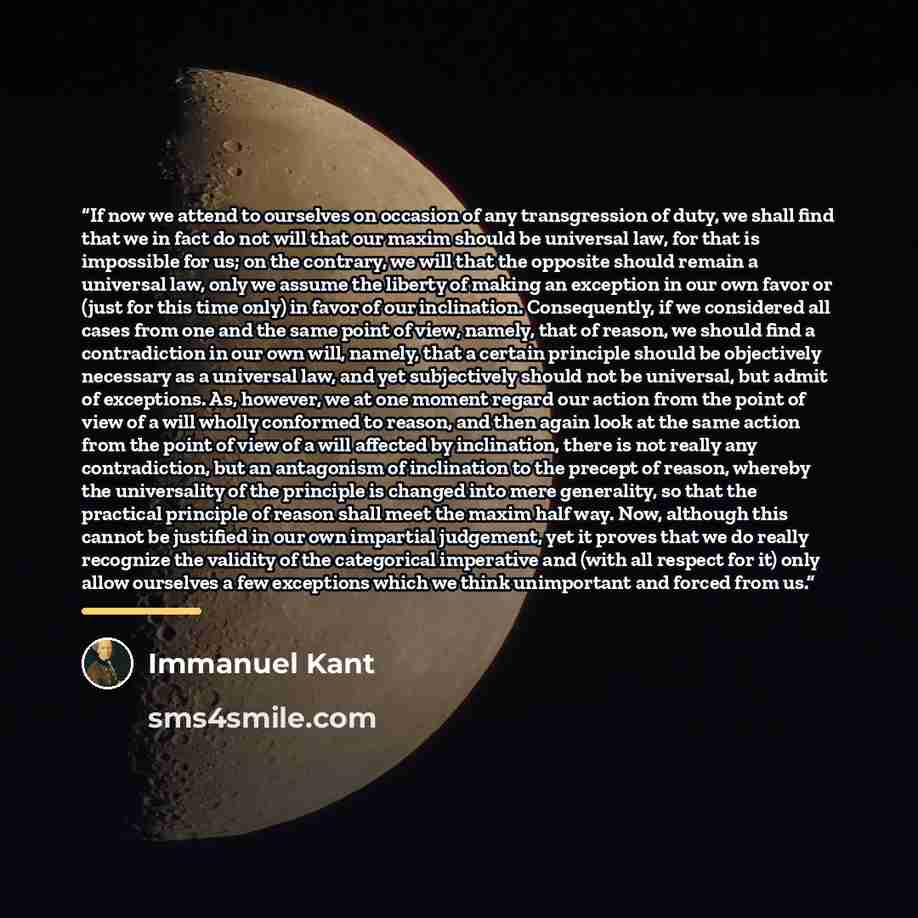
““If now we attend to ourselves on occasion of any transgression of duty, we shall find that we in fact do not will that our maxim should be universal law, for that is impossible for us; on the contrary, we will that the opposite should remain a universal law, only we assume the liberty of making an exception in our own favor or (just for this time only) in favor of our inclination. Consequently, if we considered all cases from one and the same point of view, namely, that of reason, we should find a contradiction in our own will, namely, that a certain principle should be objectively necessary as a universal law, and yet subjectively should not be universal, but admit of exceptions. As, however, we at one moment regard our action from the point of view of a will wholly conformed to reason, and then again look at the same action from the point of view of a will affected by inclination, there is not really any contradiction, but an antagonism of inclination to the precept of reason, whereby the universality of the principle is changed into mere generality, so that the practical principle of reason shall meet the maxim half way. Now, although this cannot be justified in our own impartial judgement, yet it proves that we do really recognize the validity of the categorical imperative and (with all respect for it) only allow ourselves a few exceptions which we think unimportant and forced from us.””
About This Quote
This interpretation was drafted with AI assistance. It is one reading of the quote, not the author's own explanation.
We often make exceptions to universal moral laws for personal inclinations, creating a conflict between reason and desire, yet we still recognize the law’s validity.
In simple terms: People bend moral rules for personal reasons, conflicting with universal reason.
Key Takeaway
Acknowledge the tension between duty and desire.
Themes
morality
reason
exception
universal law
human inclination
Mood
reflective
critical
Type
philosophical
ethical
When to use this quote
- legal judgments
- personal decision making
- ethical dilemmas
- policy making
Key Concepts
categorical imperative
ethical relativism
psychology of rationalization
Questions to Reflect On
- Can you identify a personal exception you make?
- How might you align desire with duty?
A Different Perspective
Human nature makes strict universal application difficult; exceptions can erode moral consistency.