He would like either to overcome the wolf and become…
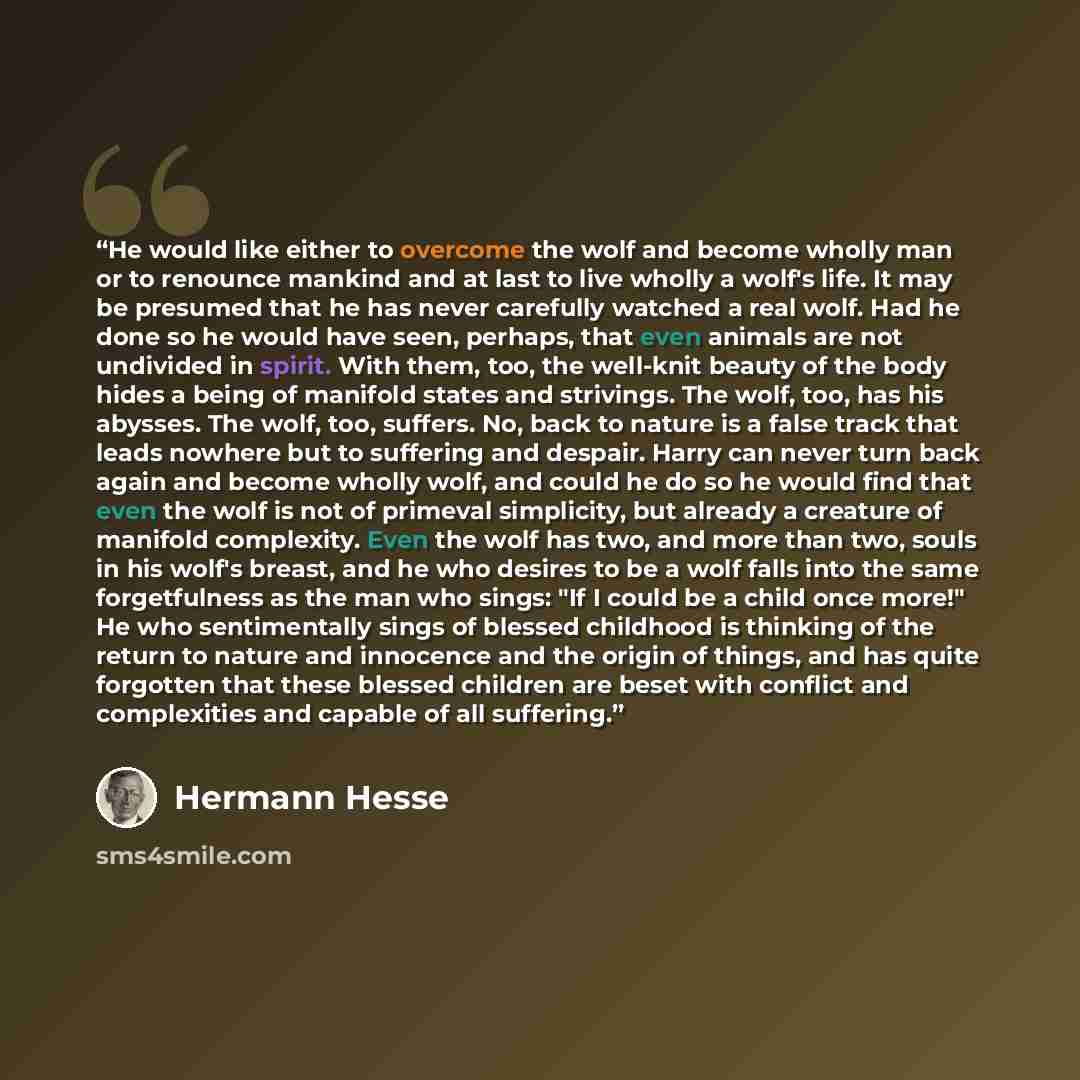
““He would like either to overcome the wolf and become wholly man or to renounce mankind and at last to live wholly a wolf's life. It may be presumed that he has never carefully watched a real wolf. Had he done so he would have seen, perhaps, that even animals are not undivided in spirit. With them, too, the well-knit beauty of the body hides a being of manifold states and strivings. The wolf, too, has his abysses. The wolf, too, suffers. No, back to nature is a false track that leads nowhere but to suffering and despair. Harry can never turn back again and become wholly wolf, and could he do so he would find that even the wolf is not of primeval simplicity, but already a creature of manifold complexity. Even the wolf has two, and more than two, souls in his wolf's breast, and he who desires to be a wolf falls into the same forgetfulness as the man who sings: "If I could be a child once more!" He who sentimentally sings of blessed childhood is thinking of the return to nature and innocence and the origin of things, and has quite forgotten that these blessed children are beset with conflict and complexities and capable of all suffering.””
About This Quote
This interpretation was drafted with AI assistance. It is one reading of the quote, not the author's own explanation.
Romanticizing a return to nature ignores human complexity; both man and beast possess inner conflicts.
In simple terms: Nature isn’t simple; both humans and animals are complex.
Key Takeaway
Accept that simplicity is a myth; embrace inner complexity.
Themes
identity
nature
complexity
Mood
introspective
melancholic
Type
literary
philosophical
When to use this quote
- personal growth
- self‑acceptance
- mental health
- philosophical reflection
Key Concepts
dualism
psychology
mythic symbolism
Questions to Reflect On
- What does “wolf” symbolize for you?
- Can you find balance between instinct and society?
A Different Perspective
Idealizing “wolf” life can lead to escapism.