The objective of learning is not necessarily to remember…
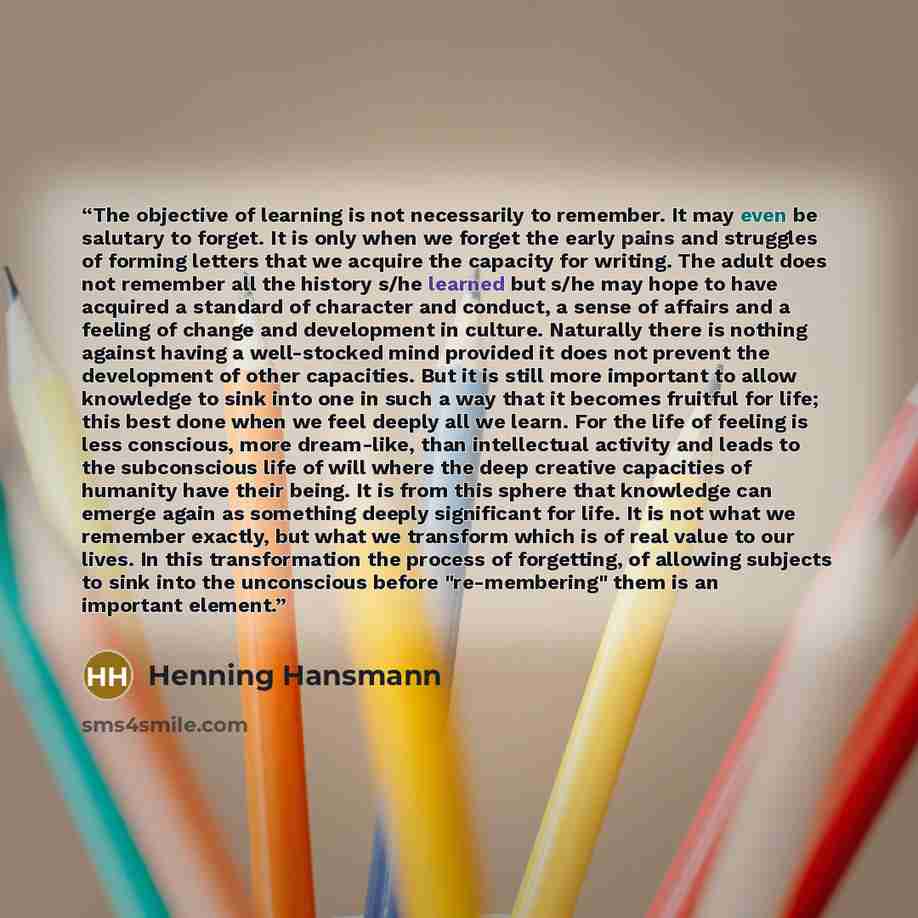
““The objective of learning is not necessarily to remember. It may even be salutary to forget. It is only when we forget the early pains and struggles of forming letters that we acquire the capacity for writing. The adult does not remember all the history s/he learned but s/he may hope to have acquired a standard of character and conduct, a sense of affairs and a feeling of change and development in culture. Naturally there is nothing against having a well-stocked mind provided it does not prevent the development of other capacities. But it is still more important to allow knowledge to sink into one in such a way that it becomes fruitful for life; this best done when we feel deeply all we learn. For the life of feeling is less conscious, more dream-like, than intellectual activity and leads to the subconscious life of will where the deep creative capacities of humanity have their being. It is from this sphere that knowledge can emerge again as something deeply significant for life. It is not what we remember exactly, but what we transform which is of real value to our lives. In this transformation the process of forgetting, of allowing subjects to sink into the unconscious before "re-membering" them is an important element.””
About This Quote
This interpretation was drafted with AI assistance. It is one reading of the quote, not the author's own explanation.
Learning is valuable when knowledge sinks deeply, allowing forgetting of early struggles and fostering creative transformation rather than mere memorization
In simple terms: True learning forgets the process, not the insight
Key Takeaway
Allow knowledge to become intuitive and transformative
Themes
education
memory
forgetting
creativity
growth
transformation
Mood
thoughtful
inquisitive
inspiring
Type
Camphill:0
Education:1
Feeling:0
Forgetting:1
Goals:0
Knowledge:1
Learning:1
Life:1
Memory:0
Real value:1
School:0
Waldorf:0
Life Remember:0
Stocked Mind:0
Forgetting Allowing:0
Learning Necessarily:0
When to use this quote
- teaching methods
- personal study
- mindful reflection
Key Concepts
deep learning
cognitive integration
creative emergence
personal development
Questions to Reflect On
- How can you balance forgetting and retaining essential knowledge?
- What practices help knowledge become lived experience?
A Different Perspective
Forgetting may lead to loss of useful details