How much better it is to understand it all, to recognise…
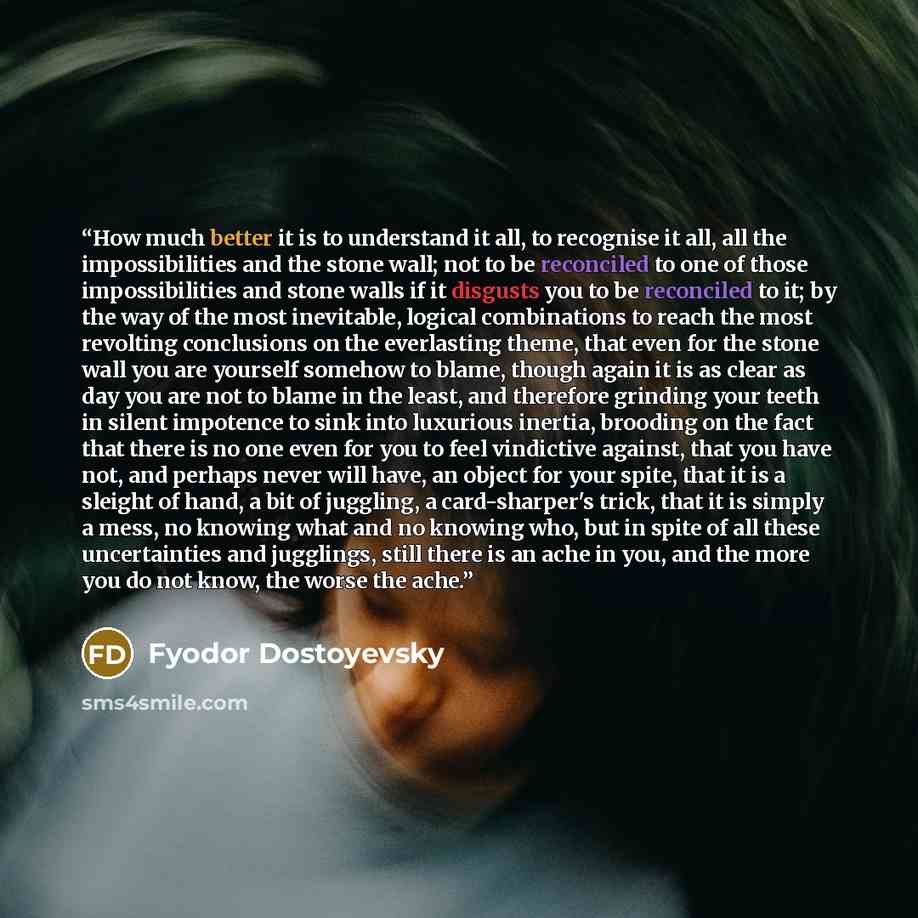
““How much better it is to understand it all, to recognise it all, all the impossibilities and the stone wall; not to be reconciled to one of those impossibilities and stone walls if it disgusts you to be reconciled to it; by the way of the most inevitable, logical combinations to reach the most revolting conclusions on the everlasting theme, that even for the stone wall you are yourself somehow to blame, though again it is as clear as day you are not to blame in the least, and therefore grinding your teeth in silent impotence to sink into luxurious inertia, brooding on the fact that there is no one even for you to feel vindictive against, that you have not, and perhaps never will have, an object for your spite, that it is a sleight of hand, a bit of juggling, a card-sharper's trick, that it is simply a mess, no knowing what and no knowing who, but in spite of all these uncertainties and jugglings, still there is an ache in you, and the more you do not know, the worse the ache.””
About This Quote
This interpretation was drafted with AI assistance. It is one reading of the quote, not the author's own explanation.
The quote explores existential frustration when confronting incomprehensible obstacles, feeling blamed yet powerless, leading to inner turmoil and a yearning for purpose.
In simple terms: Facing unknown obstacles creates inner pain and confusion.
Key Takeaway
Accept uncertainty, seek meaning despite confusion.
Themes
existentialism
psychology
human condition
blame
uncertainty
Mood
conflicted
melancholic
introspective
Type
philosophical
literary
psychological
When to use this quote
- personal crisis
- creative block
- decision making
- moral dilemmas
Key Concepts
free will
moral responsibility
absurdity
self‑reflection
Questions to Reflect On
- What does the “stone wall” symbolize for you?
- How can you transform inner ache into constructive action?
A Different Perspective
The insight may ignore the possibility of external factors shaping obstacles.