Sentience is not an end in itself. It is a means to the…
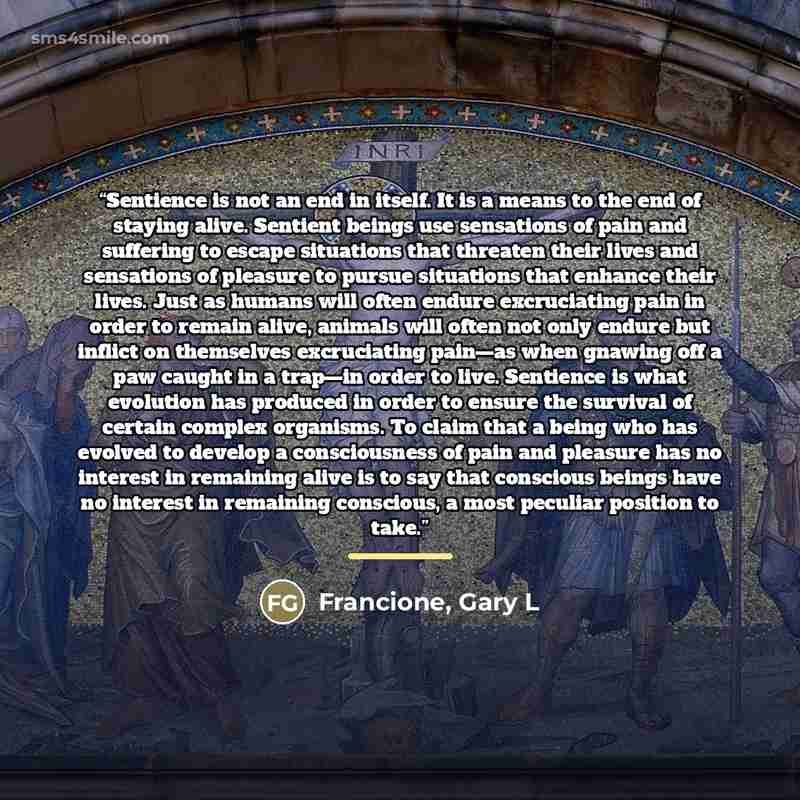
““Sentience is not an end in itself. It is a means to the end of staying alive. Sentient beings use sensations of pain and suffering to escape situations that threaten their lives and sensations of pleasure to pursue situations that enhance their lives. Just as humans will often endure excruciating pain in order to remain alive, animals will often not only endure but inflict on themselves excruciating pain—as when gnawing off a paw caught in a trap—in order to live. Sentience is what evolution has produced in order to ensure the survival of certain complex organisms. To claim that a being who has evolved to develop a consciousness of pain and pleasure has no interest in remaining alive is to say that conscious beings have no interest in remaining conscious, a most peculiar position to take.””
About This Quote
This interpretation was drafted with AI assistance. It is one reading of the quote, not the author's own explanation.
Sentience functions as an adaptive mechanism for survival, motivating avoidance of harm and pursuit of benefit, rather than being an intrinsic goal.
In simple terms: Sentience drives survival behaviors.
Key Takeaway
Sentience is a tool for staying alive.
Themes
Evolutionary biology
Ethics
Pain and pleasure
Survival instincts
Consciousness
Type
Philosophical
Scientific
Ethical
When to use this quote
- Animal welfare decisions
- Medical ethics debates
- Artificial intelligence design
- Conservation strategies
- Philosophical discussions on consciousness
Key Concepts
Adaptive function
Motivation
Self-preservation
Practical Applications
- Designing humane animal treatment protocols
- Guiding AI safety frameworks
Questions to Reflect On
- How does recognizing sentience as a survival tool affect moral obligations?
- Can sentience be ethically engineered?
- ee
- Reflective
- Analytical