•Communicating: low-context vs. high-context •Evaluating…
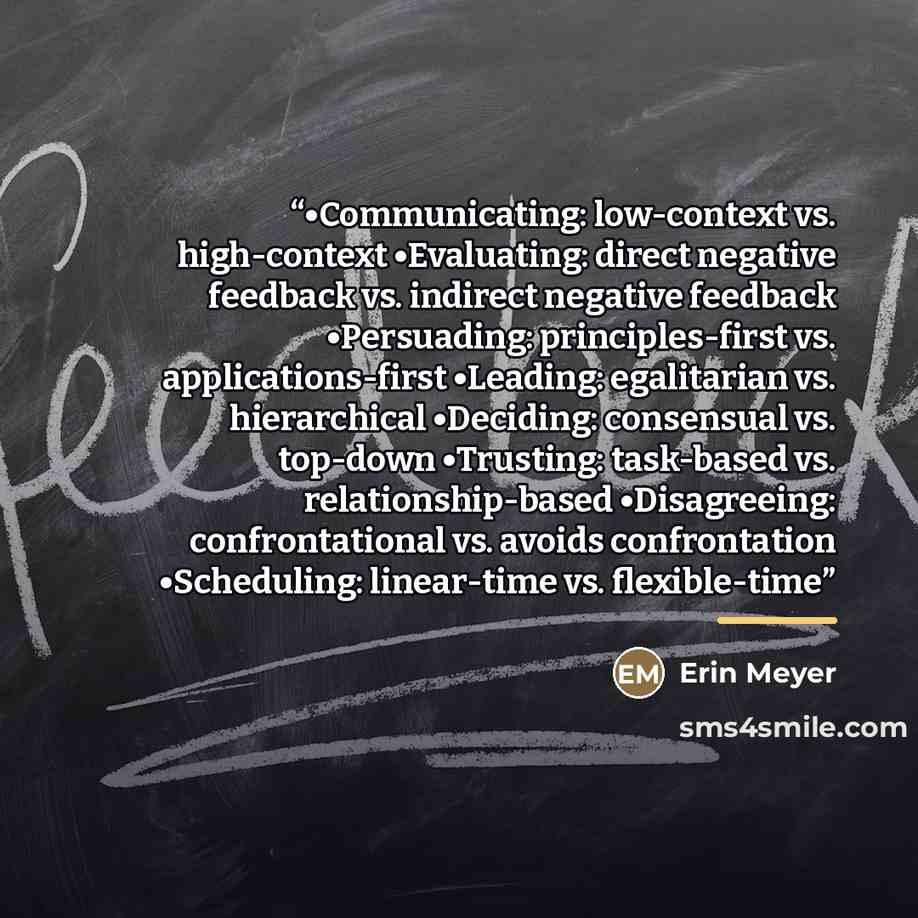
““•Communicating: low-context vs. high-context •Evaluating: direct negative feedback vs. indirect negative feedback •Persuading: principles-first vs. applications-first •Leading: egalitarian vs. hierarchical •Deciding: consensual vs. top-down •Trusting: task-based vs. relationship-based •Disagreeing: confrontational vs. avoids confrontation •Scheduling: linear-time vs. flexible-time””
About This Quote
This interpretation was drafted with AI assistance. It is one reading of the quote, not the author's own explanation.
The quote outlines contrasting communication and leadership styles across cultures, highlighting low vs high context, direct vs indirect feedback, and other dichotomies.
In simple terms: It describes cultural differences in communication and decision‑making.
Key Takeaway
Recognize and adapt to cultural style for effective collaboration.
Themes
culture
communication
leadership
decision‑making
trust
Mood
curious
analytical
Type
educational
practical
When to use this quote
- international business meetings
- multinational project teams
- cross‑cultural negotiations
- global leadership training
- conflict resolution workshops
Key Concepts
high‑context
low‑context
direct feedback
indirect feedback
egalitarian
hierarchical
consensual
top‑down
task‑based
relationship‑based
confrontational
avoidance
linear‑time
flexible‑time
Questions to Reflect On
- How do you identify your own cultural style?
- When might a hybrid approach be more effective?
A Different Perspective
The model may oversimplify complex cultures and ignore individual variation.