The greatest, equally with the smallest motions of the…
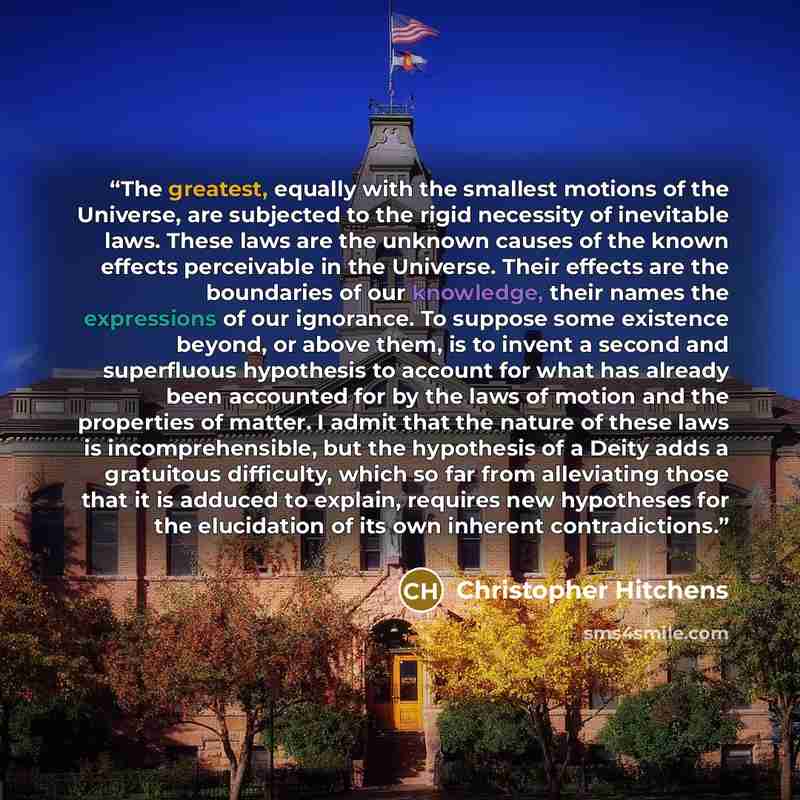
““The greatest, equally with the smallest motions of the Universe, are subjected to the rigid necessity of inevitable laws. These laws are the unknown causes of the known effects perceivable in the Universe. Their effects are the boundaries of our knowledge, their names the expressions of our ignorance. To suppose some existence beyond, or above them, is to invent a second and superfluous hypothesis to account for what has already been accounted for by the laws of motion and the properties of matter. I admit that the nature of these laws is incomprehensible, but the hypothesis of a Deity adds a gratuitous difficulty, which so far from alleviating those that it is adduced to explain, requires new hypotheses for the elucidation of its own inherent contradictions.””
About This Quote
This interpretation was drafted with AI assistance. It is one reading of the quote, not the author's own explanation.
Human understanding is limited by natural laws; invoking a deity adds unnecessary complexity to explanations of the universe.
In simple terms: Laws explain effects; gods are extra hypotheses.
Key Takeaway
Prefer natural explanations over supernatural ones.
Themes
science
philosophy
skepticism
religion
epistemology
Mood
thoughtful
critical
inquisitive
Type
philosophical
skeptical
When to use this quote
- academic debate
- personal belief
- education
- policy making
- public discourse
Key Concepts
natural law
causality
falsifiability
Questions to Reflect On
- Do natural laws fully satisfy our need for meaning?
- How does belief in a deity affect scientific inquiry?
A Different Perspective
Religious explanations can provide comfort and community, which pure naturalism may lack.